Background:
Children living with HIV (HIV+) have higher rates of cognitive dysfunction, particularly in domains of attention, information processing speed, episodic memory, psychomotor, and executive functioning. HIV-exposed uninfected children (HEU) have been shown in some, but not all, studies to suffer from more neurodevelopmental delays than HIV-unexposed uninfected children (HUU). The Penn Computerized Neurocognitive Battery (PCNB) includes 14 tests that have been adapted for school-aged children in Botswana to assess memory, complex cognition, motor/processing speed, and executive function. We hypothesized that differences between HIV+, HEU and HUU children would be measurable using the PCNB.
Methods:
We compared PCNB accuracy, speed, and efficiency scores in 628 children aged 7-< 18 years, ~1/3 of whom were in each of the following groups: a) HIV+, randomly selected from a clinic; b) HUU, randomly selected from public schools; and c) HEU, 18% of whom were randomly selected as part of the public school recruitment and 82% recruited HEU family members of clinic patients. Scores were age-normed using non-linear multiple regression. Multivariate normative comparisons were used to detect clinically relevant impairment (i.e., below the lower bound of the 95% confidence interval for HUU children) in individuals.
Results:
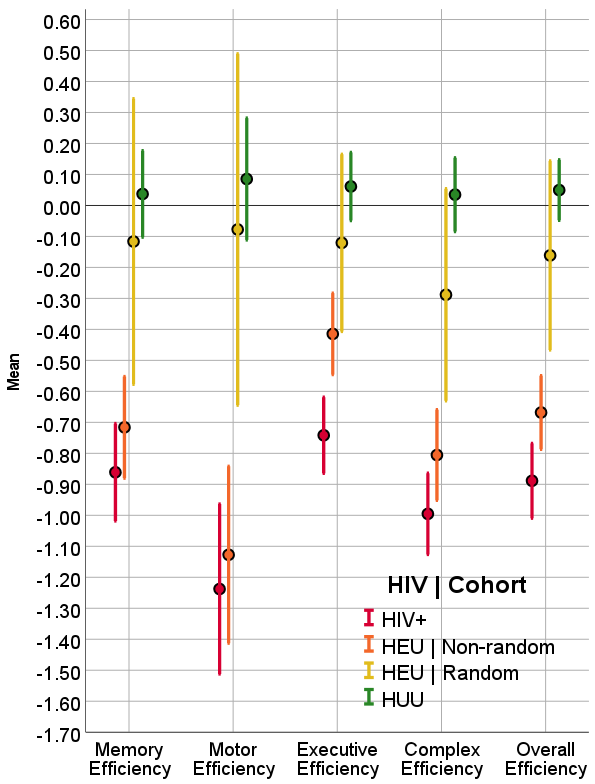
All summary scores and domain scores (e.g., memory) were significantly lower for HIV+ children compared to HUU children, with medium-to-large effect sizes. In nine out of 15 comparisons, the means of the HIV+ and non-randomly selected HEU were contained within each other’s confidence intervals (CIs), indicating some level of equivalence. By contrast, there were no comparisons in which the randomly selected HEU CIs included the HIV+ mean (or vice versa). HUU CIs included the randomly selected HEU mean in six of the 15 comparisons of accuracy, speed, and efficiency. (See Figure for efficiency data.) Multivariate normative comparisons flagged 27% of HIV+, 23% of HEU, and 9% of HUU children as clinically impaired. Of the HEU, 49 of 168 (29%) non-randomly selected and 6/36 (17%) randomly selected children were flagged as neurocognitively impaired.
Conclusions:
HIV+ children showed worse neurocognitive function than HUU children in Botswana, supporting the validity of the PCNB in this setting. Interestingly, results also raise questions of whether previous findings of worse performance in HEU children were related to biased sampling or unmeasured confounding.
PCNB efficiency scores stratified by HIV status and cohort