Background:
The perturbation of tryptophan (TRP)-kynurenine (KYN) metabolism has been linked with HIV infection and cardiovascular disease (CVD), but the relationship of other TRP metabolites with the gut microbiome and atherosclerosis is not fully understood within the context of HIV infection.
Methods:
Ten TRP metabolites, including microbial indole derivatives, were quantified in plasma among women from 3 sites of the Women’s Interagency HIV Study between 2018-2019. The gut microbiome was profiled through 16S ribosomal RNA sequencing and shotgun metagenomics in fecal samples that were collected close to the visits of blood collection for TRP metabolites measurements. Carotid artery ultrasound was used to assess the presence of plaque. The Analysis of Compositions of Microbiomes with Bias Correction was performed to select gut microbial features associated with TRP metabolites. We used logistic regression to examine cross-sectional associations of plasma metabolites and selected gut microbial features with carotid artery plaque. Associations analyses were adjusted for sociodemographic factors, study sites and HIV serostatus.
Results:
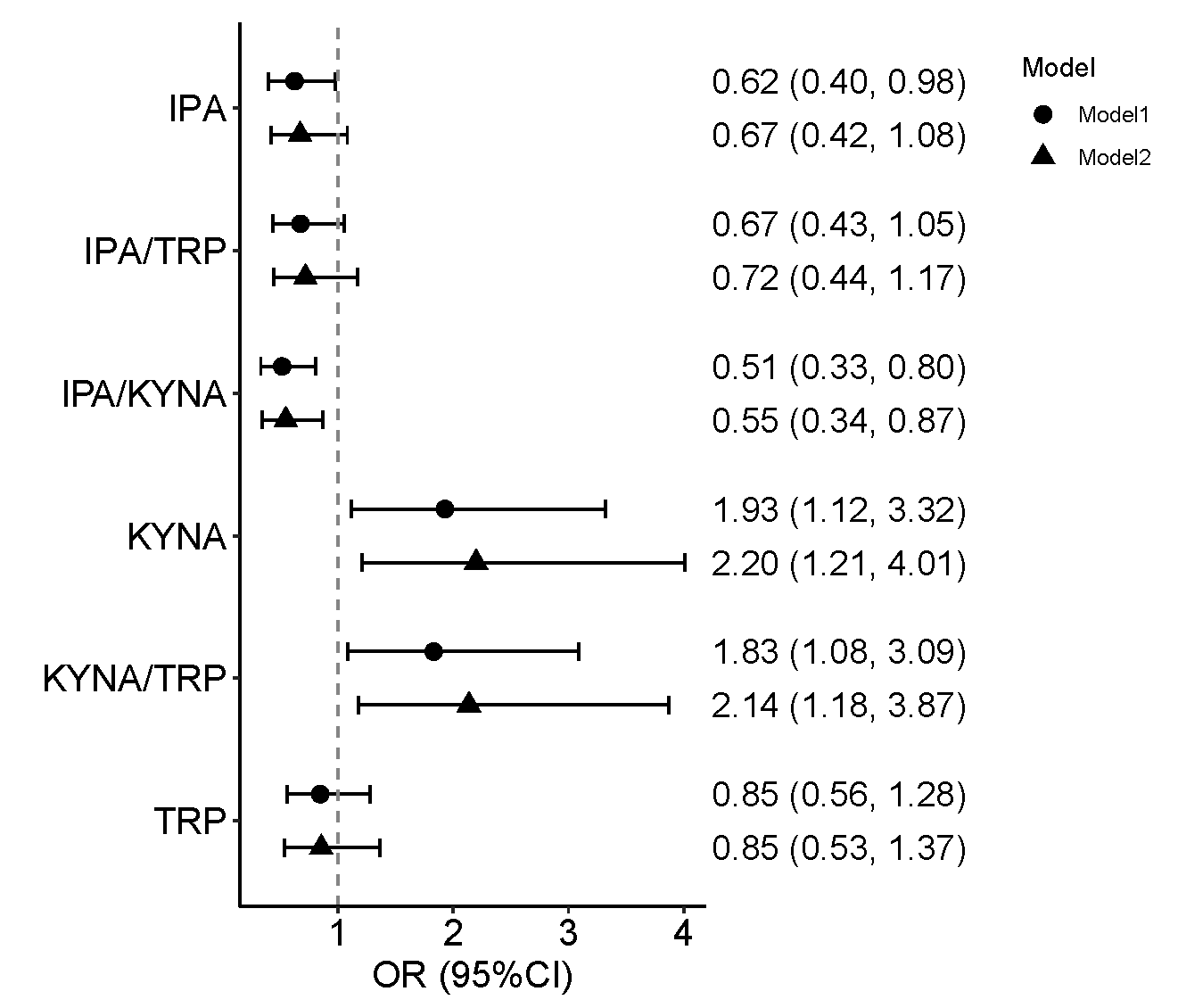
We included 251 women (median age: 52.4 yrs, 71.7% Black; among 138 HIV+ women, 93.5% on ART, 80.4% with undetectable viral load) in the main analysis. After multivariate adjustment, carotid artery plaque was positively associated with kynurenic acid (KYNA) (odds ratio [OR] = 1.93, 95% confidence interval [CI]: 1.12, 3.32, per one Z-score increase) and KYNA/TRP (OR=1.83, 95%CI: 1.08, 3.09), and inversely associated with indole-3-propionate (IPA) (OR = 0.62, 95% CI: 0.4, 0.98) and IPA/KYNA (OR= 0.51, 95%CI: 0.33, 0.8). We identified six gut bacterial genera associated with IPA levels (FDR-q < 0.25), five of which and multiple species within them were positively with IPA, most especially Roseburia sp., Eubacterium sp. Lachnospira sp., and Coprobacter sp. No gut bacteria were associated with KYNA levels. Furthermore, a constructed IPA-associated-bacteria score was inversely associated with plaque (OR=0.47, P=0.004), and the association was attenuated after further adjustment for IPA levels (OR=0.54, P=0.02) or IPA/KYNA (OR=0.58, P=0.05). No effect modification by HIV serostatus was observed.
Conclusions:
In a subset of WIHS women, plasma IPA levels and related gut bacteria were inversely associated with carotid artery plaque, suggesting a potential beneficial role of IPA and its gut bacterial producers in atherosclerosis and CVD.
Figure1. Associations of selected tryptophan (TRP) metabolites and derived ratios with prevalent carotid artery plaque.Model 1 was adjusted for age, race/ethnicity, study sites, education, smoking and HIV serostatus at visit. Model 2 was additionally adjusted for BMI, total cholesterol, HDL cholesterol, systolic blood pressure,fasting glucose, use of antihypertensive, lipids lowering and antidiabetic medication.