Background:
Invasive mycoses are prevalent in hospitalized patients with advanced HIV disease, but fungal blood culture is rarely performed in Southeast Asia. The standard 5-day incubation of the BD BACTEC or BACT/ALERT blood cultures misses slow-growing fungi endemic in Southeast Asia like Talaromyces marneffei (Tm) and Histoplasma capsulatum (Hc). We report preliminary results of an on-going multi-center study comparing the use of Myco/F Lytic blood culture with the standard BACTEC and BACT/ALERT systems in detecting invasive mycoses in patients with advanced HIV disease.
Methods:
We prospectively enrolled adult patients with CD4 ≤ 100 cells/µL or WHO stage III or IV disease, were not on ART or were on ART for ≤ 3 months or >12 months, who were hospitalized at the National Hospital for Tropical Diseases (NHTD) in Hanoi and the Hospital for Tropical Diseases in Ho Chi Minh City. Myco/F Lytic and standard blood culture were performed for all study participants. Incubation was up to 5 days and 42 days for standard bottles and Myco/F Lytic bottle, respectively. For all positive bottles, microscopy with Gram and Giemsa stains, followed by standard MALDITOF identification and fungal sub-culturing on SDA were performed to demonstrate dimorphism. The two culture procedures were compared for the number of positive fungal blood cultures using Student’s t-tests, and culture turnaround time was described.
Results:
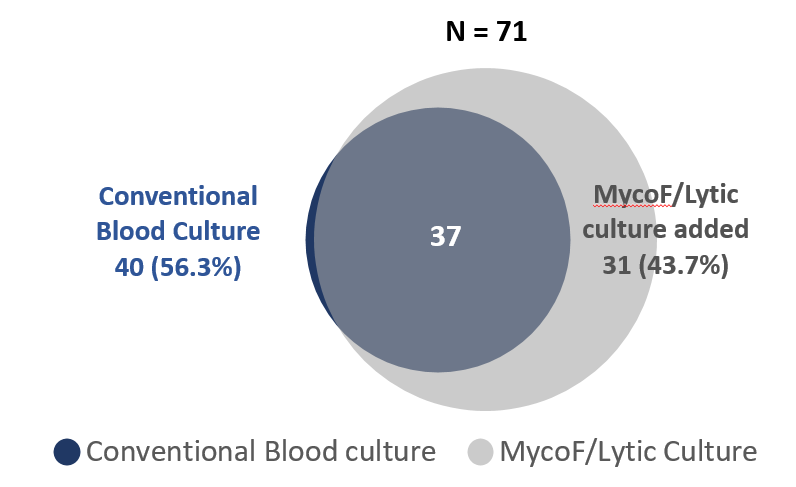
We recruited 319 eligible patients between 22 Feb 2021 and 31 May 2022. A total of 71 patients (22.3%) had a fungal pathogen detected in blood culture: 59/71 cases (83.1%) had Tm; 06/71 cases (8.5%) had Hc, and 06/71 cases (8.5%) had C. neoformans. Of the 71 fungal infections, the standard blood cultures only detected 40 (56.3%) cases while Myco/F Lytic blood culture detected 68 (95.8%) cases. The median time to detection of Tm cases and Hc cases by Myco/F Lytic blood culture were 13 days (IQR 8 – 17.5) and 31 days (IQR 23.5 – 45.5), respectively.
Conclusions:
Invasive mycoses were prevalent in 22.3% of hospitalized patients with advanced HIV disease. Tm was most prevalent (83/1), followed by Hc and Cryptococcus (each 8.5%). Myco/F Lytic blood culture detected 25 additional Tm cases and all 6 Hc cases. A total of 43.7% of infections would have been missed by standard blood cultures. Our data demonstrate the need to urgently implement MycoF Lytic blood culture system into routine diagnostic for hospitalized patients with advanced HIV disease in Southeast Asia.
Venn diagram demonstrating the detection of invasive mycoses by the standard versus MycoF Lytic blood culture systems