Background:
The gastrointestinal (GI) tract constitutes one of the main anatomical sites in which HIV establishes persistence, mainly during acute infection and when ART is initiated. However, sample availability from PLWH limits its study. Here, we have developed an intestinal explant model to study tissue cell reservoirs and assess strategies directed to impact viral persistence.
Methods:
Human intestinal tissue resections from uninfected donors were obtained from routine surgeries. To develop the best model, we assayed different times for HIV infection, ART initiation and duration, and LRA treatment, in addition to different doses of IL-2 and IL-7. HIV-reservoir cells were first identified by quantification of intracellular p24 in CD4+ T subsets in the presence of ART, after viral reactivation with PMA+Ionomycin. Furthermore, the effect of different LRAs, including Ingenol (ING), Romidepsin (RMD), Panobinostat, AZD5582, IL-15, and the combination of RMD+ING, was evaluated in Naïve (TNA), Central Memory (TCM), Effector Memory (TEM), Resident Memory (TRM, CD69+ and/or CD103+) and Memory CD127+(TM-CD127+) CD4+ T cells.
Results:
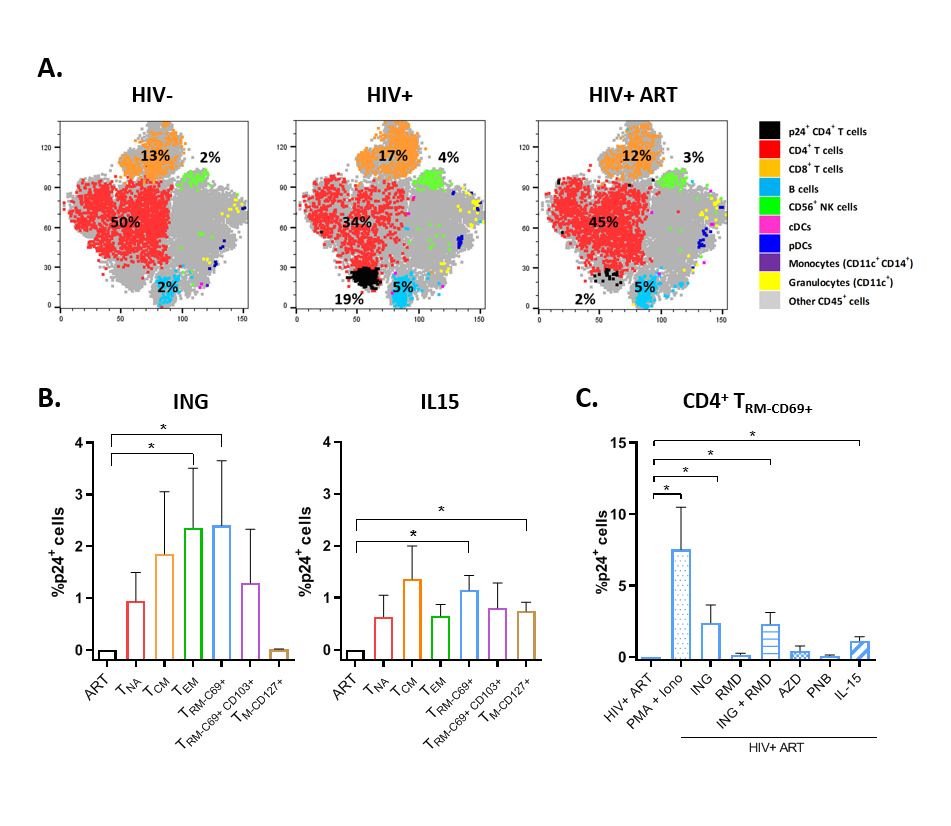
The optimal model consisted in 9 days of HIVBAL infection of unstimulated tissue blocks on top of gelatin sponges and the introduction of ART from day 6. HIV caused a significant decline in CD4+ T cells (p=0.03), an increase of NK cells (p=0.06), and an expansion of B cells (p= 0.03) (Figure 1A). ART significantly reduced HIV replication (from 10.5 to 1.9% p=0.03), and partially reverted the changes observed in the immune populations. Addition of LRAs on day 8 revealed the presence of viral reservoir cells in all tested CD4+ T subsets, which differed in their reactivation potential (example in Figure 1B). Viral reactivation was observed in TEM (p= 0.03) and TRM-CD69+ (p=0.03) using ING; in TCM (p=0.03), TEM (p= 0.01) and TRM-CD69+ (p= 0.01) cells with the combination of ING+RMD; and in TRM-CD69+ (p=0.03) and TM-CD127+ (p=0.03) with IL-15 (example in Figure 1C). No significant changes were observed for the remaining LRAs.
Conclusions:
Despite the limited lifespan of the tissue culture, the model recapitulates major features of HIV infection, ART treatment, and viral reactivation. Besides identifying LRAs acting in different tissue CD4+ T cells, the model may be useful for testing tissue-specific immune-related approaches. Efforts directed to molecularly characterize both different cell reservoirs and signatures of immune cells are currently ongoing.
Figure 1. Effect of HIV infection, ART treatment and viral reactivation in the intestinal model. (A) t-distributed Stochastic Neighbour Embedding (t-SNE) representations displaying the major cell clusters present in live CD45+ gate, based on FSC and SSC, of a representative human intestinal tissue uninfected, HIV-infected and HIV-infected and ART-treated. HIV-infected cells are displayed in black. Main immune cells are shown. (B) HIV reactivation of CD4+ T subsets in the intestinal tissue model (n=7) using ING and IL15. Means with SEM are represented and statistical comparisons were performed using the Wilcoxon test. *p < 0.05. (C) Reactivation of CD4+ TRM-CD69+ viral reservoir cells (n=7) with the different LRAs. Data is normalized to the unstimulated condition (ART). Means with SEM are represented and statistical comparisons were performed using the Wilcoxon test. *p < 0.05.