Background:
In Nigeria, recency testing was introduced in 2020 to assist in identifying those who had recently acquired HIV infection between 4weeks and 12 months so that prevention programs can focus on preventing incident infections and ultimately break the chain of transmission to control the epidemic. This study aimed to identify the spatial distribution pattern of recent HIV infection among adult PLHIV, identify correlates of recent HIV infection and detect recent HIV infection hotspots.
Methods:
This was an ecological descriptive and analytical design conducted between October 2019 and December 2021. We georeferenced recent HIV case reports from 197 of 774 Local Government Areas (LGAs) spread across all of Nigeria’s six geographic regions. Percent of recent HIV infections among adult PLHIV was calculated from data extracted from the national Recency testing registers. Spatial autocorrelation of recent HIV infection was analysed via a Global Moran’s I test. Hotspot analysis using Getis-Ord-Gi* statistics highlighted regions of significant clusters of recent HIV infection among neighbouring geographic regions, and Poisson regression model identified correlates of recent HIV infection in Nigeria.
Results:
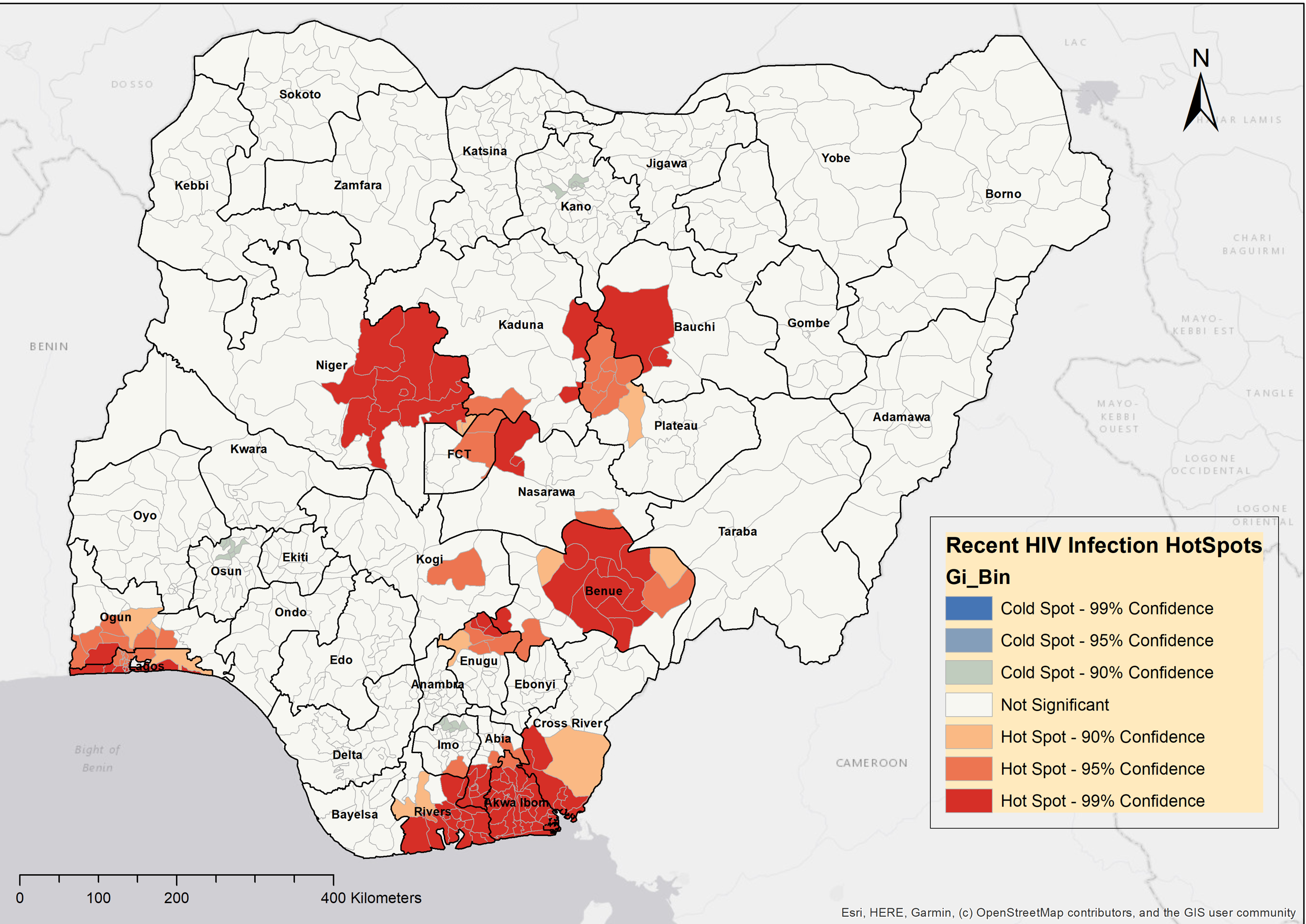
Among the 62,382 PLHIV tested for recent infection, 61% were females. Of the 4,077 (6.5%) PLHIV identified as having recent HIV infection, 1,499 (6.3%) were males and 2,578 (6.7%) were females. Females between the ages of 15-19 (10%) had the highest recent infection when compared to other female age groups, while males (16%) aged 50 and over were four times more likely than females (4%) in this age group to have recently contracted HIV. The global spatial autocorrelation Moran’s I statistics (z-score=10.7, p< 0.0001, Moran’s Index=0.104) revealed a clustered distribution of the spatial pattern of recent HIV infection. Hotspot analysis identified significant clusters of recent HIV infection that were confined to LGAs in the North Central, North East, South West, South East and the South South regions of the country. In the Poisson model, knowledge of HIV prevention (p< 0.0004) and ART coverage (p< 0.0001) were significantly associated with recent HIV infection.
Conclusions:
Given the effect of knowledge of HIV prevention and ART coverage on recent HIV infection among adult PLHIV, adopting policies and strategies to enhance awareness and encourage people to seek early HIV testing and implementation of intensified community ART delivery services can break the transmission of HIV infection.
Hotspots of Recent HIV Infections, October 2019 and December 2021