Background:
Globally in 2022, Brazil ranks second in number of mpox cases and deaths. Stigma and discrimination, against the LGBTQIA+ community, might result in structural barriers that impact access to health services, leading to undertesting and underreporting of cases. We aim to evaluate community knowledge of mpox, and describe sociodemographic and behavioral aspects according to self-reported mpox diagnosis.
Methods:
Cross-sectional on-line survey conducted among adults (>18 years) living in Brazil through advertisements on Scruff, Grindr, Instagram, and Facebook. Questions addressed sociodemographics; mpox knowledge, symptoms, and diagnosis; sexual behavior; HIV testing; and STI diagnoses. For statistical comparison, we used chi-square and Kruskal-Wallis tests.
Results:
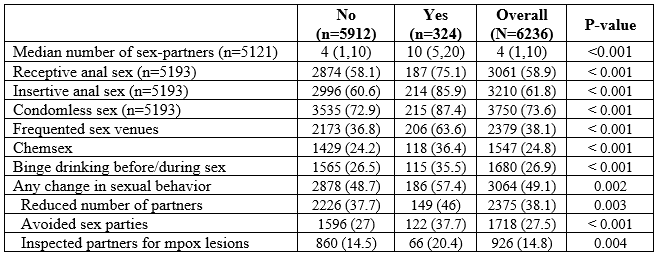
From October to November 2022, 6236 participants completed the survey: 5686(91.2%) cis-man, 252(4.0%) non-binary, 247(4.0%) cis-women, 15(0.2%) trans-man and 15(0.2%) trans-women. Most were gay/bi/pansexual (6032; 96.7%), white (3877; 62.2%), had college education (4902; 78.7%), and low/middle income (4070; 73.0%). Most had heard of mpox (6044; 96.9%) and reported willingness to take mpox vaccine (5008; 95.1%). Overall, 324 (5.6%) reported a mpox diagnosis; 318 of them (98.1%) reported lesions, 178 (56.0%) local pain and 316 (99.4%) attended health facilities for investigation. Among participants who reported no mpox diagnosis (Nf5912), 4974 (84.1%) reported knowledge of mpox, 288 (4.9%) had a suspicious mpox lesion, but only 54.9% of those (n=158/288) attended a health facility for investigation. Participants reporting mpox diagnosis compared to those not diagnosed were younger (median 34 [IQR:30-39.2] vs. 37 [IQR:31-44] years; p< 0.001), reported sex partners with suspicious/confirmed mpox (34.6% vs. 3.5%; p< 0.001) and more sexual contacts (Table). HIV testing in the prior 3 months (74.1% vs. 42.1%; p< 0.001), current PrEP use (47.8% vs. 24.4%; p< 0.001) and any STI diagnoses (25.0% vs. 10.6%; p< 0.001) were higher among those reporting mpox diagnosis. Participants reporting mpox diagnosis more frequently reported changes in sexual behavior after mpox onset. HIV prevalence differed by report of mpox diagnosis (37.7% vs. 22.9%; p< 0.001). The majority affirm that LGBTQIA+ communities are being stigmatized due to mpox (5258; 84.4%).
Conclusions:
Our results show high rates of mpox knowledge in the LGBTQIA+ communities. Expand access to gender competent care is critical to avoid underdiagnosis and fight stigma and discrimination.
Sexual behavior since June 2022 according to mpox self-reported diagnosis