Background:
In people living with HIV (PLWH) lamivudine (3TC)+dolutegravir (DTG) maintenance dual therapy (DT) could be less effective than three-drug therapies (TT) with 2NRTIs+DTG in the context of both resistance-associated mutations (RAMs) and lower time of virological suppression (VS). However, data have shown that PLWH who switch to DT usually have longer time of VS than PLWH switching to TT, leading to an immortal-time bias when analyzing observational data. To overcome this issue, we emulated a trial-study design by querying the Italian “ARCA” database.
Methods:
PLWH on a TT with PI or a NNRTI, switching to a DTG-based TT or to DT with 3TC+DTG were followed from the first HIV-RNA< 50 cps/mL (baseline, BL) up to virological failure (VF) (i.e., 2 consecutive HIV-RNA≥50 cps/ml or one HIV-RNA³200 cp/mL). After choosing a grace period of 3 years (i.e., the maximum time of VS after which we supposed an advantage in terms of virologic success for PLWH on DT, based on literature data) we assigned PLWH switching to DT within 3 years to the “treatment”-arm, and PLWH switching to 2NRTIs+DTG (or to DT after 3 years) to the “control”-arm. By using a cloning technique, each participant was also assigned the opposite strategy and censored at the time of deviation from that strategy. By estimating the inverse-probability of censoring weight (IPCW) for each participant, we accounted for the informative censoring triggered by cloning. A Cox regression model was then performed to obtain an unbiased estimate of the effect of DT over TT on VF.
Results:
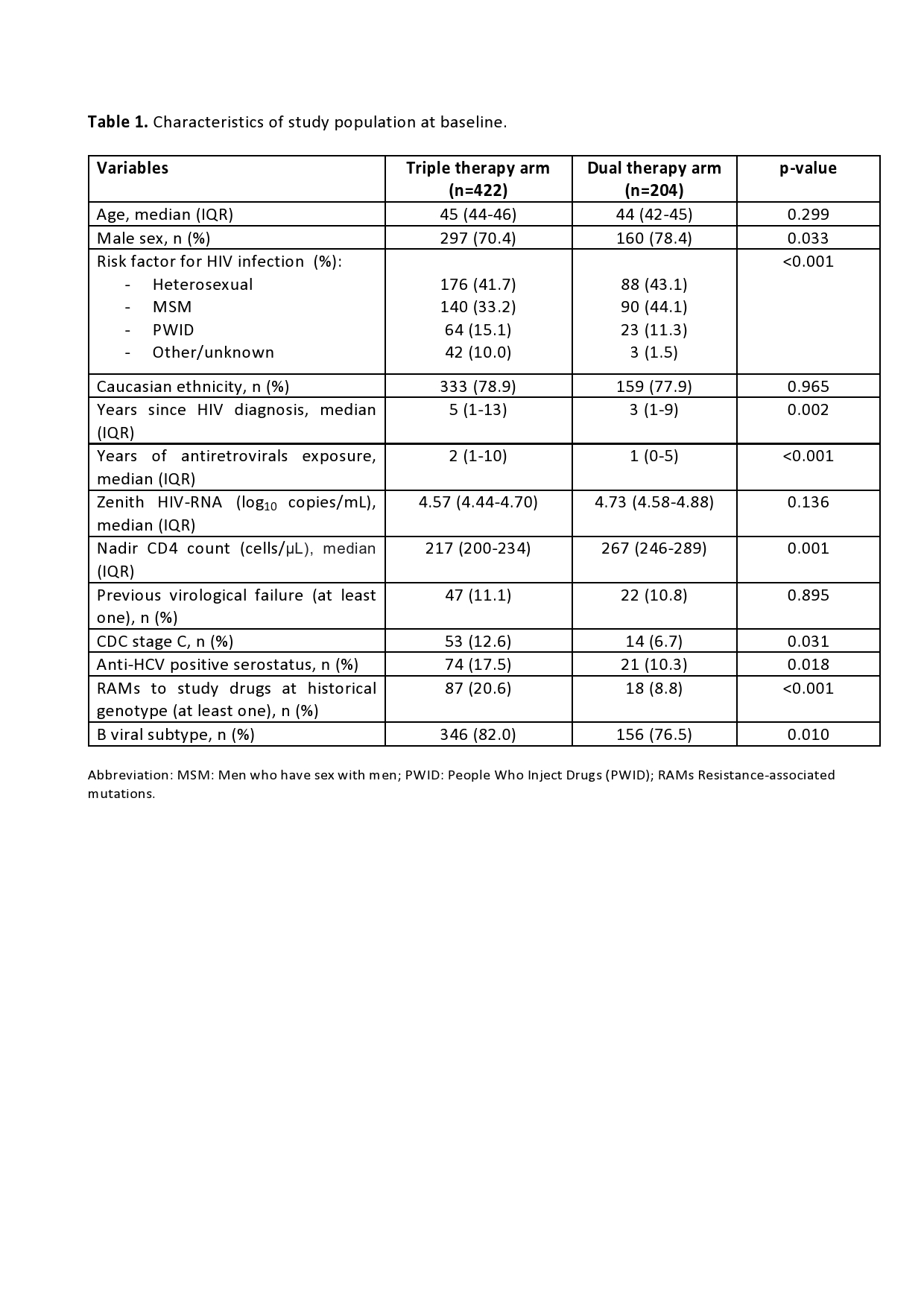
A cohort of 626 PLWH (204 on DT, 422 on TT; 73% men, mean age 44 years) was eligible for analysis (table 1 summarizes characteristics of study population). The mean time of VS was 5 and 4 years before switch to DT and DTG-based TT, respectively. Overall, 41 VF (10 with DT, 31 with TT) occurred after a mean time of 2.2 and 1.6 years with DT and TT, respectively. A higher crude risk of VF was shown for TT (7.6% versus 4.5% at 2 years; p=0.055). Conversely, the inverse probability weighted-Cox model indicated a similar risk of VF between DT and TT when no RAMs were present (DT versus TT aHR: 0.88, 95% CI 0.45-1.72; p=0.713) but a higher risk of VF for DT in the presence of M184V/I (versus TT and no RAMs: aHR 4.24, 95% CI 1.29-13.93; p=0.017). No difference in VF risk among TT with and without previous RAMs was detected.
Conclusions:
Previous detection of M184V/I could affect the efficacy of 3TC+DTG as a maintenance strategy.
Table 1. Characteristics of study population at baseline.