Background:
Monitoring mother-infant pairs with HIV exposure is needed to assess effectiveness of vertical transmission prevention programmes and progress towards vertical transmission elimination.
Methods:
We used routinely-collected data on infants with HIV exposure, born May 2018 – April 2021 to mothers diagnosed with HIV prior to delivery, in the Western Cape, South Africa, with follow-up through mid-August 2022. We assessed proportion of infants with HIV exposure who were diagnosed with HIV at birth (≤7 days), 10 weeks ( >1to 14 weeks) and >14 weeks as proxies for intrauterine, intrapartum/early breastfeeding and late breastfeeding transmission, respectively.
Results:
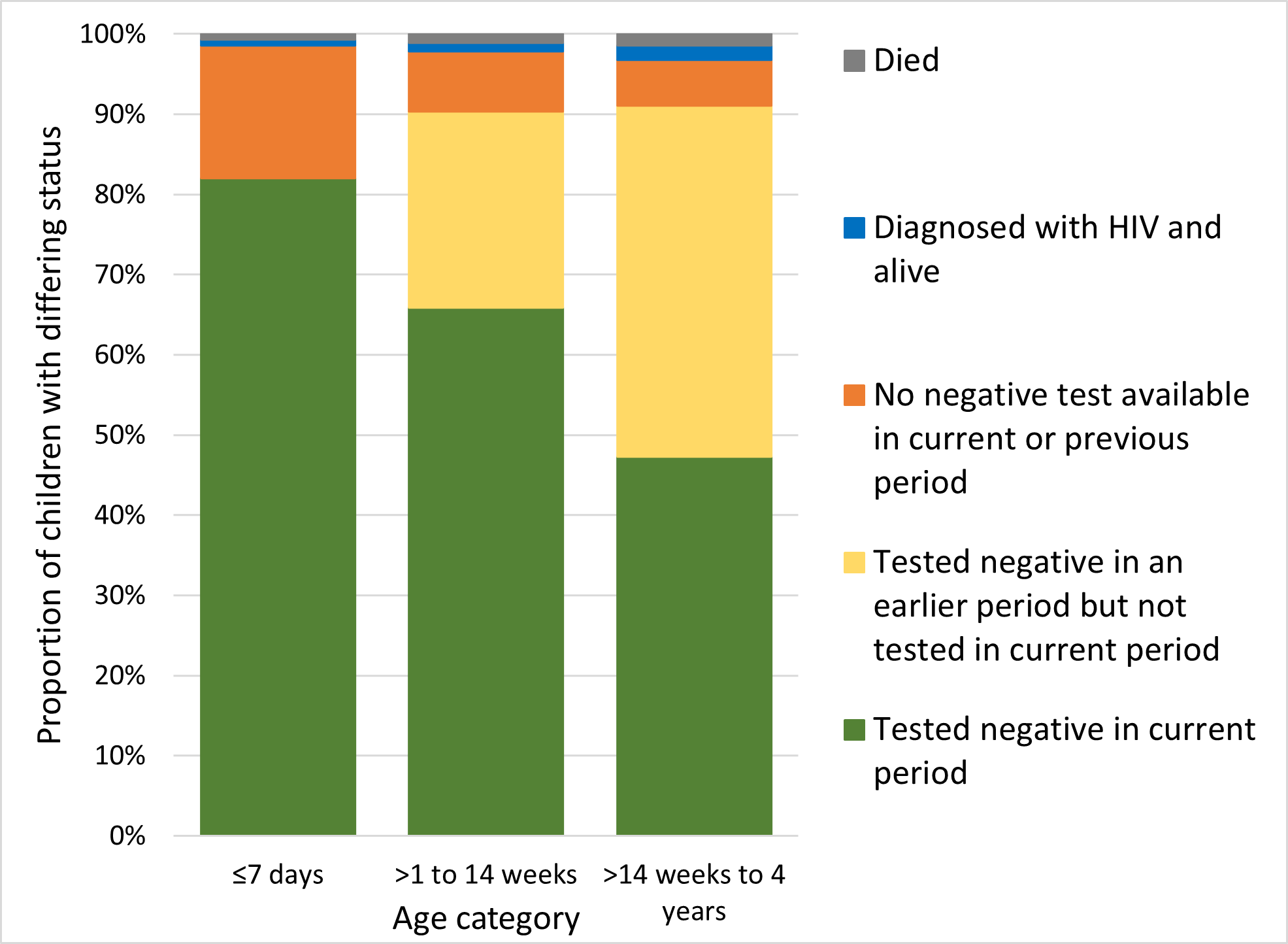
Among 49 824 HIV-exposed infants, 925 (2%) were diagnosed with HIV. Among the mothers, 68% started antiretroviral treatment (ART) before and 27% during pregnancy; 90% received any ART during pregnancy and 86% received any ART in the year after delivery. Most pregnancy regimens included non-nucleoside reverse transcriptase inhibitors (84%); 11% integrase strand transfer inhibitors and 5% protease inhibitors. Of mothers with available results, 74% had viral load < 100 copies/ml and 62% CD4 count ≥350 cells/µl at delivery. HIV-PCR test results were available for 83%, 67% and 48% of eligible infants at birth, 10 weeks and >14 weeks. Among eligible infants who were tested, 0.8%, 0.4% and 1.1% were positive at birth, 10 weeks and >14 weeks, respectively, and among infants with positive HIV-PCR tests, 47%, 18% and 35% were diagnosed at these respective time periods. Of infants who first tested positive at 10 weeks, 68% had previous negative birth tests (suggesting intrapartum/early breastfeeding transmission) and 52% who first tested positive at >14 weeks had previous negative tests at 1-14 weeks (suggesting late breastfeeding transmission). Of infants with HIV, 94% had mothers who started ART before or during pregnancy. Overall infant mortality was 1% (n=720/49824) but was 4% (n=41/925) among infants with HIV. An additional 742 infants were diagnosed with HIV in the study period but were excluded as maternal evidence of HIV was after delivery (n=341) or no linked maternal data was available (n=401).
Conclusions:
Despite high maternal ART coverage, ongoing vertical transmission is a concern. Interventions to improve maternal viral suppression and reduce vertical transmission in pregnancy and breastfeeding are needed to achieve an HIV-free generation.
Vital status and HIV status at different time points for infants with HIV exposure