Background:
Mpox (previously known as monkeypox) is a disease caused by the mpox virus (MPXV) belonging to the orthopoxvirus (OPXV) genus which includes smallpox and vaccinia virus (VACV). VACV-based vaccines provide protection against mpox disease but complicate differentiation of infection-specific from vaccine-induced immunity. We tested the reactivity of serum from recently vaccinated or mpox-infected individuals and controls to a dozen MPXV/VACV proteins and developed and validated a novel immunoassay to measure vaccine response and distinguish mpox infection from vaccination.
Methods:
Vaccine and control sera were obtained from ongoing studies with IRB approval. MPXV-vaccinated individuals (Nf3) received MVA-BN (VACV-based) vaccine ≥ 2 weeks prior to serum collection and had no history of mpox infection. OPXV-naïve control sera (Nf71) were collected prior to the global mpox outbreak from individuals < 40 years of age (born after routine smallpox vaccination ended). Mpox sera (Nf5) were from individuals who recovered from PCR-confirmed mpox. Indirect IgG ELISAS were performed using conserved OPXV antigens: A27L, A29L, A30L, A33R, A35R, B16R, C19L, D6L, E8L, H3L, I1L. For the MPXV-specific assay we used the complete, 1879 amino acid B21R protein which is present in MPXV but absent in VACV. Statistical analyses were performed on background-reduced ODs with two-tailed Mann-Whitney tests for comparisons.
Results:
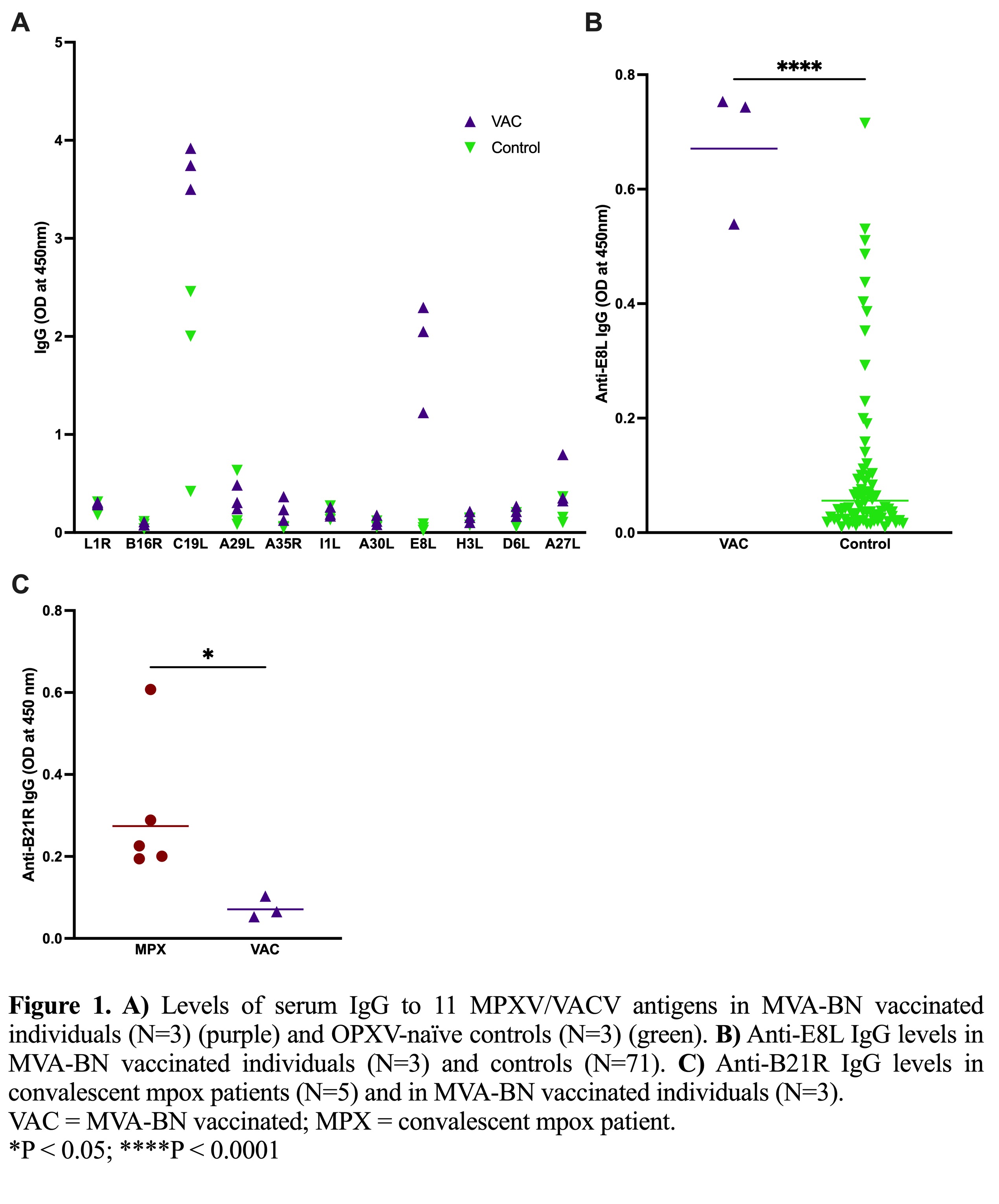
Reactivity of vaccine serum was low or nonspecific for most antigens (A35R, L1R, B16R, A29L, A30L, A27L, I1L, D6L, A33R) (Fig 1a). E8L showed consistently high levels of reactivity in vaccine sera with low background. We re-ran the E8L assay with vaccine sera against a larger pool of controls and again found high levels of IgG in vaccinated but not in control sera (OD = 0.62 vs. 0.056, P < 0.0001) (Fig 1b). B21R IgG was detectable in all mpox sera but low in vaccine sera (OD 0.27 vs. 0.07, P < 0.05) (Fig 1c).
Conclusions:
We developed and validated the first mpox-specific seroassay which uses the complete B21R peptide, which can distinguish recent infection from vaccination, which in turn was associated with a robust E8L antibody response. Collectively, our assays provide tools for conducting vaccine response and immunosurveillance studies to longitudinally detect immunity to MPXV, determine the true prevalence of MPXV infection and identify asymptomatic community spread.