Background:
Since the beginning of the current MPOX outbreak, reports and case series have highlighted a significant distribution in people living with HIV (PLWHA) and also in pre-exposure prophylaxis (PrEP) users. Despite similar vulnerability behaviors, these populations are distinct from an immunological view. We evaluated the differences in clinical presentation between PLWHA and PrEP users.
Methods:
We conducted an observational cross-sectional study among adults with suspected MPox in a public reference institution for the prevention and care of HIV infection and other sexually transmitted infections (STI) between 6/18/2022 and 9/22/2022. The data were obtained from the MPox notification database and supplemented by dispensing systems and electronic records. Multivariate analysis was performed using logistic regression models to compare clinical presentation between PLWHA and PrEP users.
Results:
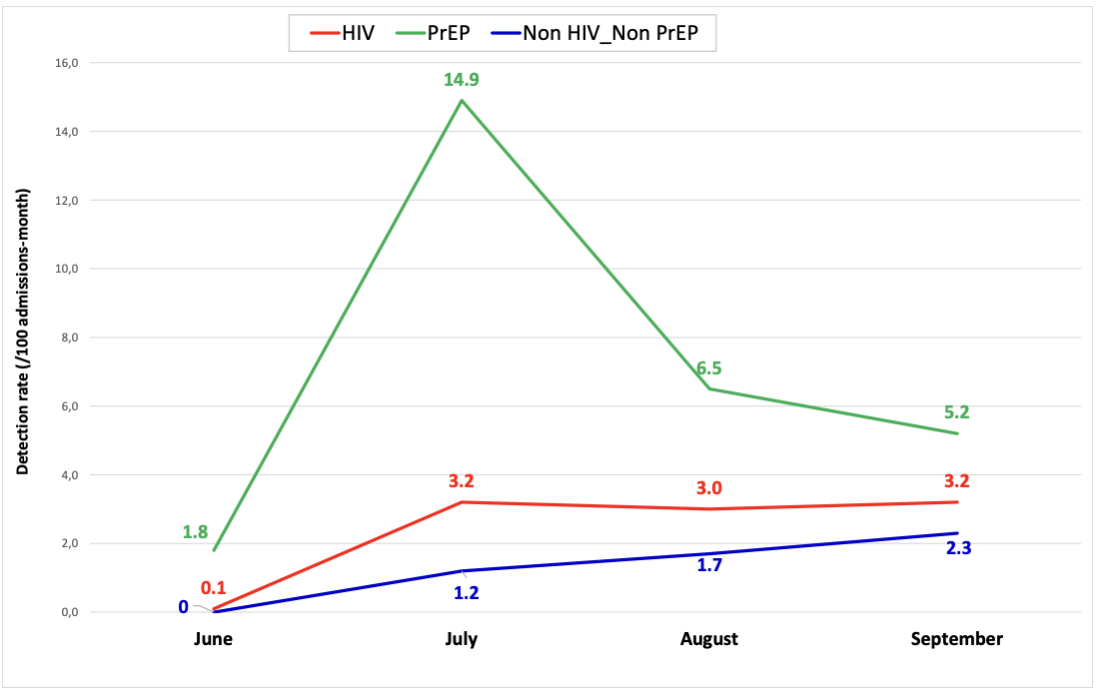
A total of 394 suspected cases were tested for Mpox RT-PCR, of which 304 (78.4%) were positive. The number of incident cases peaked in July/2022 (Figure 1). PCR-positive patients had a mean age of 33 years, 297 were male and MSM (97,7%) , 247 had anogenital lesions (82,3%). 167 (55%) were PLWH, and 97 (32%) were PrEP users, and no one died. In PLWHA, 85,2% were virologically suppressed patients, while 88,7% have CD4 >350 cells/mL. The patients with a positive PCR result, compared to patients with a negative result, were more likely to be in the 25-39 age group (OR 2.8; 95%CI 1.1-7.5), have fever (OR 4.7; 2.3-9.7), MSM/transgender women (OR 17,2;4,5-65,9), adenomegaly (OR 7.2; 3.8-13.7), multiple vesicular lesions (OR 4.2; 2.1-8.5) and have an STI concurrently (OR 3.2; 1.2-8.6). PLWHA, compared to PrEP users, were more likely to have extragenital involvement (26,3% vs 13,3%; p=0,016). The two groups did not exhibit any other significant differences in clinical presentation.
Conclusions:
The Mpox outbreak in Brazil curbed in September, possibly as a result of the strong mobilization of the LGBTQIA+ community. The vast majority of our study participants were PLWHA and PrEP users. PLWA in our study presented more frequently with extragenital involvement than PrEP users, possibly due to a weakened immune response of PLWHA to contain the spread to distant areas.In low-incoming countries with limited diagnostic resources, the development of an epidemiological and clinical screening prioritizing testing in MSM, young ,with fever, adenomegaly and genital lesions, could be a strategy to be implemented.
MPOX DETECTION RATES ( PER 100 ADMISSIONS-MONTH) FROM JUNE TO SEPTEMBER /2022 PER GROUP, CRT SAO PAULO