Background:
Nirmatrelvir/ritonavir (NMV/r) was granted Emergency Use Authorization in December 2021 for treatment of early symptomatic patients with mild to moderate COVID-19 at high risk of progression. However, its benefit is specific population subgroups remains unclear.
Methods:
We used a matched cohort design to emulate a target trial within the VA COVID-19 Shared Data Resource database. Eligible individuals were those with at least two episodes of care in the VA in the last 2 years, who had a first confirmed SARS-CoV-2 infection between January 1 and August 31, 2022 and were free of hospitalization or death within 3 days of testing positive. Those hospitalized in the previous 60-days and those who received Molnupiravir after diagnosis were ineligible. Among the eligible individuals, we matched those prescribed NMV/r with those not prescribed NMV/r within 3 days of diagnosis. Controls were matched 1:1 on age (5-year blocks), race, sex, body mass index, Charlson Comorbidity Index, VA facility where NMV/r was prescribed, and vaccination status. Our primary outcome measure was hospitalization or death within 30 days of the index COVID-19 diagnosis date.
Results:
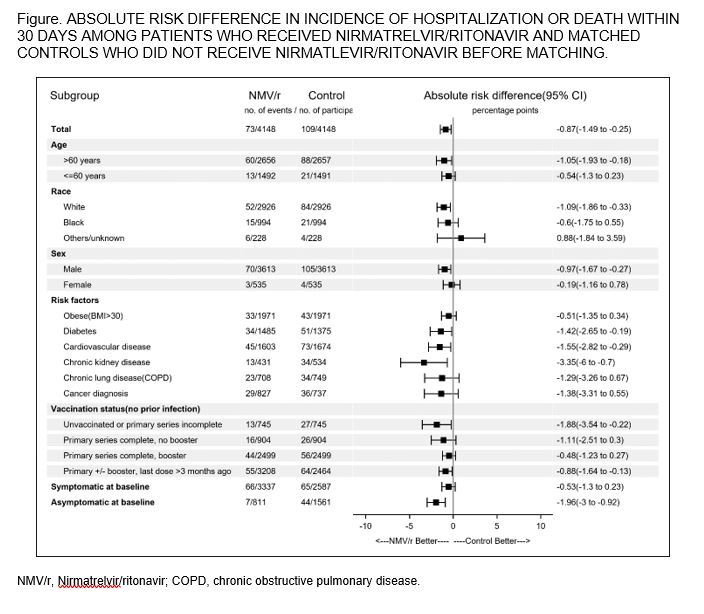
Among 90,432 persons with a confirmed first SARS-CoV-2 positive test, 68,236 persons met the eligibility criteria. Of those, 4,886 were prescribed NMV/r. Final primary analysis dataset included 4,148 matched pairs of NMV/r treated cases and controls. The incidence of hospitalization or death was significantly lower among those who were prescribed NMV/r overall (73 vs. 109 events; ARD [95% CI] -0.87 [-1.49 to -0.25]), for those older than 60 years (60 vs. 88 events; ARD [95% CI] -1.05 [-1.93 to -0.18]), for unvaccinated/incomplete primary series (ARD -1.88 [-3.54 to -0.22]), and those asymptomatic at baseline (ARD -1.96 [-3.00 to -0.92]). Those who were <60 years old, vaccinated with or without a booster, and those symptomatic at baseline did not experience a significant benefit.
Conclusions:
NMV/r use is associated with a modest but statistically significant reduction in hospitalization or death among previously uninfected, non-hospitalized population with COVID-19 who are at a high risk of progression to severe disease. The benefit is evident in older, unvaccinated, asymptomatic persons and those with certain comorbidities. But not in younger, vaccinated, and symptomatic persons.
ABSOLUTE RISK DIFFERENCE IN INCIDENCE OF HOSPITALIZATION OR DEATH WITHIN 30 DAYS AMONG PATIENTS WHO RECEIVED NIRMATRELVIR/RITONAVIR AND MATCHED CONTROLS WHO DID NOT RECEIVE NIRMATLEVIR/RITONAVIR BEFORE MATCHING.