Background:
The U.S. population of immigrants has grown rapidly over the past two decades. Knowledge about reasons for migration and their association with HIV-related behaviors is limited. We explored patterns in reasons for migrating to the U.S. among cisgender gay, bisexual, and other sexual minority men (SMM) and determined their associations with HIV risk and prevention behaviors.
Methods:
Data were from the 2018-2020 cycles of the American Men’s Internet Survey, an annual online survey of SMM in the U.S who report having sex with other men in the past year. We limited analyses to participants born outside the U.S. who reported reason(s) for migration and reported HIV-negative/unknown status. Participants selected from a list of reasons and could write in a reason. Latent Class Analysis (LCA) was performed to identify patterns in the reasons for migration. We used multivariate logistic regression controlling for demographic characteristics to assess class associations with the following in the past 12 months: condomless anal sex (CAS), illicit drug use, marijuana use, HIV testing, and PrEP use.
Results:
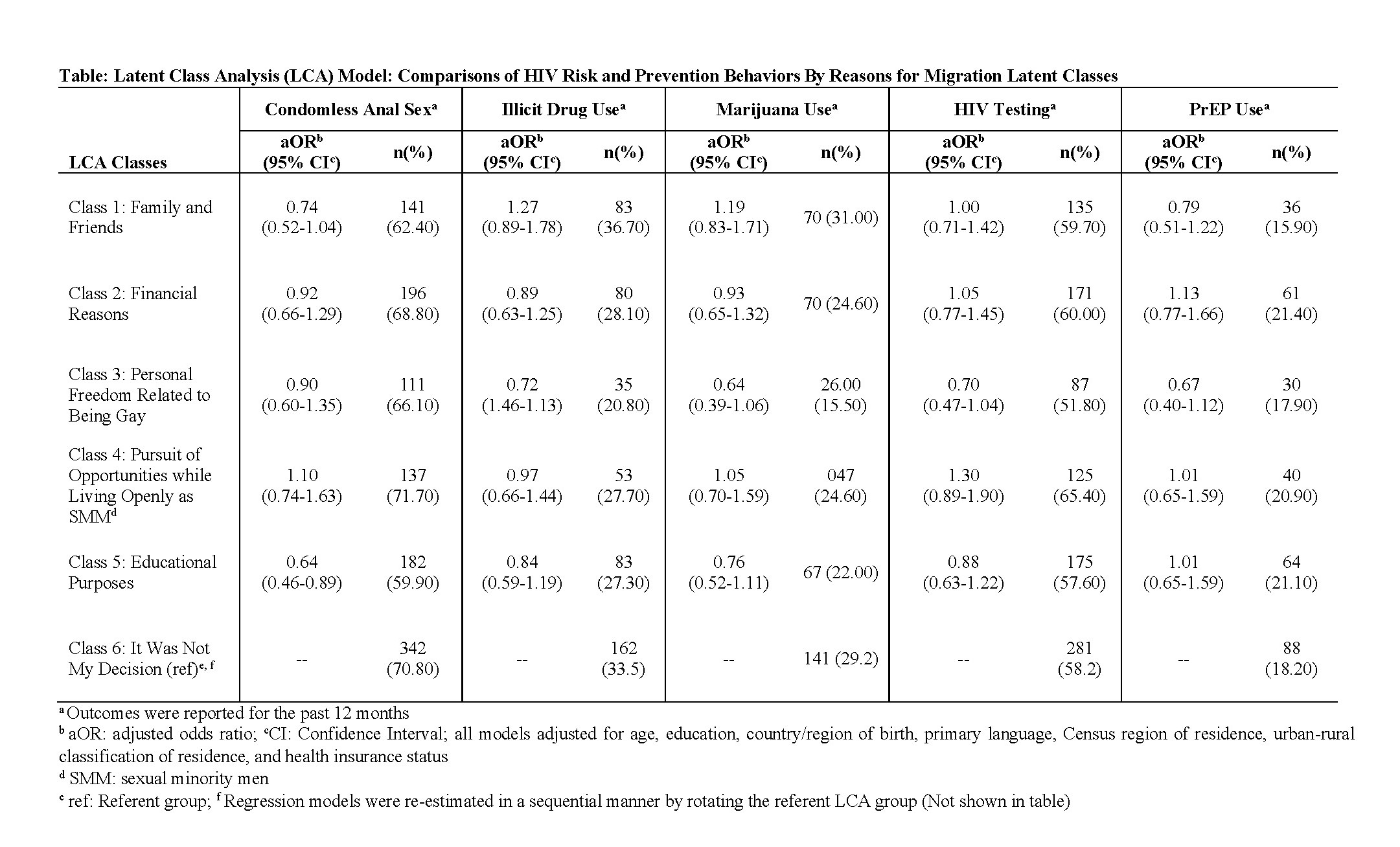
Among 1,657 SMM, 21% were from Mexico, 18% from Europe, and 13% from South America; 29% spoke a primary language other than English. LCA identified 6 distinct patterns in reasons for migration: 1) Family and friends (14%); 2) Financial (17%); 3) Personal freedom related to being gay (10%); 4) Pursuit of opportunities while living openly as SMM (12%); 5) Educational purposes (18%); 6) Not my decision (29%). While HIV testing (range=57.6-65.4%) and PrEP use (15.6-21.4%) did not vary by class (p >0.05 for all), CAS and illicit drug use were significantly different (Table). SMM who migrated to pursue opportunities while living openly and whose reasons were not their decision had greater odds of CAS than SMM who migrated for educational purposes (adjusted odds ratio [aOR]:1.72, 95% confidence interval [95%CI]:1.15-2.59; 1.57, 1.13-2.19, respectively). SMM who migrated because of personal freedom related to being gay and for educational purposes had lower odds of illicit drug use than SMM who migrated due to family and friends (aOR, 95%CI: .57, .35-.93; .67, .45-1.00, respectively).
Conclusions:
Reasons for migrating to the U.S. among SMM were associated with behaviors that can increase HIV risk. Push and pull factors related to migration matter when considering the HIV prevention needs of immigrant SMM.
Latent Class Analysis (LCA) Model: Comparisons of HIV Risk and Prevention Behaviors By Reasons for Migration Latent Classes