Background:
The ongoing Mpox outbreak is notable for its global reach and atypical presentations with significant variation in time of prodromal symptoms, staging and distribution of rash, and varied syndromic presentations (e.g., proctitis, pharyngitis). The overlap of the clinical presentation with common sexually transmitted infections and the high prevalence of co-infections (e.g. herpes simplex virus [HSV], varicella zoster virus [VZV]) highlights a need for improved diagnostic methods. A diagnostic test able to detect and differentiate Mpox from its common close mimics will be useful however, there are no multi-panel assays for vesicular and/or ulcerative lesions approved for clinical use. We evaluated a commercially available “research use only” multiplex PCR assay to detect Mpox virus, HSV, and VZV in clinical specimens.
Methods:
Residual specimens collected during routine clinical care were tested using the multiplex panel (Qiagen, Germantown, MD, USA). This panel is a single-use automated multiplex real-time RT-PCR assay commercially available in the United States for “research use only” to detect Mpox virus Clade 1 (MPXV1), Mpox virus Clade 2 (MPXV2), HSV1, HSV2, HHV6, HEV, and VZV. Reference testing was done by a commercial laboratory as part of routine care. Performance of the test assay was measured by calculating positive percent agreement and negative percent agreement with 95% confidence intervals using the efficient-score method (vassarstats.net).
Results:
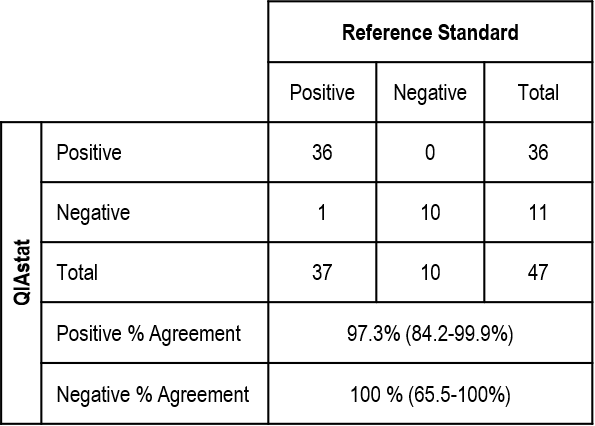
We tested 47 specimens from 40 unique patients (Table 1). The multiplex panel detected MPXV2 in 36/47 specimens whereas the reference standard detected MPXV2 in 37/47 (PPA 97.3%, 95% CI: 84.2-99.9%). The multiplex panel did not detect Mpox in any specimen that was negative for the reference test (NPA 100%, 95% CI: 65.5-100%). Other viruses beyond Mpox were detected by the multiplex panel in 11 samples, eight of which were co-infections with Mpox according to the reference method.
Conclusions:
We report the first validation in the clinical context of a commercially available multiplex PCR assay for the detection of Mpox virus. The multiplex assay was highly accurate for the detection of Mpox and offers several advantages over current assays; short turn-around-time, ease of use, detection of other pathogens. Wider availability of Mpox testing could shorten time to treatment and improve infection control interventions. Finally, multiplex assays that can detect Mpox have utility in both disease surveillance and outbreak response.
Figure 1