Background:
Not much is known on differences in treatment -adherence, psychiatric health and HIV-viral control between women transitioning through menopause and men of similar age, risk group and treatment history. With this study, we aimed at closing this knowledge gap.
Methods:
We identified 1,437 HIV-positive women with menopause onset between 01/2010 and 12/2021, and 1,094 men of similar age from the same time period in the Swiss HIV Cohort Study (SHCS). We considered data on HIV-viral load, depression and/or being in psychiatric care and self-reported treatment adherence between the ages of 41 and 60. Non-adherence was defined as any person self-reporting missing one dose once every 2 weeks, or more often.We fitted log-binomial interrupted time series (ITS) regression models to estimate the trajectory for the respective events over the age range and compared outcomes between men and women. We adjusted for differences in risk group (heterosexual, injection drug users [IDU]), time on ART and year of visit between men and women using inverse probability weighting (IPW), and calculated sandwich-type standard errors as patients have many clinical visits.
Results:
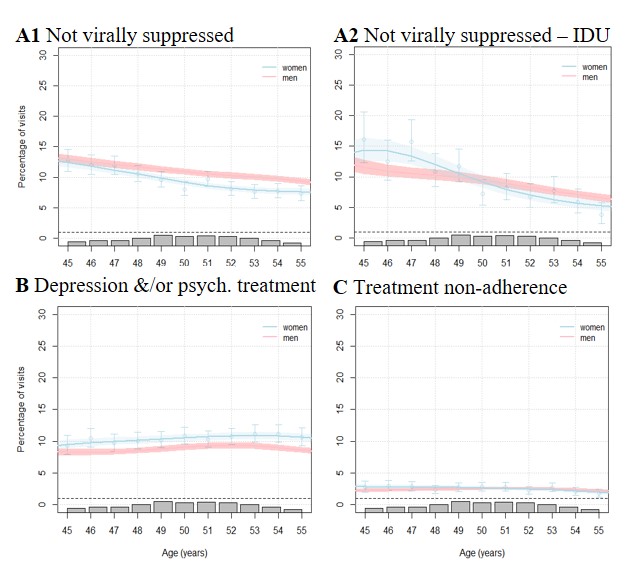
2,531 people living with HIV attending 90,310 clinical visits were included, of which detectable HIV-RNA ( >50 copies/ml) was observed in 9.4% of women and 10.7% of men. 10.1% of women (men 8.6%) were depressed and/or in psychiatric care, and 2.3% of women (men 2.3%) self-reported treatment non-adherence. Women had fewer visits with detectable HIV-RNA compared to men, but there was little overall difference between the ages of 48 and 52 (p=0.7, Figure A1). Women were slightly more likely to be depressed and/or in psychiatric care (IPW adjusted incidence rate ratio for women 1.26 (reference: men), 95% confidence interval [1.12, 1.41], p < 0.001, Figure B), but there was no difference in terms of treatment adherence (p=0.9, Figure C). Women IDU exhibited a slight increase in detectable HIV-RNA during peri-menopause (Figure A2).
Conclusions:
There were no differences between men and women in terms of both detectable HIV-RNA and treatment adherence, but a slightly higher rate of being depressed and/or in psychiatric care for women of 48-53 years. Apart from women with IDU as the probable mode if HIV acquisition, there were no significant increases in viral events during peri-menopause.
Figure: Percentage of visits with detectable HIV-RNA (A), psychiatric treatment and/or depression (B) and treatment non-adherence (C) for women (blue) and men (red); age at menopause histogram on the x-axis.