Background:
Prior to local scale-up of new antiretroviral therapy (ART) for HIV treatment, exploring drug-drug interactions between ART and contraception is crucial. We are conducting EPIC (Evaluation of Pharmacokinetic drug-drug Interactions between Contraceptives and doravirine-containing ART), a parallel group pharmacokinetic study to examine interactions with doravirine (DOR)-containing ART (DOR+3TC+TDF) among women of reproductive potential living with HIV in Johannesburg, South Africa.
Methods:
EPIC began in November 2021 and is ongoing. A ≥6-week lead-in period with oral DOR was required after aviraemic participants switched from their existing ART. Participants in the 3 intervention groups on DOR-containing ART concomitantly self-selected contraception: intramuscular depomedroxyprogesterone acetate (DMPA; Group 1), etonogestrel implant (ETG; Group 2), or copper intrauterine device (IUD; Group 3). ETG & IUD groups were compared to historical control groups using the same contraceptive method but on dolutegravir-containing ART, plus a fourth group to compare DMPA-users (dolutegravir + DMPA; Group 4). Participants were followed up for 12 (Groups 1 & 4) or 24 weeks (Groups 2 & 3). Early safety (measured by number & severity of adverse events (AE)), tolerability (measured by patient satisfaction & drug adherence), and efficacy (HIV aviraemia as ≤40 copies/mL) are reported.
Results:
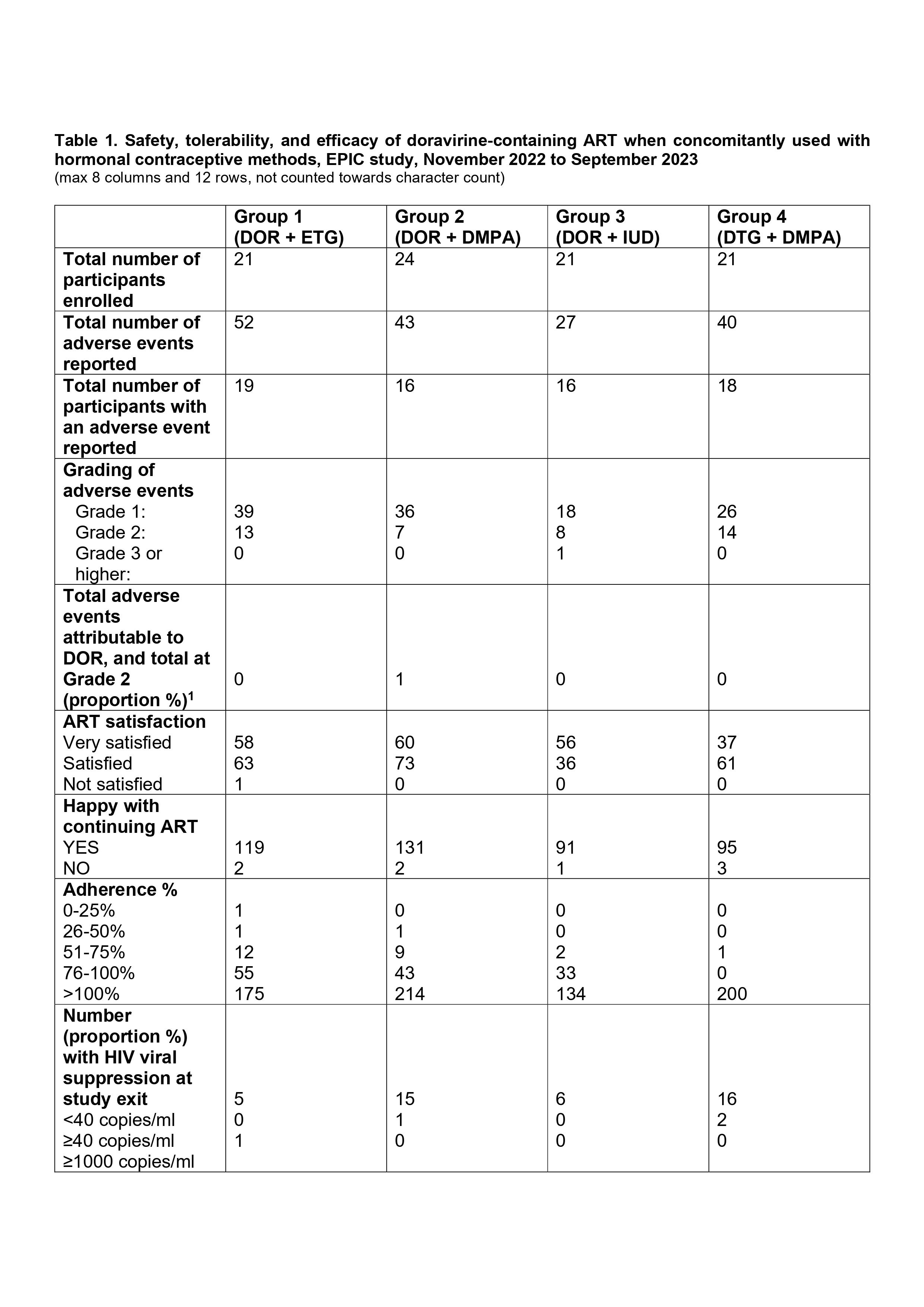
Of 155 women screened, 87 have been enrolled: Group 1 (n=21), Group 2 (n=24), Group 3 (n=21) & Group 4 (n=21). The most common reasons for ineligibility were lack of HIV aviraemia (n=43, 74%) and/or haemoglobin abnormality of grade 2 or higher (n=13; 22%) at screening. Of all AEs reported to date (n=162), 13 (8%) were attributable to DOR, of which headaches (n=4, 2%) or nausea (n=2, 1%) were most frequent. All AEs were reported at grade 1, except for one AE of diarrhoea in Group 2 at grade 2. Among the DOR groups, only 1 participant reported dissatisfaction with this ART, 99% were happy to continue it, and adherence by pill count was 96% for >76% adherence. All but 2 participants (7%) in the DOR groups maintained viral suppression at study exit.
Conclusions:
Switching from first-line regimens to DOR-containing ART appears to be safe, tolerable, and efficacious in maintaining viral suppression in South African women concomitantly using hormonal contraceptives. These data support the viability of this option for those living in resource-limited settings who are intolerant of or unable to take dolutegravir-containing ART.
Table 1. Safety, tolerability, and efficacy of doravirine-containing ART when concomitantly used with hormonal contraceptive methods, EPIC study, November 2022 to September 2023