Background:
People with HIV are at greater risk for cardiovascular disease compared with those without HIV, and this risk may be further elevated in women with HIV (WWH). We examined 8 circulating cardiac, metabolic or inflammatory biomarkers in women with or at risk for HIV with echocardiographic data, and assessed whether these markers are associated with cardiac dysfunction.
Methods:
Eligible participants from 3 Women’s Interagency HIV Study (WIHS) sites underwent transthoracic echocardiography between 2014-2018 and had the following serum biomarkers measured: NT-proBNP, high-sensitivity troponin I (hsTnI), soluble ST2 (sST2), non-esterified free-fatty acids (NEFA), C-reactive protein (hsCRP), interleukin-6 (IL-6), soluble CD14 (sCD14) and growth/differentiation factor-15 (GDF-15). Outcomes included left ventricular (LV) systolic dysfunction (LV ejection fraction < 54%), isolated LV diastolic dysfunction (ASE 2016 definition) and pulmonary hypertension (peak tricuspid regurgitation velocity >2.8 m/s). Biomarkers were log2-transformed and Z-score standardized, and modified Poisson regression models produced prevalence ratios (PRs) for associations with each outcome, adjusted for demographic, behavioral and cardiometabolic factors.
Results:
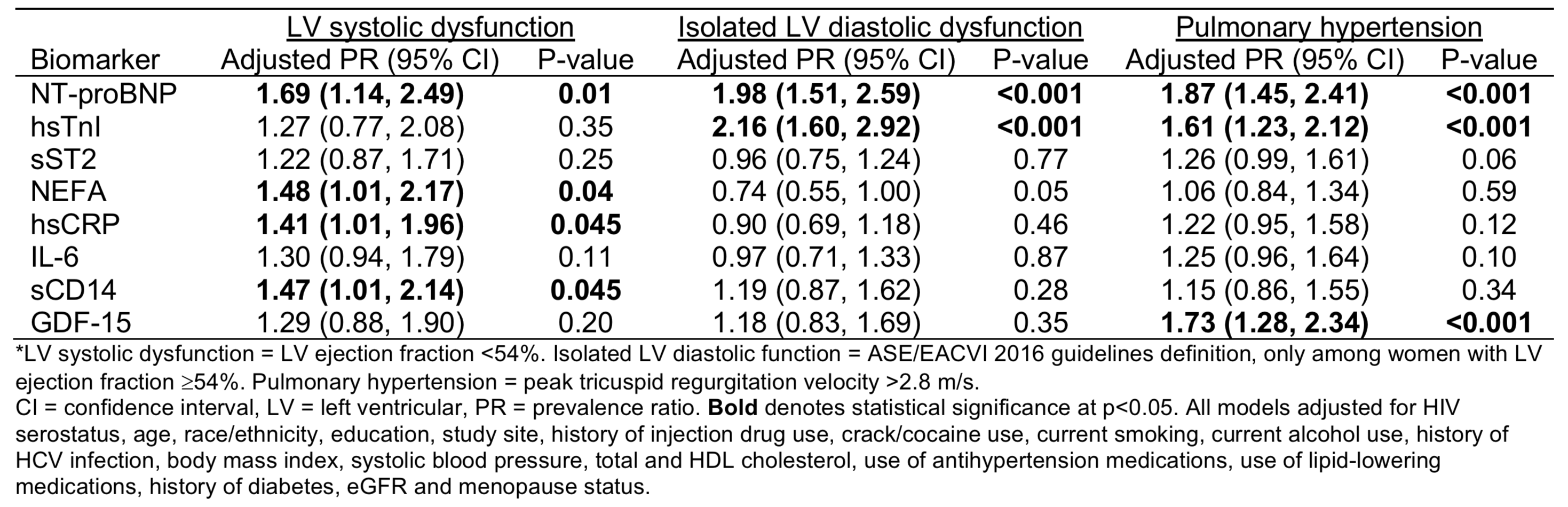
Data were available for 709 women (68% WWH, median age 52 years, 65% black, 22% Hispanic, 40% smokers). Among WWH, median CD4+ count was 649 cells/uL (IQR 442-869), 93% reported ART use and 69% had HIV viremia < 20 cp/mL. Prevalence was 6% in WWH and 4% without HIV for LV systolic dysfunction, 9% and 8% for isolated LV diastolic dysfunction, and 12% and 9% for pulmonary hypertension. Compared with women without HIV, WWH had higher levels of sCD14 (median 1,792 vs 1,539 ng/mL) and GDF-15 (median 1,069 vs 697 pg/mL, both p< 0.001), with a stepwise gradient by CD4+ count category. In adjusted analyses (Table), higher NT-proBNP levels were significantly associated with each outcome, while NEFA, hsCRP and sCD14 levels were associated with LV systolic dysfunction only, and GDF-15 with pulmonary hypertension only. hsTnI was associated with both isolated LV diastolic dysfunction and pulmonary hypertension, and these associations were more pronounced among WWH than women without HIV (e.g., pulmonary hypertension: WWH PR 1.88, 95% CI 1.35-2.62; without HIV PR 1.46, 95% CI 0.95-2.24).
Conclusions:
We identified previously unreported associations of several key cardiac biomarkers with cardiac dysfunction, including more pronounced associations of troponin I among WWH.
Associations of circulating biomarkers with cardiac dysfunction*, per Z-score unit.