Background:
On 23-Jul-2022 the World Health Organization (WHO) declared the global mpox outbreak a public health emergency, characterized by person-to-person contact and disproportionately affecting gay and bisexual men who have sex with men (gbMSM). In British Columbia (BC), 190 mpox cases were reported between June and December 2022. We describe mpox cases in BC’s population-level HIV treatment (Tx) and PrEP programs.
Methods:
We included adults aged ≥19 years, enrolled in the BC HIV Tx or PrEP programs who had program contact (based on drug dispensing and lab test results) on or after 1-May-2022. Mpox testing results reported between 1-Jun-2022 and 31-Dec-2022 were included. Mpox testing and cases over time, and client demographic and clinical characteristics are described.
Results:
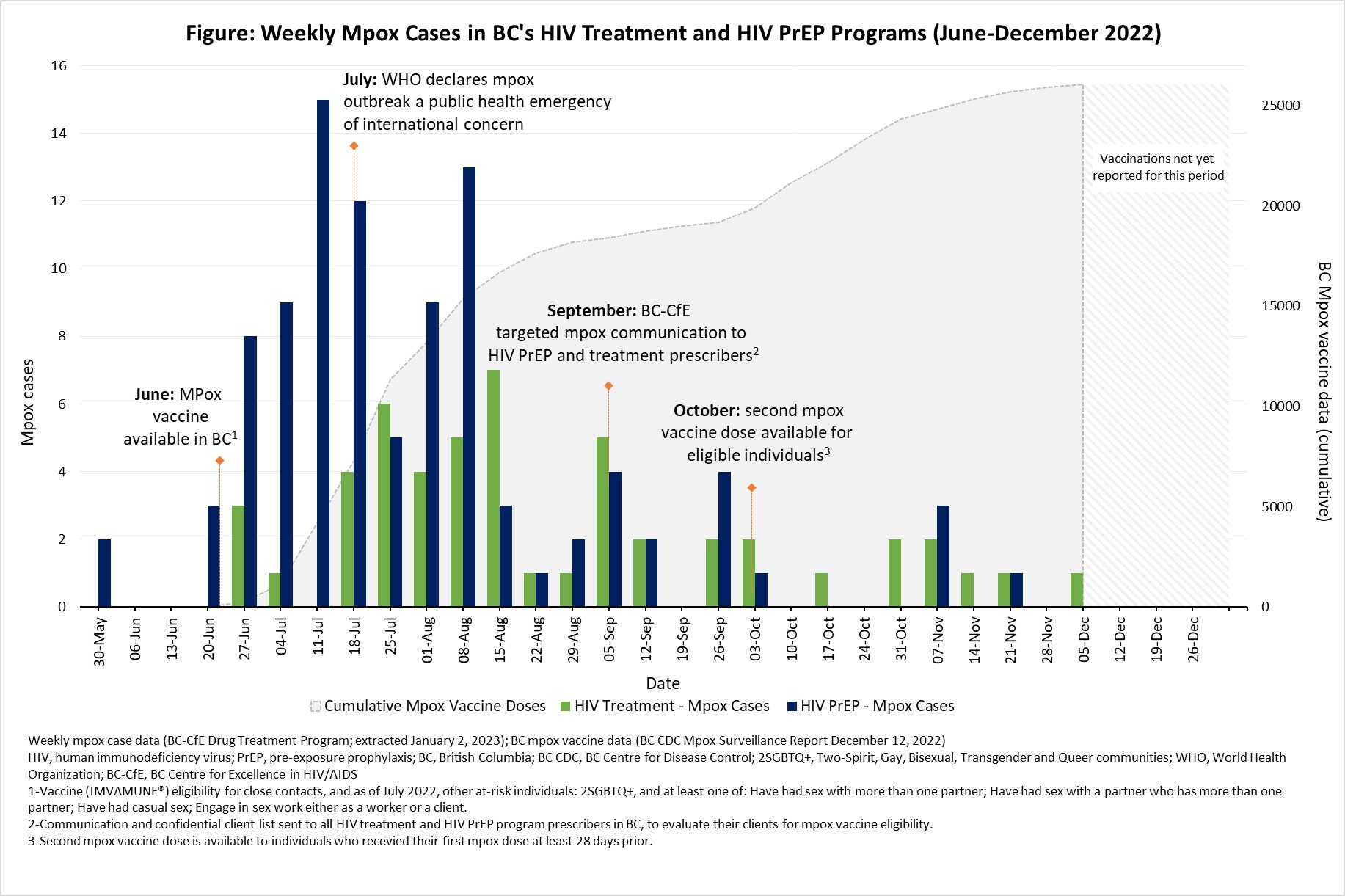
Of 16,471 program clients, a total of 148 (0.9%) mpox cases were diagnosed, including 51/8247 (0.6%) HIV Tx clients and 97/8224 (1.2%) PrEP clients. All mpox cases were cis-gender male, 87% were known gbMSM (risk group unreported in 13%), 99% were diagnosed in an outpatient or emergency room setting, and 84% resided in the populous Vancouver Coastal Health Authority. The median age of mpox cases was 42 years (Q1-Q3, 35-51) in HIV Tx and 36 years (Q1-Q3, 31-42) in PrEP (p< 0.001). Of HIV Tx mpox cases, the median CD4 count was 665 cells/mL (Q1-Q3, 450-920), two had CD4 count < 200 cells/mL, and based on dispensing records, 50/51 were on antiretroviral therapy at the time of mpox diagnosis (92% on INSTI-based regimens). Three clients were diagnosed with mpox within 6 days of a new HIV diagnosis. Overall, mpox testing was performed in 533 clients (166 HIV Tx and 367 PrEP), with testing frequency and % specimen positivity highest between July and September 2022, and 81% of mpox cases diagnosed during this period. A subsequent decline in infections has been observed thereafter (See Figure).
Conclusions:
A high proportion of mpox cases in BC were prescribed HIV PrEP, consistent with overlapping risk behaviour and eligibility criteria for HIV PrEP with mpox transmission and vaccine eligibility. A smaller proportion of the more heterogeneous HIV Tx clients was similarly affected by mpox. The decline in mpox cases suggests a potential impact of mpox vaccine uptake and/or altered client behaviour. Cases of concurrent diagnosis of HIV and mpox emphasize the importance of screening for sexually transmitted infections, including HIV, in persons being evaluated for mpox.
Figure: Weekly Mpox Cases in BC’s HIV Treatment and HIV PrEP Programs (June-December 2022)