Background:
One-quarter of all Veterans with HIV (VWH) – and three-quarters of rural VWH – live more than an hour’s drive from the nearest HIV clinic in the Veterans Administration (VA). Rural VWH who do not receive HIV care have suboptimal outcomes across the continuum of HIV care. In response, the 2014 Veterans Choice Act was enacted to expand healthcare access, which is purchased by the VA but provided by non-VA providers. Our objective was to examine the geospatial distributions of non-VA visits and detectable HIV viral load, and their associations with distance from the Atlanta VA Medical Center (AVAMC) among VWH.
Methods:
Veterans diagnosed with HIV after August 1, 2014, who have had >1 visit at the AVAMC since September 15, 2020, and who reside in Georgia were included. Non-VA visits include any healthcare purchased by the VA and provided by a non-VA provider. Detectable HIV viral load was defined as ≥50 copies/mL on the most recent measurement in the past two years. The average number of non-VA visits per year and the standardized prevalence ratio (SPR) of detectable HIV viral load were mapped by county. Spatial heterogeneity was assessed by chi-square tests. Data were fitted to Poisson regression models to estimate their associations with geodesic distance between each county and the AVAMC.
Results:
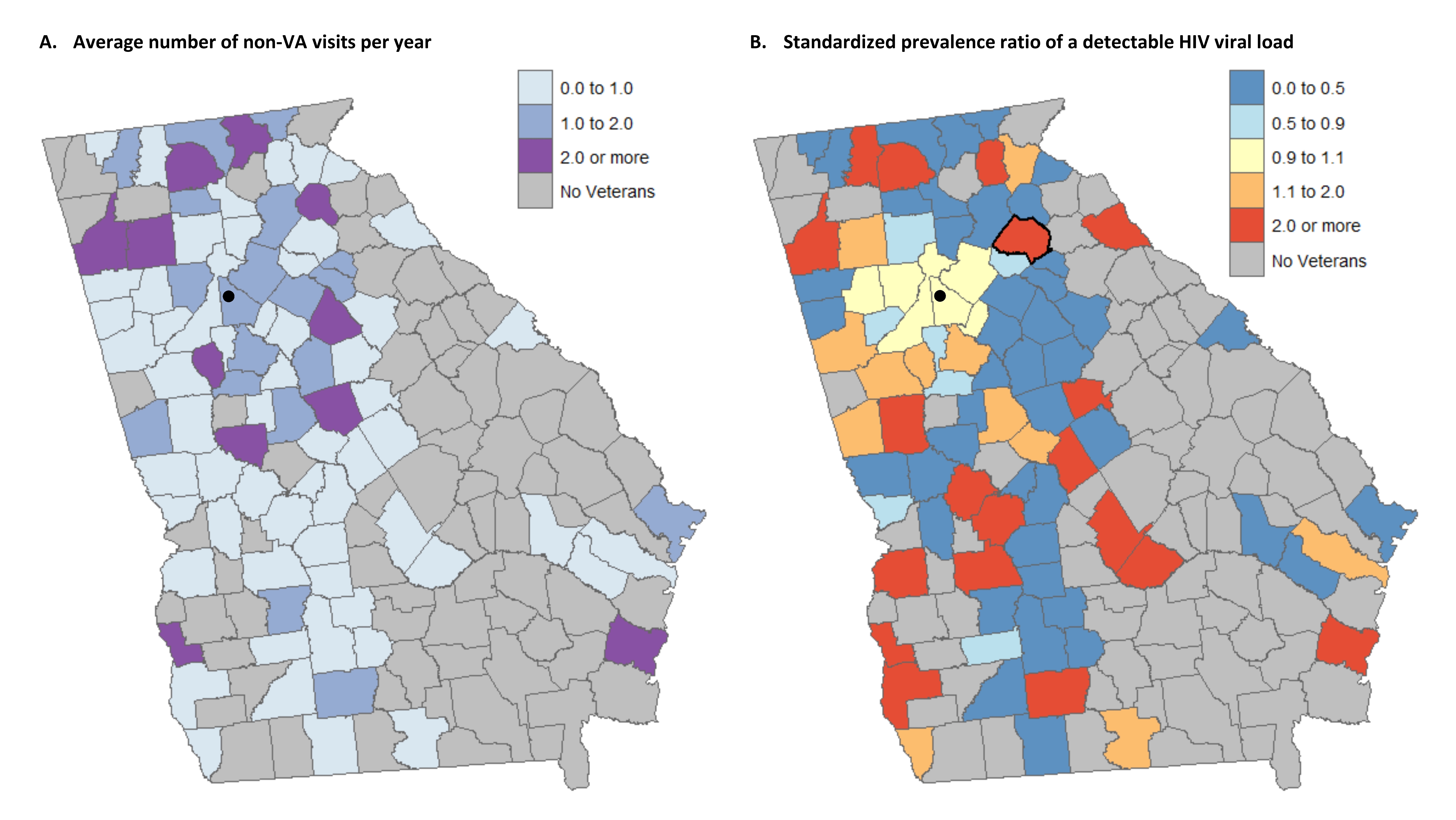
1,588 VWH met the inclusion criteria; of whom, 279 (18%) had a detectable HIV viral load. The number of non-VA visits exhibited significant spatial heterogeneity (χ2=2030, p=0.002). VWH who reside outside of but surrounding Atlanta appear to have the highest average number of non-VA visits per year. However, for every 25-mile increase, it is estimated that the average number of non-VA visits decreases by 1.7 (p< 0.001). The SPR of detectable HIV viral load varied considerably but was statistically insignificant (χ2=91, p=0.312). The observed prevalence of detectable HIV viral load is between two- and six-fold greater than what is expected in many parts of rural Georgia (e.g., SPR=4.3 in Jackson County, p=0.034). However, for every 25-mile increase, it is estimated that the number of detectable HIV viral load decreases by 1.5 (p< 0.001).
Conclusions:
VWH who reside in counties adjacent to the Atlanta metro area are more likely to receive non-VA healthcare, likely due to the >40-mile eligibility requirement and availability of such care. Non-VA healthcare may be less accessible in rural Georgia due to fewer resources and unaccounted socioeconomic factors. Telemedicine may be able to bridge this gap.
Figure 1. Geospatial distribution of non-VA purchased care visits and detectable HIV viral loads among Veterans with HIV who reside in Georgia and receive care at the Atlanta VA Medical Center, 2020-2022. Data are limited to Veterans diagnosed with HIV after the enactment of the Veterans Choice Act in August, 2014, and who have had at least one HIV viral load test in the past two years. A. Average number of non-VA purchased care visits per year since HIV diagnosis; the purpose and type of care received during these visits vary. B. Standardized prevalence ratio of a detectable HIV viral load between September 15, 2020 and September 15, 2022; a HIV viral load of < 50 copies/mL was considered undetectable; dark boundaries denote a statistically significantly higher standardized prevalence ratio than expected. No Veterans with HIV who met the inclusion criteria lived in counties that are grey in color.