Background:
Nucleos(t)ide reverse transcriptase inhibitors (N(t)RTIs) are anabolized to their active forms within multiple cell types, but data have been primarily focused on red blood cells, dried blood spots (DBS) and peripheral blood mononuclear cells (PBMCs) to date. Understanding the extent to which N(t)RTIs accumulate in other major blood cells may inform clinicians’ understanding of ART efficacy and toxicity, such as cardiometabolic effects. We examined the cell pharmacology and platelet effects of abacavir (ABC)/lamivudine (3TC) and tenofovir alafenamide (TAF)/emtricitabine (FTC) in persons with HIV (PWH). Here, we aimed to establish TFV-diphosphate (DP) and FTC-triphosphate (TP) concentrations in different cell types and compare them with historical data in persons without HIV (PWOH).
Methods:
PWH receiving TAF 25mg/FTC 200mg as part of clinical care with HIV VL < 200 c/mL for ≥6 months prior to entry were eligible (NCT04301661). Adherence was confirmed using video directly observed therapy (vDOT) for 28±3 days prior to PK sample collection (2±1 hrs post-dose). Whole blood was processed into DBS, PBMCs, platelets, and neutrophils. LC-MS/MS methods were used to quantify TFV-DP and FTC-TP across all cell types in addition to the mono (MP)- and DP fractions in platelets. Data in PWOH originated from TAF-DBS (NCT02962739). Cellular concentrations by HIV status were compared using linear regression models.
Results:
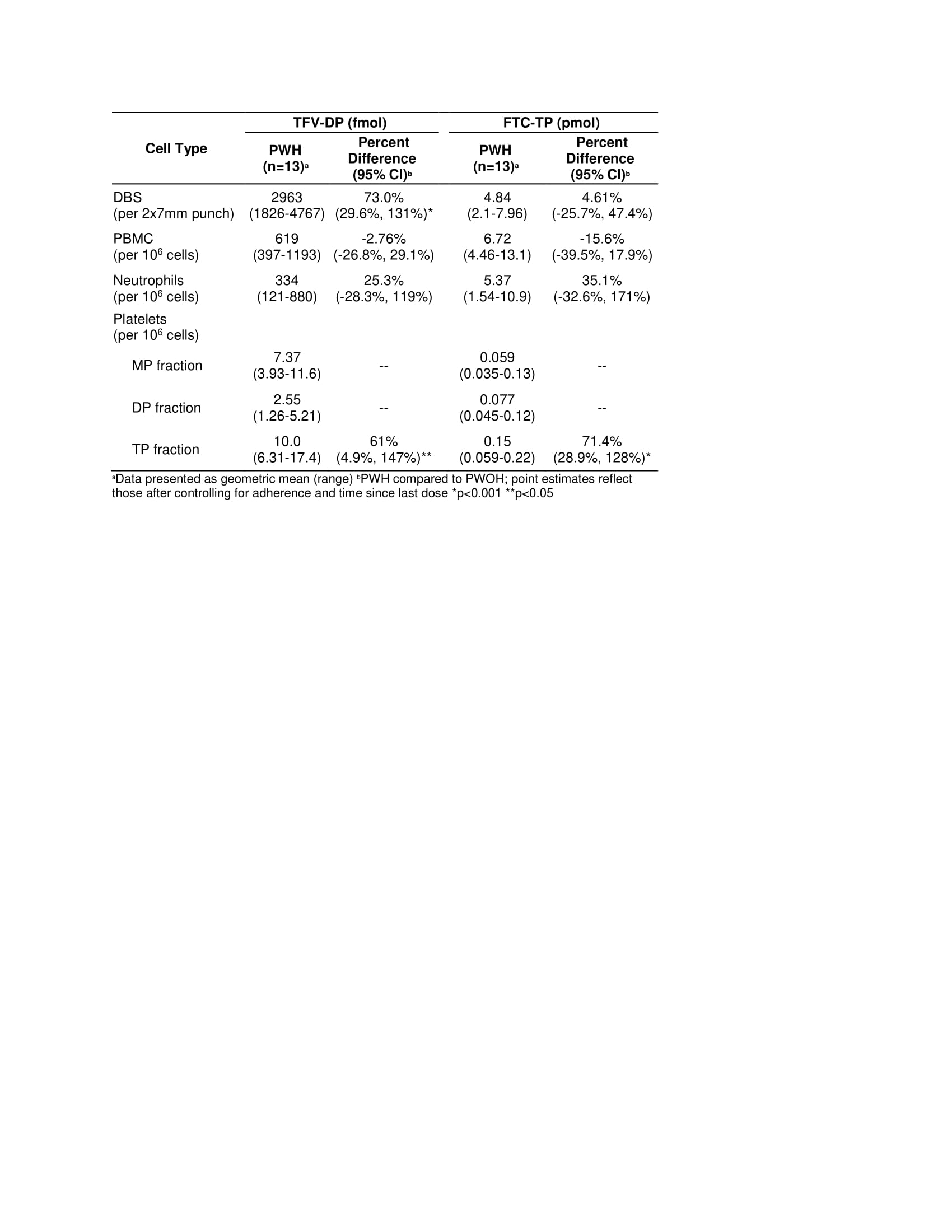
13 PWH were enrolled in the TAF/FTC cohort (12 male; 8 white, 2 black, 3 other; 4 Hispanic/Latino; median (range) age and weight of 42 (26-64) years and 74.2 (58.3-116.7) kg). Median (range) 4-week vDOT adherence was 96% (76-100%). Historical data were available in 31 PWOH (median [range] age 29 [18-41] years and weight 76.3 [56.7-118.2] kg). Cellular concentrations by cell type are summarized in the table. Within platelets, TFV-DP >TFV >TFV-MP and FTC-TP >FTC-DP >FTC-MP. TFV-DP in DBS and platelets were 73% higher and 61% higher, respectively, and FTC-TP in platelets were 71% higher in PWH vs. PWOH. No other differences were identified.
Conclusions:
Higher TFV-DP in DBS is consistent with previous studies in PWH, but higher TFV-DP and FTC-TP concentrations in platelets suggests an undescribed difference in cell-specific physiology in PWH. The mechanism behind this differential accumulation warrants further investigation. Cellular data with ABC/3TC and comparisons of metabolic effects in platelets may help provide further insight into intracellular processes.
TAF-FTC Anabolites by Cell Type in PWH & comparisons to PWOH