Background:
In 2019, the World Health Organization (WHO) recommended dolutegravir (DTG) as the preferred drug for first- and second-line antiretroviral therapy (ART) among all people with HIV (PWH), including pregnant women and those of childbearing age. DTG has a high genetic barrier to resistance, but PWH with resistance to nucleoside reverse-transcriptase inhibitors (NRTIs) who are on (functional) DTG dual- or mono-therapy, and those experiencing challenges adhering to ART, may be at particular risk of DTG resistance.
Methods:
We pooled data from six European (ATHENA, The Netherlands; Aquitaine cohort, France; Cologne Cohort, Germany; ICONA, Italy; SHCS, Switzerland; UK CHIC, UK), one North American (S Alberta HIV Clinic , Canada) and one South African (AID for Aids) cohort to identify PWH who underwent genotypic resistance testing (GRT) while on DTG-based ART. Drug resistance levels and drug resistance mutations (DRMs) were identified using the Stanford algorithm. We assessed associations with DTG resistance using uni- and multivariable ordinal logistic regression, including covariables age, sex, HIV subtype, ART regimen, time on DTG, exposure to integrase strand transfer inhibitors (INSTIs), area under the viral load curve (AUC) and testing frequency, and resistance to RTIs.
Results:
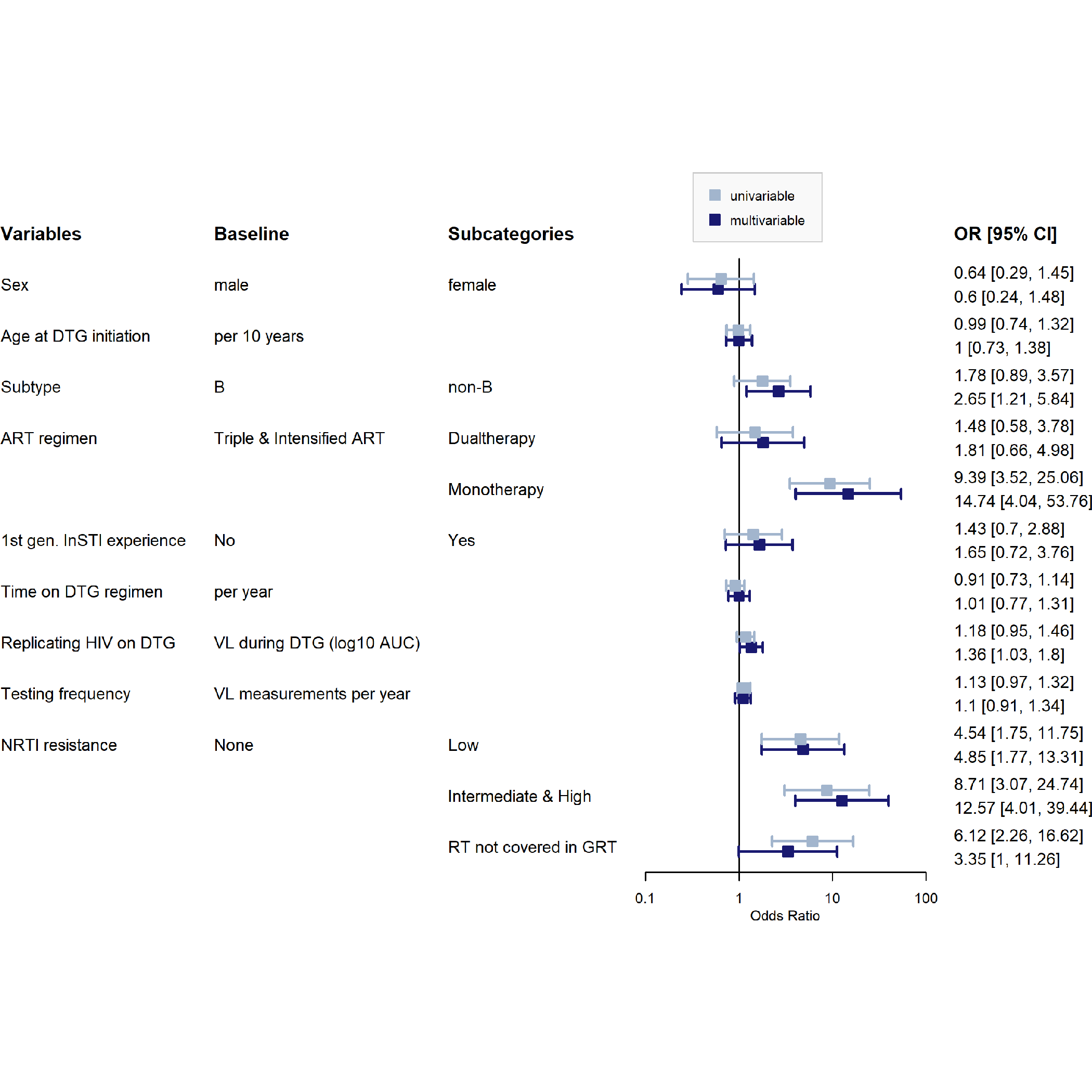
Among 728 eligible PWH most were from European cohorts (628, 86.3%), men (534, 69.8%) and had HIV subtype B (456, 59.6%). Median time on DTG-based ART was 1.7 years (IQR 0.7 – 3.2); 284 (39.0%) had resistance to RTIs. Ninety-eight (13.5%) had INSTI DRMs with: 8 potential low; 6 low; 19 intermediate; and 6 high resistance levels. DTG monotherapy and NRTI resistance were strongly associated with DTG resistance (Figure). There was some evidence that non-B subtype might be associated with DTG resistance.
Conclusions:
DTG resistance is rare in PWH failing on a DTG-based ART regimen. It might become a problem with the global scale-up of DTG, particularly in low- and middle-income countries where pre-existing drug resistance is more common, and where individuals remain longer on failing regimens and are switched to DTG without viral load or resistance testing. Global surveillance of DTG resistance is essential. The mutational pathways require further investigation.
Uni- and multivariable ordinal logistic regression models for genotypic DTG resistance levels in PLHIV on DTG-based ART. PLHIV with more than one year of clinical data available prior to the GRT were included (N = 653).