Background:
Recent reports describe the reemergence of HHV8-induced Kaposi sarcoma (KS) in people living with HIV (PLWH) despite efficient antiretroviral therapy (ART). We aimed to assess the influence of immunological and virological factors in the development of KS in ART-treated PLWH compared to HIV-uninfected people with classic KS.
Methods:
4 groups of 11 participants were compared: 1. ART-treated PLWH with KS (KS HIV+), 2. Age-matched ART-treated PLWH without KS (HIV+), 3. HIV-uninfected patients with classic KS (KS HIV-), 4. Age-matched HIV-uninfected people without KS. We assessed CD4/CD8 ratios, circulating cytokines by ELISA multiplex, anti-HHV-8 IgG levels with an in-house cell-based assay, anti-HHV-8 specific T-cells by ELISPOT, and circulating and skin T-cells phenotypes by flow cytometry. HHV-8 viral loads (VL) were quantified by digital-droplet PCR and next-generation sequencing was performed.
Results:
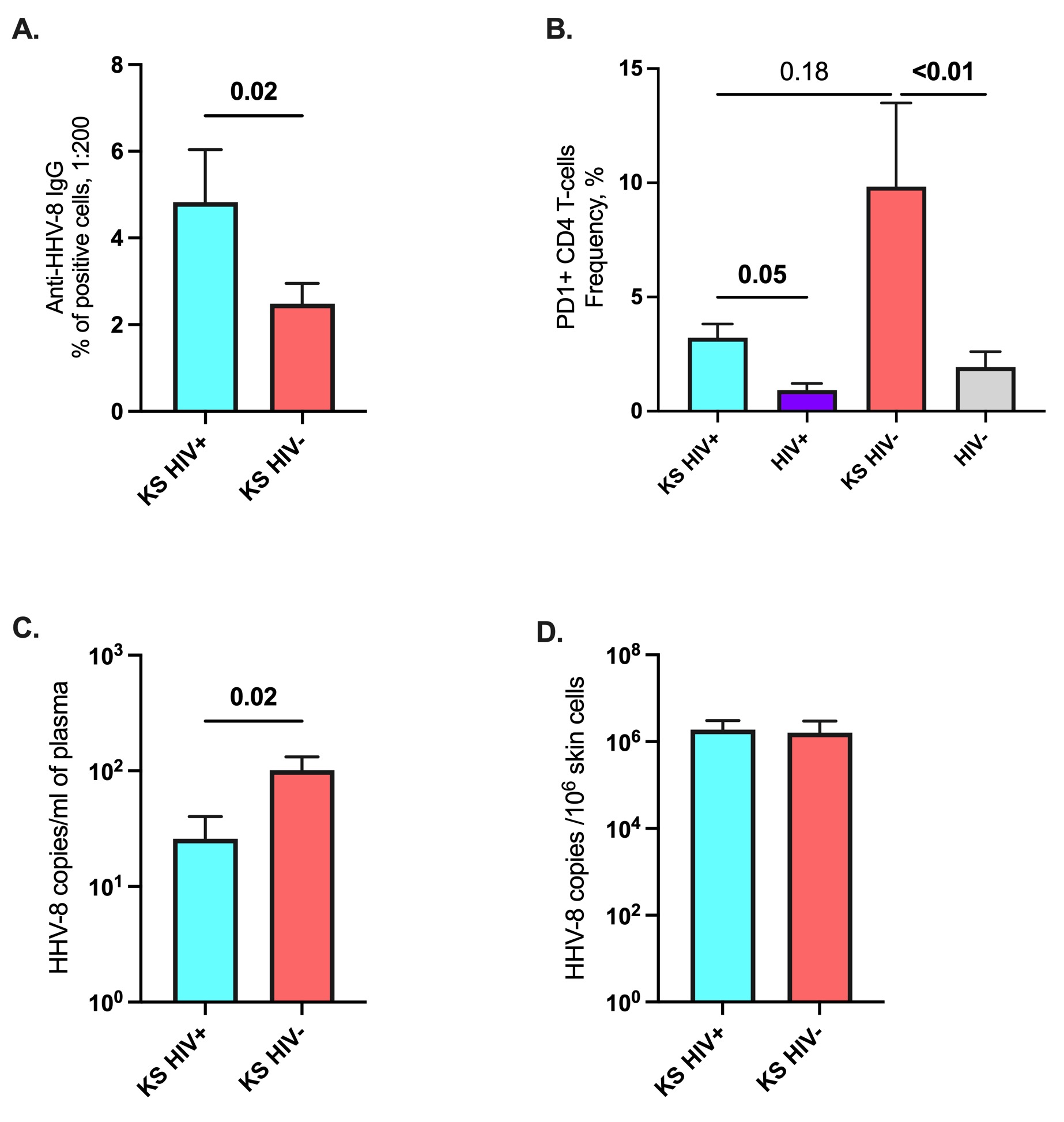
All KS participants presented with limited skin disease. KS HIV+ were younger than KS HIV- (53 vs 75yo, p< 0.01). CD4/CD8 ratios were lower in KS HIV+ compared to KS HIV- (p=0.01) and to HIV+ (p< 0.05). In KS HIV+, anti-HHV-8 IgG levels were higher compared to KS HIV- (p=0.02, Figure 1) and frequency of specific T-cells was low but similar. Circulating and tissular CD4 T-cells of both KS HIV+ and KS HIV- expressed a similarly high frequency of senescence markers (CD57+/CD28-) and PD1, higher than their own control group. Among cytokines, IL-10 levels were higher only in KS HIV- (p=0.02). HHV-8 VL were lower in KS HIV+ than in KS HIV- in plasma (p=0.02) and PBMCs (p=0.04), but were similar in skin biopsies. HHV-8 genetic subtypes A and C were similarly isolated in both KS groups, and a newly identified variant was found in two KS HIV- Inuit patients from Northern Canada.
Conclusions:
Compared to age-matched PLWH, ART-treated PLWH with KS exhibited features of early immune senescence, with a lower CD4/CD8 ratio and increased frequency of CD57+/CD28- T-cells. Despite the younger age, senescent T-cells frequency was similar among KS HIV+ and KS HIV-. However, anti-HHV8 IgG levels were higher in KS HIV+ compared to KS HIV-, which was associated with lower circulating HHV-8 DNA and IL-10 levels. Although HHV-8 strains did not significantly differ between groups, we could isolate a new HHV-8 variant. Altogether, early immune senescence/exhaustion seems involved in the development of KS in ART-treated PLWH. Such insights will help developing therapeutical strategies to reduce KS-induced stigma.
Figure 1