Background:
Diagnosis of tuberculosis (TB) in people with HIV (PWH) with significant immunosuppression remains a challenge. Integration of flow cytometry, cytokine, and gene expression data is a promising approach for developing diagnostic TB biomarkers but such “multi-omic” analysis remains poorly explored.
Methods:
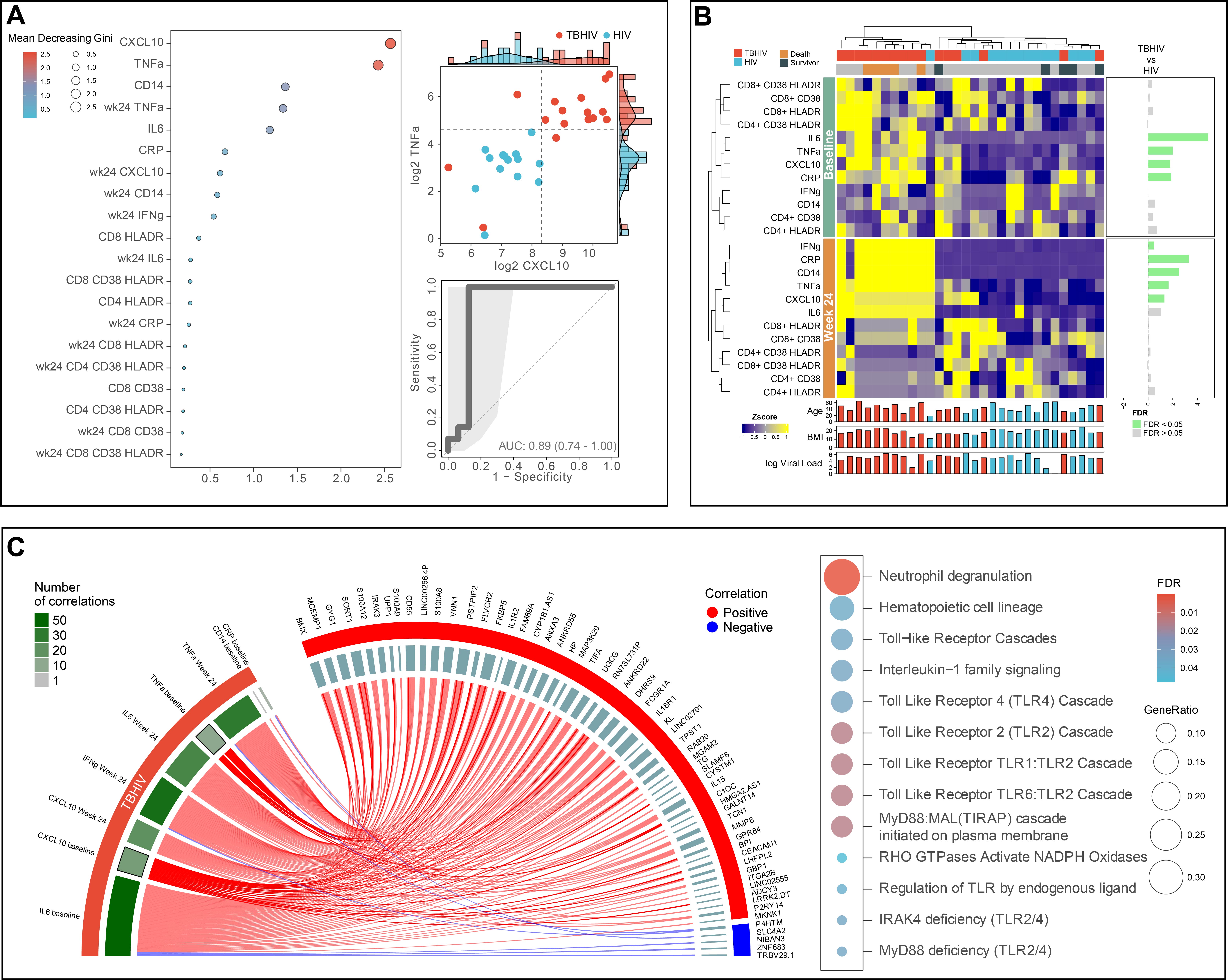
We enrolled 30 adults with advanced HIV(CD4< 100cells/mm3) in India; 16 with microbiologically confirmed active pulmonary TB and 14 without. Transcriptomics (RNA-seq), flow cytometry to track T-cell (CD4+/CD8+) activation markers (CD38/HLA-DR), and Luminex-based measurement of plasma cytokines/chemokines performed at baseline and week 24 of anti-TB therapy. Comparisons between HIV and TBHIV groups performed using the Mann-Whitney U test. Feature selection analysis with a random forest algorithm was employed to determine the most predictive variables for classification of HIV and TBHIV. Accuracy was depicted using c-statistics. Associations between measurements of biomarkers in different assays were assessed using Spearman correlation networks defined with False Discovery Rate < 0.05.
Results:
Comparison between HIV and TBHIV did not show significant differences in the expression of CD38+HLADR+ on CD4+/CD8+ T-cells. Levels of CRP, CXCL10, IL6, CD14, and TNF were higher in TBHIV at baseline and week 24. Baseline levels of CXCL10 and TNF accurately identified TB cases with an AUC of 0.89. Age, BMI, and Viral load values did not directly influence cytokine levels. While examining relationships between protein, cellular markers, and overall profile of gene expression, we noted only TBHIV group exhibited statistically significant correlations. Pathway enrichment analysis uncovered a variety of processes associated with innate immunity, such as neutrophil degranulation and toll-like receptor cascades, hallmarked the transcriptional profile of TBHIV but not in HIV without TB(Fig1).
Conclusions:
Circulating levels of TNF and CXCL10 are uniquely distinct among PWH with advanced disease with or without TB coinfection both at baseline and week 24 of anti-TB therapy. Integrative multi-omic analysis suggests a distinctive inflammatory profile is linked to the activation of key processes related to innate immunity. Major contributions of the findings presented are twofold as they (i) reveal parsimonious biomarker signatures highly accurate in identifying TB cases among PWH with advanced disease (ii) underscore biologic pathways that may further explore as therapeutic targets to reduce disease severity.
IMMUNE OMIC PROFILES TO DISTINGUISH TUBERCULOSIS AMONG ADVANCED HIV ADULTS IN INDIA