Background:
Inequities across the HIV care continuum persist between non-Hispanic Black and white men who have sex with men (MSM) in the US, due partly to structural barriers, systemic racism, and stigma. We examined the impact of diagnostic testing, engagement in care, and virologic suppression (VS) rates on life expectancy (LE) among non-Hispanic Black MSM (BMSM) and white MSM (WMSM) with HIV.
Methods:
Using the validated CEPAC microsimulation HIV model, we projected LE among BMSM and WMSM who acquire HIV under simulated Status Quo HIV care conditions. Status Quo HIV care was modeled using race-stratified 2019 data from the Centers for Disease Control and Prevention and estimates of: 1) average age at HIV infection (BMSM: 26.8y, WMSM: 35.0y), 2) average HIV testing frequency (BMSM: every 4.9y, WMSM: every 4.1y), 3) percent of time engaged in care for the 5y after diagnosis (BMSM: 75.2%, WMSM: 80.6%), and 4) percent of time with VS while in care after ART initiation (BMSM: 82.0%, WMSM: 91.2%). To account for non-HIV-related mortality, we adjusted national race-stratified life tables for increased tobacco-related mortality, given the high prevalence of tobacco use among MSM with HIV. We conducted sensitivity analysis by varying HIV testing frequencies (6m; annually; 6y), engagement in care (75%-95%), and VS (75%-95%).
Results:
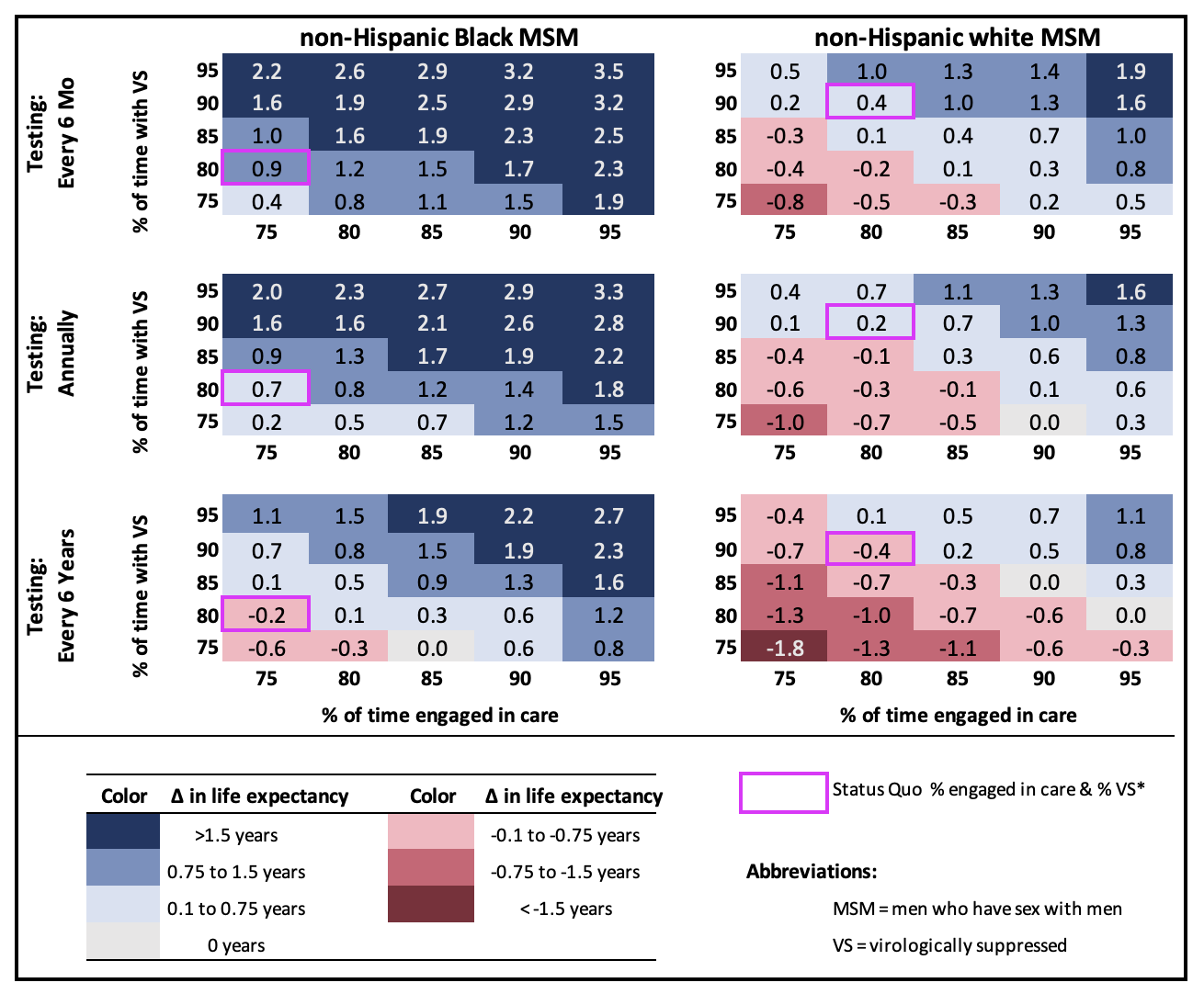
Among MSM who acquire HIV, average age at diagnosis was 30.3y for BMSM and 38.3y for WMSM. We projected LE to be 67.2y (BMSM) and 73.5y (WMSM) with Status Quo care. In sensitivity analysis (Figure 1), BMSM would gain 0.7 or 0.9 life years (LY) if testing frequency improved to annually or every 6 months, respectively (assuming Status Quo engagement in care and VS); WMSM were projected to gain 0.2 or 0.4LY, respectively. If testing frequency decreased to every 6 years, LE would decrease by 0.2LY among BMSM and 0.4LY among WMSM. When increasing both engagement in care and VS levels to 95% (“95-95”), BMSM would gain 3.3LY (annual testing) or 3.5LY (6m testing), whereas WMSM would gain 1.6LY (annual testing) or 1.9LY (6m testing) compared to LE under Status Quo care.
Conclusions:
Projected LE for Black MSM with HIV is substantially lower than white MSM with HIV, but inequities decline with improved HIV testing, engagement in HIV care, and VS for Black MSM. Our findings highlight the need for an equity-driven approach to HIV care interventions around testing and engagement in care.
Figure 1: Model-projected differences in life expectancy (LE, years) from Status Quo care with variation in diagnostic testing frequency, % engagement in care, and % virologic suppression (VS) among non-Hispanic Black MSM (left) and white MSM (right) with HIV. Dark blue represents greater increase in LE; darker red represents greater decrease in LE. *Status Quo levels: engagement in care (BMSM: 75.2%, WMSM: 80.6%); VS (BMSM: 82.0%, WMSM: 91.2%). Status Quo testing frequency is not shown in the figure (BMSM: every 4.9y; WMSM: every 4.1y).