Background:
Skeletal muscle quality and mass are critically important for maintaining physical function during advancing age. We leveraged baseline data from REPRIEVE to evaluate whether paraspinal muscle density (MD) and muscle area (MA) are associated with cardiac or physical function outcomes in people with HIV (PWH).
Methods:
REPRIEVE is a double-blind randomized trial evaluating the effect of pitavastatin for primary prevention of coronary artery disease (CAD) in PWH. This cross-sectional analysis focuses on participants who underwent coronary CT at baseline. Lower thoracic paraspinal MD (Hounsfeld units, HU) and MA (cm2) were assessed on non-contrast CT image. MA was divided by height to allow examination of associations across various body sizes (MA/HT). Physical function was standardized by maximum performance. Associations between muscle measures (risk factors) and baseline coronary CT and physical function measures (outcomes) were evaluated using log-binomial regression and linear regression models adjusted for age, sex, and body mass index (physical function only).
Results:
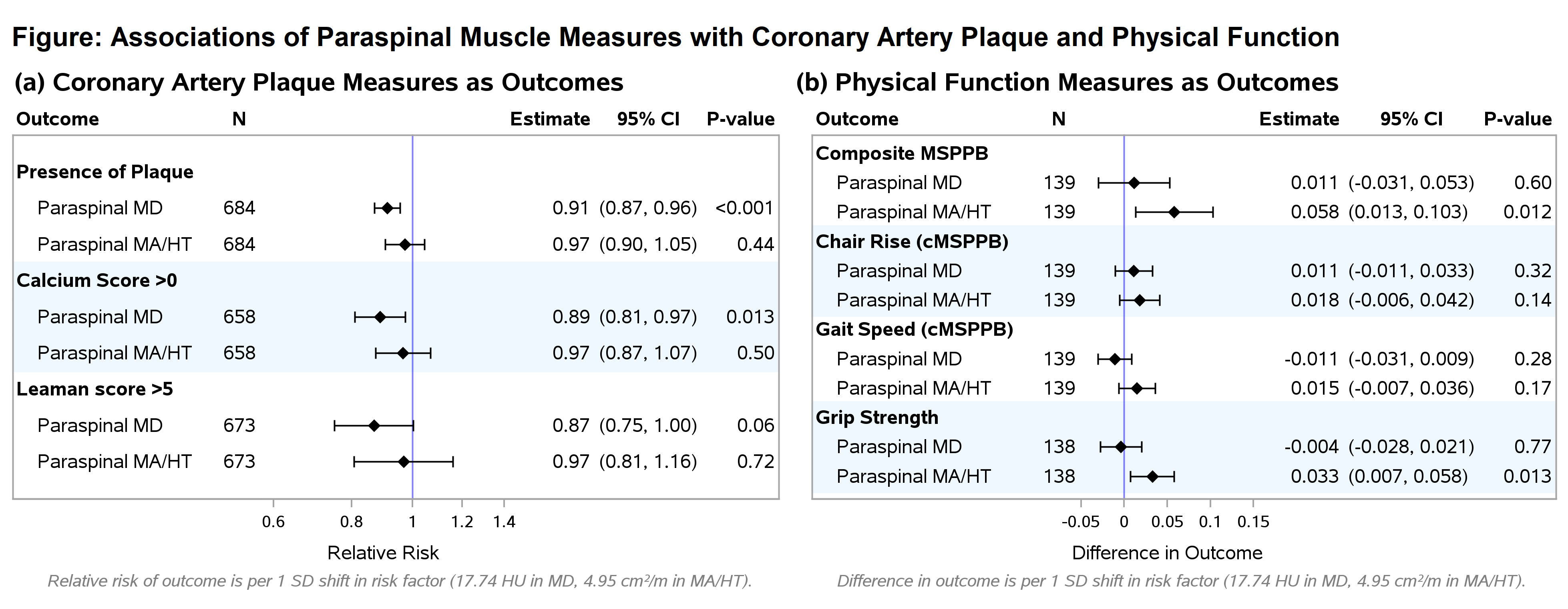
Of 805 PWH, 708 had paraspinal measurements. Median age was 51 (Q1, Q3: 46, 55) years; 17% were natal female, 53% White, 36% Black, and 25% Hispanic. The median MD was 41 (31, 49) HU in males and 30 (16, 39) HU in females, and MA/HT 13.2 (9.4, 16.3) cm2/m in males and 9.9 (7.5, 13.2) cm2/m in females. In adjusted analyses, higher MD (less fat) was associated with lower prevalence of coronary artery plaque, lower prevalence of coronary artery calcium score >0, and lower prevalence of high plaque burden (Leaman score >5; p=0.06), while MA/HT was not associated with cardiac measures (Figure panel a). Among the 139 with baseline physical function measures, greater MA/HT was associated with better performance on a short physical performance battery and grip strength, while no associations between MD and physical function measures were apparent (Figure panel b).
Conclusions:
Higher MD (less fat) was associated with lower prevalence of CAD, while higher MA was associated with better physical performance in PWH. Whether changes in muscle fat or area (especially if associated with pitavastatin) are associated with changes in CAD or improved physical performance will be evaluated as part of the REPRIEVE longitudinal analyses.