Background:
Cytomegalovirus (CMV) infection is associated with poor outcomes, including physical function impairment, in people without HIV. We examined associations of CMV IgG antibody titers with physical function and muscle quality/quantity in virologically suppressed middle-aged people with HIV (PWH), leveraging REPRIEVE baseline data.
Methods:
REPRIEVE is a double-blind randomized trial evaluating pitavastatin for primary prevention of cardiovascular disease in PWH. This cross-sectional analysis focuses on participants enrolled in a substudy with additional biomarker testing and imaging at study entry. CMV IgG was measured in duplicate using the human CMV IgG enzyme immunoassay by Genway Biotech. Paraspinal muscle area (MA) and density (MD) were assessed on non-contrast CT. Physical function and frailty were obtained by Short Physical Performance Battery (SPPB), a modified version (mSPPB) and the Fried Frailty Phenotype, respectively. Associations between CMV IgG (risk factor) and outcomes were evaluated using partial Spearman correlation, and linear and log-binomial regression.
Results:
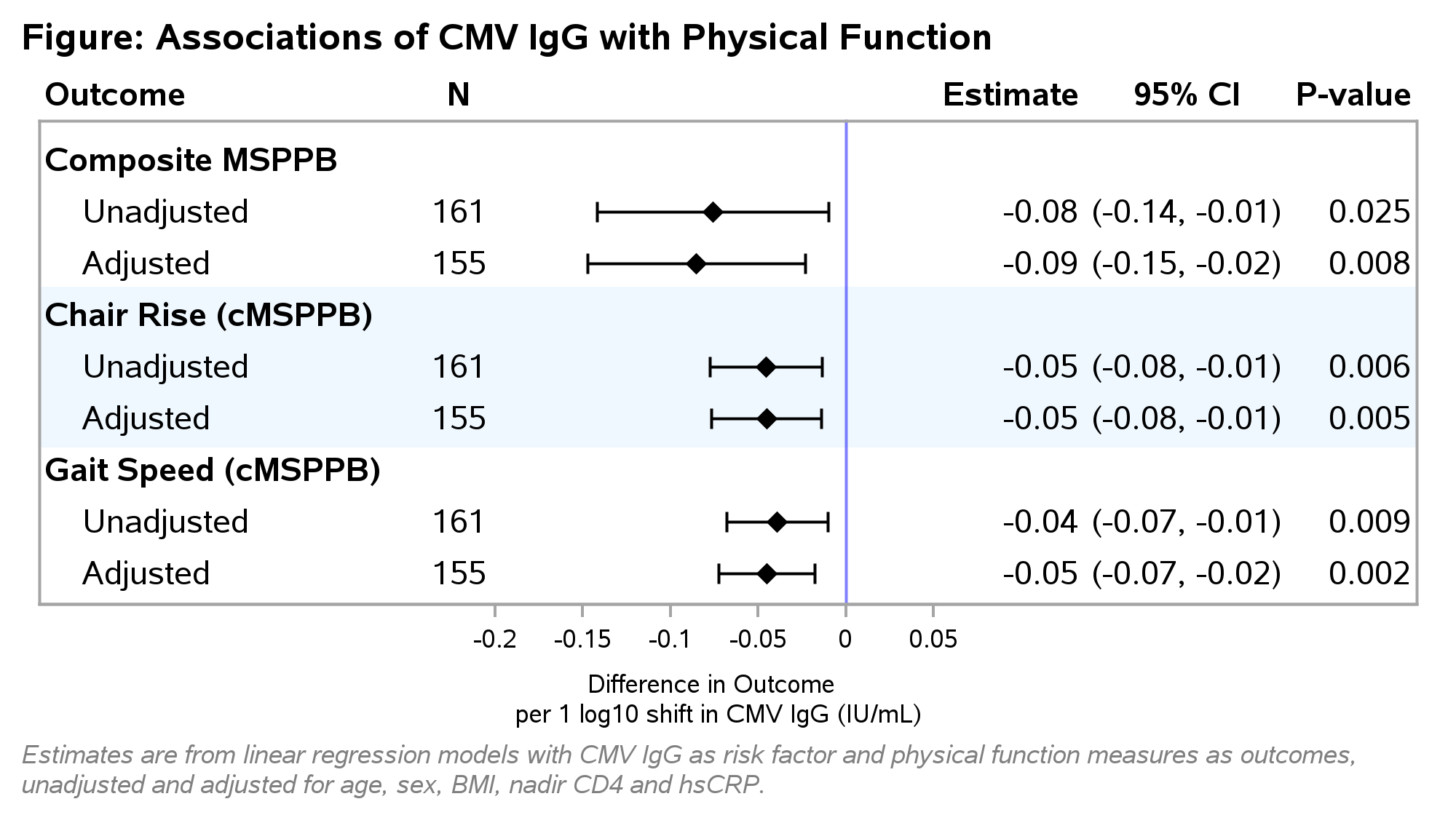
Of 717 participants with CMV IgG measurements, the median age was 51 (Q1, Q3: 46, 55) years; 18% were natal female, 51% White, 37% Black, and 25% Hispanic; median BMI was 27 (24, 30) kg/m2, 93% had HIV-1 RNA < 50 copies/mL, and 50% nadir CD4< 200 cells/mm3. Median CMV IgG was 2716 (807, 6672) IU/mL, none below the limit of quantification. There was no evidence of association between CMV IgG and MD or MA among n=631 with CT-based measures, controlling for age, sex and BMI (r=-0.03, p >0.5). Among 161 participants with physical function data, higher CMV IgG was associated with poorer physical function (mSPPB), largely driven by chair rise and gait speed components (Figure). Similarly, higher CMV IgG was associated with impairment on SPPB (score≤10) (relative risk=1.74 per 1 log10 shift, 95% CI: 1.13, 2.69). The effect sizes were similar after adjusting for CD4 nadir and hsCRP. While the number of frail participants was limited (n=7), trends were consistent for associations with pre-frailty and frailty.
Conclusions:
The known association between CMV IgG and physical function or frailty is replicated in PWH and does not appear to be explained by changes in muscle quantity or quality, nadir CD4 or inflammation. Further mechanistic studies are needed to understand this association and whether CMV eradication or CMV-specific therapy can impact physical function in PWH.