Background:
The global warning of potential teratogenicity associated with antiretroviral therapy containing dolutegravir (ART-DTG) issued in May 2018 may have exacerbated sex inequalities in access to DTG, though this warning was later rescinded in July 2019. Therefore, we evaluated ART-DTG uptake by women with HIV in Latin America and the Caribbean (LAC), and its potential impact on HIV-1 viral load (VL).
Methods:
ART-naive adult (≥16 years old) persons with HIV (PWH) receiving care at Caribbean, Central and South America network for HIV epidemiology (CCASAnet) sites, and starting ART after local DTG availability in Brazil, Chile, Haiti, and Honduras, were included. Estimated prevalence risk ratios of DTG use and VL suppression (< 50 copies/mL) during the first year after ART initiation were calculated using multivariable modified Poisson regression models adjusted for site, baseline tuberculosis, prior AIDS illness, and birth sex-age-calendar period interactions.
Results:
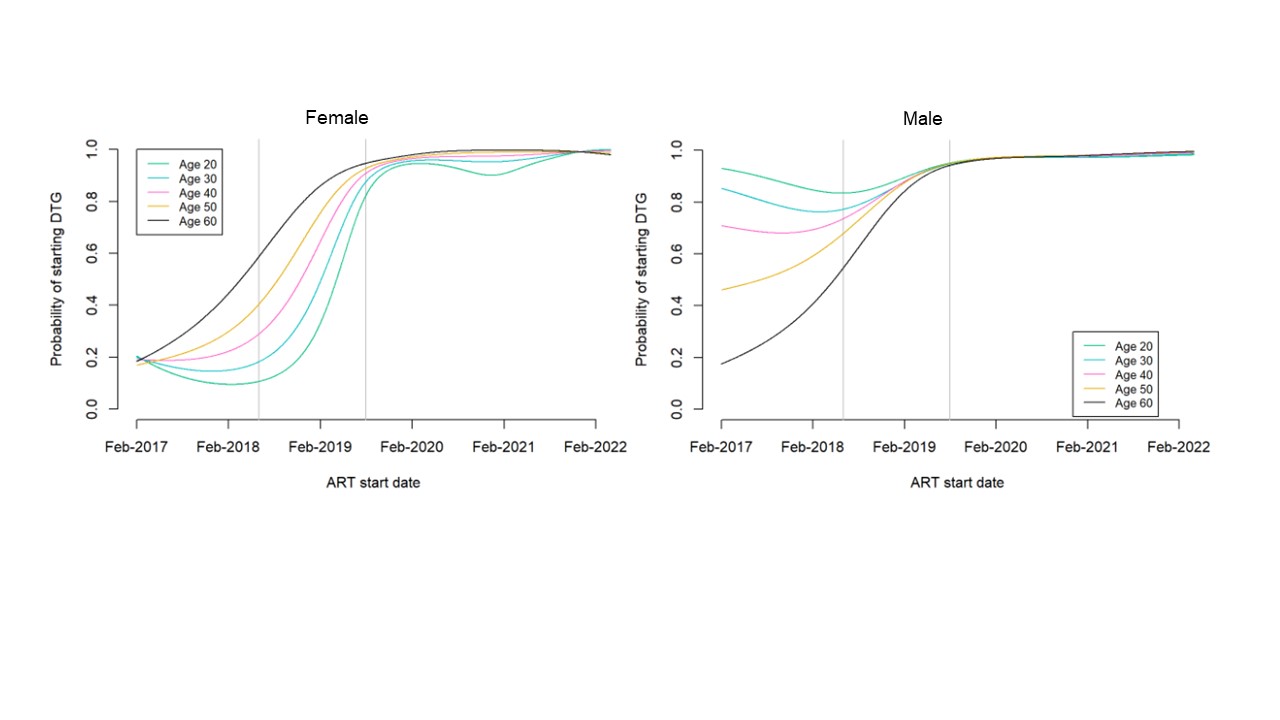
Overall, 4115 PWH initiated ART after local DTG rollout (Brazil: 859, Chile: 578, Haiti: 2605, Honduras: 73). Among these, 1693 (41%) were female, and median age at ART initiation was 34 years (interquartile range 27-42). PWH starting ART before, during, and after the DTG warning numbered 313 (8%), 1191 (29%), and 2611 (63%), respectively. Overall, 3390 (82%) started ART-DTG. Prior to or during the DTG warning period, younger (age< 50) female was much less likely to start ART-DTG than younger male (aRR=0.75, 95% confidence interval (CI): 0.70-0.80) and older women (aRR=0.79, 95% CI: 0.71-0.87). In the post-DTG warning period, younger female was still slightly less likely to start ART-DTG than younger male (aRR=0.96, 95% CI: 0.94-0.98). Overall, of 2362 PWH with ≥1 year of follow-up and ≥1 VL test after ART initiation, 1953 (83%) were on ART-DTG and 2078 (88%) achieved VL suppression. Starting ART-DTG was associated with a higher likelihood of VL suppression (aRR=1.12, 95% CI: 1.05-1.19). In the post-DTG warning period, younger female had a similar likelihood of VL suppression as younger male (aRR=0.99, 95% CI: 0.94 -1.03), which was unchanged after controlling for DTG use (aRR=0.99, 95% CI: 0.95-1.04).
Conclusions:
Despite the updated guidelines recommending DTG for all PWH, younger female in LAC continue to experience discrepancies in ART-DTG uptake, potentially impacting treatment outcomes. Therefore, assuring sex-equitable access to ART-DTG is needed in LAC.
Adjusted probability of starting a DTG based regimen by date and age for women and men