Background:
Universal test and treat (UTT) for all people living with HIV (PLHIV) was recommended in 2016 by the World Health Organization and adopted by Kenya’s national HIV program in 2017. We analyzed data from Kenya’s HIV case surveillance (CS) system to determine mortality and interruptions in treatment (IIT) among PLHIV who initiated antiretroviral therapy (ART) after scale-up of UTT.
Methods:
CS system is a repository of sentinel events among PLHIV (HIV diagnosis, linkage and retention on ART) derived from the Kenya National Data Warehouse (NDW) of electronic medical record containing data from over 80% of PLHIV on ART. We extracted data on outcomes in the first 12 months after enrollment among PLHIV enrolled in care between January to December in 2020 (97,176) and 2021 (84,103). Outcomes were: died, IIT, transfer-out (TO), and active on care. Clients who had IIT did not return for a clinic visit or ART refill for more than 90 days from the last scheduled visit. TO was a client who transferred out of a facility without a record of transfer-in (TI) to another facility. Clients without either a recorded death, IIT or who had a recorded TI after TO during the follow-up period were active on care. We used descriptive statistics to calculate monthly average and cumulative death, IIT and TO, accounting for censoring at the end of each month.
Results:
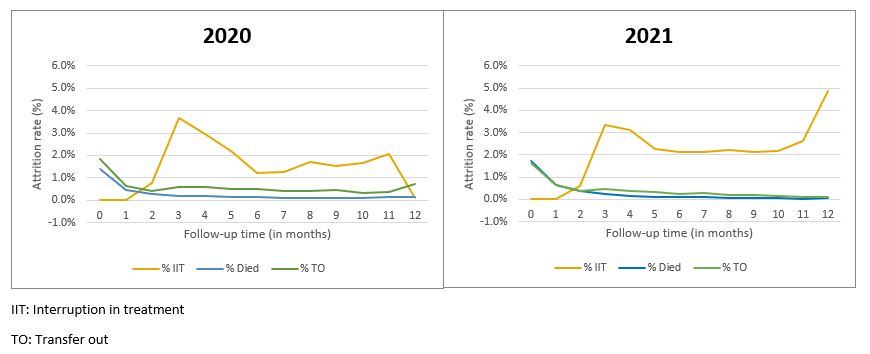
Monthly average rate of death, IIT and TO in the first 12 months from enrollment for each cohort are shown in figure 1. Monthly attrition was similar in the two cohorts. While death and TO rates were highest in the first month from enrollment, IIT rates peaked between months three and five. Cumulatively, 3,044 (3.5%)and 2,859 (3.7%) of clients died in the first year of enrollment in 2020 and 2021, respectively. IIT accounted for the greatest cumulative rate of attrition in both cohorts. In the 2020 and 2021 cohorts, 19.1% (15,046) and 27.6% (14,021) of clients experienced treatment interruption, respectively. Cumulative rates of TO were 7.8% (6273) in 2020 and 5.0% (3.684) in 2021.
Conclusions:
HIV CS data in Kenya shows high levels of attrition in the first 12 months of enrollment, with concerning trends in mortality and IIT. These findings suggest early diagnosis of HIV, before the onset of advanced disease, with intensive clinical management and adherence support to PLHIV newly initiating ART continue to be key areas for program strengthening. Examination of causes of death and IIT could identify additional areas for program improvement.
Figure 1: Monthly death, interruptions in treatment and transfer-out among PLHIV who initiated ART in 2020 and 2021, Kenya National HIV Case Surveillance