Background:
A large mpox outbreak in NYC caused significant morbidity beginning in May 2022. Tecovirimat, an anti-Orthopoxvirus medication in the US Strategic National Stockpile available through the Centers for Disease Control and Prevention expanded access investigational new drug protocol, is recommended for patients at risk for or presenting with severe mpox disease. Due to administrative barriers limiting treatment access, our academic medical center at NYU Langone (NYULH) along with our public health system–NYC Health + Hospitals/Bellevue and NYC Department of Health and Mental Hygiene–set up an outpatient telehealth model to deliver tecovirimat to eligible patients. Here we present telehealth outcomes from June 19-August 8 2022.
Methods:
Demographic/clinical characteristics and post-treatment outcomes were collected for NYULH and Bellevue patients. We used descriptive statistics and report results by HIV status. Outcomes were followed for 30 days post-treatment.
Results:
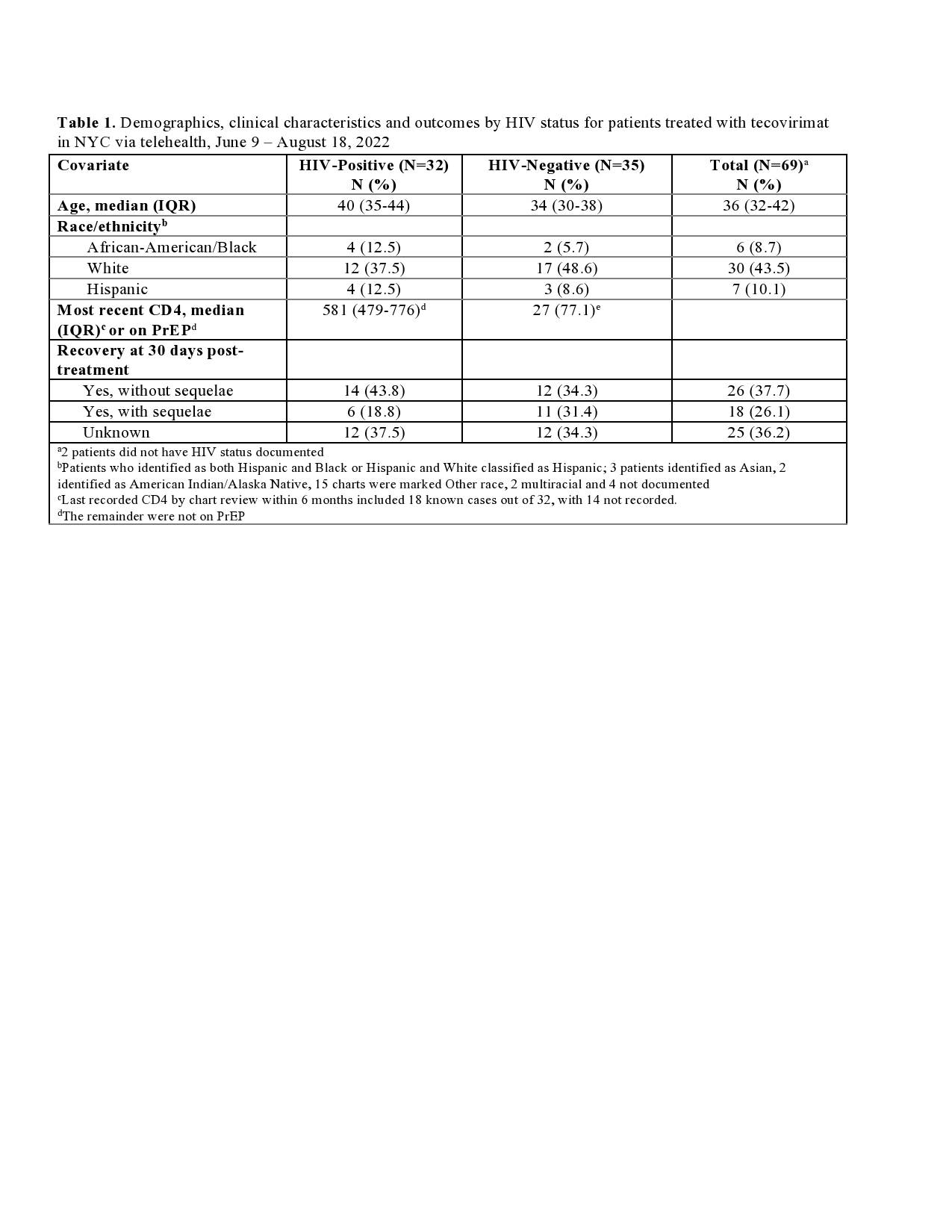
Of 83 patients treated with tecovirimat, 69 (83.1%) completed an initial telehealth visit. Of this cohort, nearly all (98.6%) were cisgender men. Median (IQR) age was 36 (32-42) with 82.6% men who have sex with men (MSM). Patients were mostly White (43.5%) or Hispanic (10.1%). Table 1 shows outcomes by HIV status. Nearly half (46.4%) had HIV and all were on ART. Out of 20 cases with known viral load within 6 months, 19 were undetectable ( < 200copies/mL). Among those without HIV, 77.1% were on PrEP. The most common mpox exposure was sexual contact (71.0%) and 40.6% received empiric STI treatment. The most common tecovirimat indication was mucosal involvement (85.5%), including proctitis, pharyngitis, urethritis or conjunctivitis. Median (IQR) time from symptom onset to testing was 4 days (3-9), and from symptom onset to treatment was 9 days (7-12). Most completed the 14-day treatment (59.4%) and completed at least one visit after treatment initiation (87.0%), while about 33.3% were lost to follow-up. Nearly all (89.9%) reported improvement and median (IQR) time to improvement on treatment was 3 days (2-4). No mpox-related hospitalizations or deaths were observed. Only 4 (5.8%) patients reported fatigue and 3 (4.3%) reported headache on tecovirimat.
Conclusions:
In this NYC cohort of mostly MSM receiving tecovirimat, a telehealth model facilitated access to treatment that resulted in positive mpox outcomes. Patients were mostly well-controlled on ART or on PrEP, reflecting a population in care at baseline with high tech literacy.
Table 1. Demographics, clinical characteristics and outcomes by HIV status for patients treated with tecovirimat in NYC via telehealth, June 9 – August 18, 2022