Background:
Tyrosine kinase inhibitors (TKIs) interfere with the formation and replenishment of HIV reservoir by preserving SAMHD1 antiviral activity in CD4 cells and impeding homeostatic proliferation. We evaluated the persistence of TKI-mediated protective activity against HIV in CD4 from individuals who received one-year treatment with ponatinib against chronic myeloid leukemia (CML).
Methods:
Nine participants of Phase II clinical trial NCT04043676 were recruited. They achieved deep molecular response against CML after 14 (IQR 5.5-15.5) years of treatment with imatinib before interruption and then received one-year consolidation treatment with ponatinib 15 mg/day. Blood samples were taken before starting ponatinib (t=-12 months), after one year of treatment (t=0), and 3, 6 and 12 months after interruption. PBMCs were activated with PHA/IL-2 for 48h and then infected with NL4-3_wt for 72h. HIV p24, SAMHD1 phosphorylation at T592 (pSAMHD1), and distribution of CD4 memory subpopulations were analyzed by flow cytometry
Results:
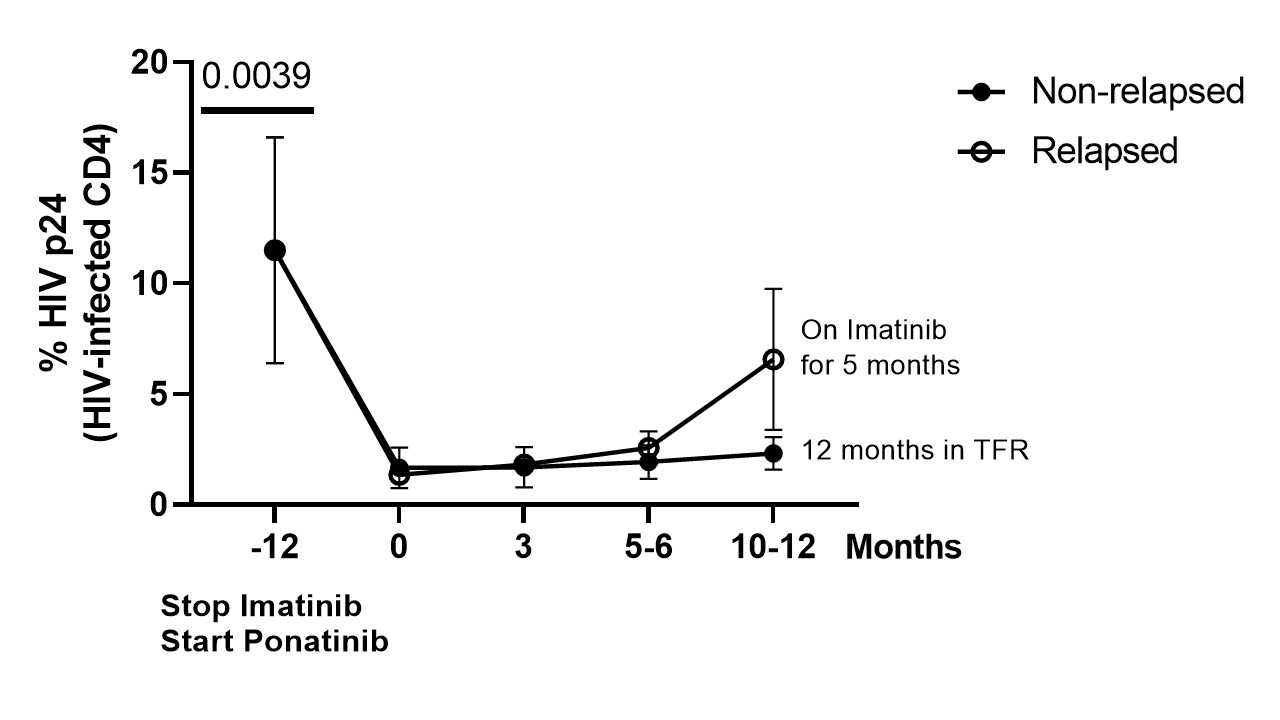
1) 5 participants (55.5%) did not relapse from CML 12 months after ponatinib interruption (Non-relapsed), while 4 participants (44.4%) relapsed after 5,5 months (IQR 4,25-6,75) of ponatinib interruption (Relapsed). 2) CD4 were susceptible to HIV infection in all participants while they were treated with imatinib, but one-year treatment with ponatinib reduced 8.8-fold HIV infection in these cells (Figure). This protection was maintained after 12 months of treatment-free remission (TFR) in Non-relapsed (p=0.0039), in correlation with interference of pSAMHD1. 3) All CD4 memory subpopulations regained susceptibility to HIV infection after CML relapse and imatinib reintroduction. Therefore, p24 production was increased 6.1-(p=0.0159), 8.6-(p=0.0159), and 5.0-fold (p=0.0317) in CD4 naïve, TCM, and TEMRA cells of Relapsed, while CD4 of Non-relapsed were protected against HIV infection 12 months after ponatinib interruption. Increased p24 synthesis correlated with increased pSAMHD1 in CD4; pSAMHD1 levels were not significantly modified in CD8.
Conclusions:
One-year treatment with ponatinib preserved SAMHD1 antiviral activity in CD4 by a potent sustained cytostatic effect, impeding HIV infection. The antiviral protection was maintained for 12 months during TFR in correlation with sustained antileukemic response. Transient use of TKIs may be applied to advance towards an HIV cure.
Figure