Background:
Mechanisms underlying mortality in some early ART-treated HIV-perinatally infected children remain unclear. The prospective EARTH study (Early Anti-Retroviral treatment in HIV- infected children), enrolled in 6 African centers, 220 perinatally HIV-infected children collecting clinical data and peripheral blood (< 2weeks of age). Trying to identify biomarkers predictive of mortality risk at enrollment visit, we assessed the differential plasma concentration of pro-inflammatory molecules in 3 different groups: deceased (dead-HIV+), non-deceased HIV+ children (HIV+) and healthy control (HC) study participants.
Methods:
Selection of patients was done using Nearest Neighbor matching 1:2. A propensity score distance was used to select 59 individuals (HIV+), within the EARTH cohort, with similar characteristics at entry (including CD4 count, HIV viremia, weight for height, ART adherence, age at enrollment, age at ART start, country of birth, and prematurity) to 20 deceased children. Plasma samples were analyzed using an Inflammation panel proximity extension assay (Olink platform; T96) and benchmarked to 13 HC HIV unexposed controls. Principal Component Analysis (PCA) was done to visualize patterns in proteomics.
Results:
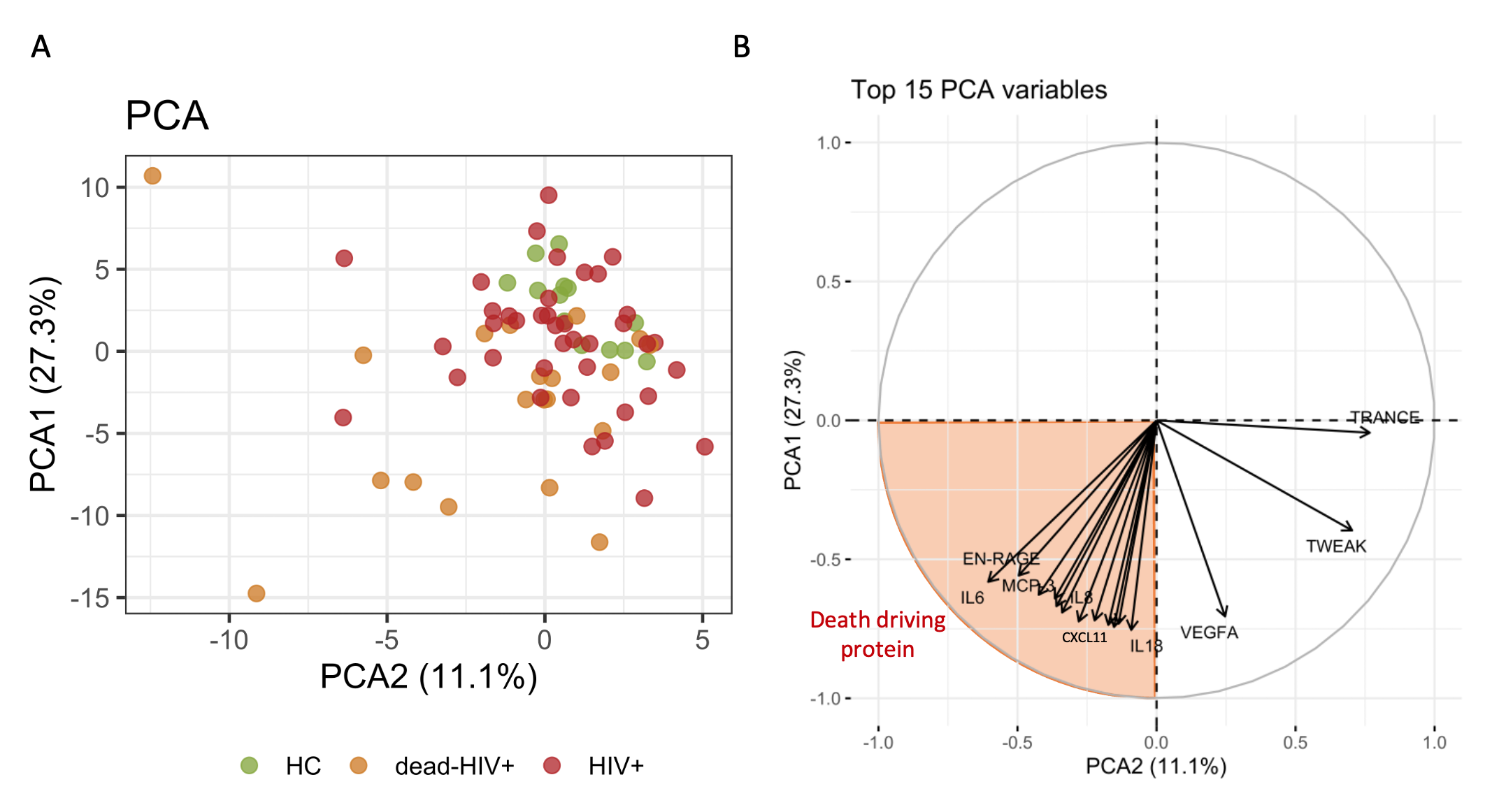
PCA analysis on proteomic data revealed a gradient in the distribution of samples with dead-HIV+ clustering separately from HC and matched HIV+ participants (FIG.1A). Top 15 loading proteins highlighted molecules as pro-inflammatory IL-6, CXCL11 (potent agonist of CXCR3, involved in activated T cells chemotaxis) and CCL7 (also known as MCP-3, important for the activation and chemoattraction of macrophages) as death driving proteins (Fig.1B). Differential analysis at the same time point, also revealed significant higher levels in the relative concentration (NPX) of these 3 molecules, with the plasma of those who died. Logistic regression model adjusted for gender and propensity score pair match, reveals that an increase of one NPX of IL-6, CXCL11, and MCP-3 is associated with a probability increase in death of 0.75, 0.80 and 0.87, respectively.
Conclusions:
HIV+ children who prematurely died demonstrated higher concentrations of inflammatory molecules at enrollment, suggesting a possible role of inflammation in driving eventual mortality. Larger studies are needed to confirm early molecular correlates of mortality in HIV+ children which may identify actionable biomarkers and inform trials of novel immunomodulatory drugs to reduce mortality.
Figure 1. A) PCA showing the sample distribution among the groups: HIV+, dead-HIV+ and HC; B) Top 15 loading proteins contributing to samples distribution within PCA.