Background:
Hepatitis B virus (HBV) remains endemic in Africa despite effective vaccines. Limited studies suggest horizontal modes of transmission within households or communities may be driving continued endemicity in the region. The relative impact of horizontal versus vertical transmission is unknown.
Methods:
We conducted the Horizontal and Vertical Transmission of Hepatitis B in the Democratic Republic of Congo (DRC) study (HOVER-HBV), a prospective, cross-sectional study to determine HBV prevalence within households and characterize transmission in Kinshasa, one of Africa’s largest cities. We recruited households of index mothers with (“exposed”) and without (“unexposed”) HBV through HBV surface antigen (HBsAg) screening during routine antenatal care at two large maternity centers. Enrolled household members underwent HBsAg testing, dried blood spot sampling, and an epidemiological survey. We used logistic regression and Moran’s I to evaluate HBV risk factors.
Results:
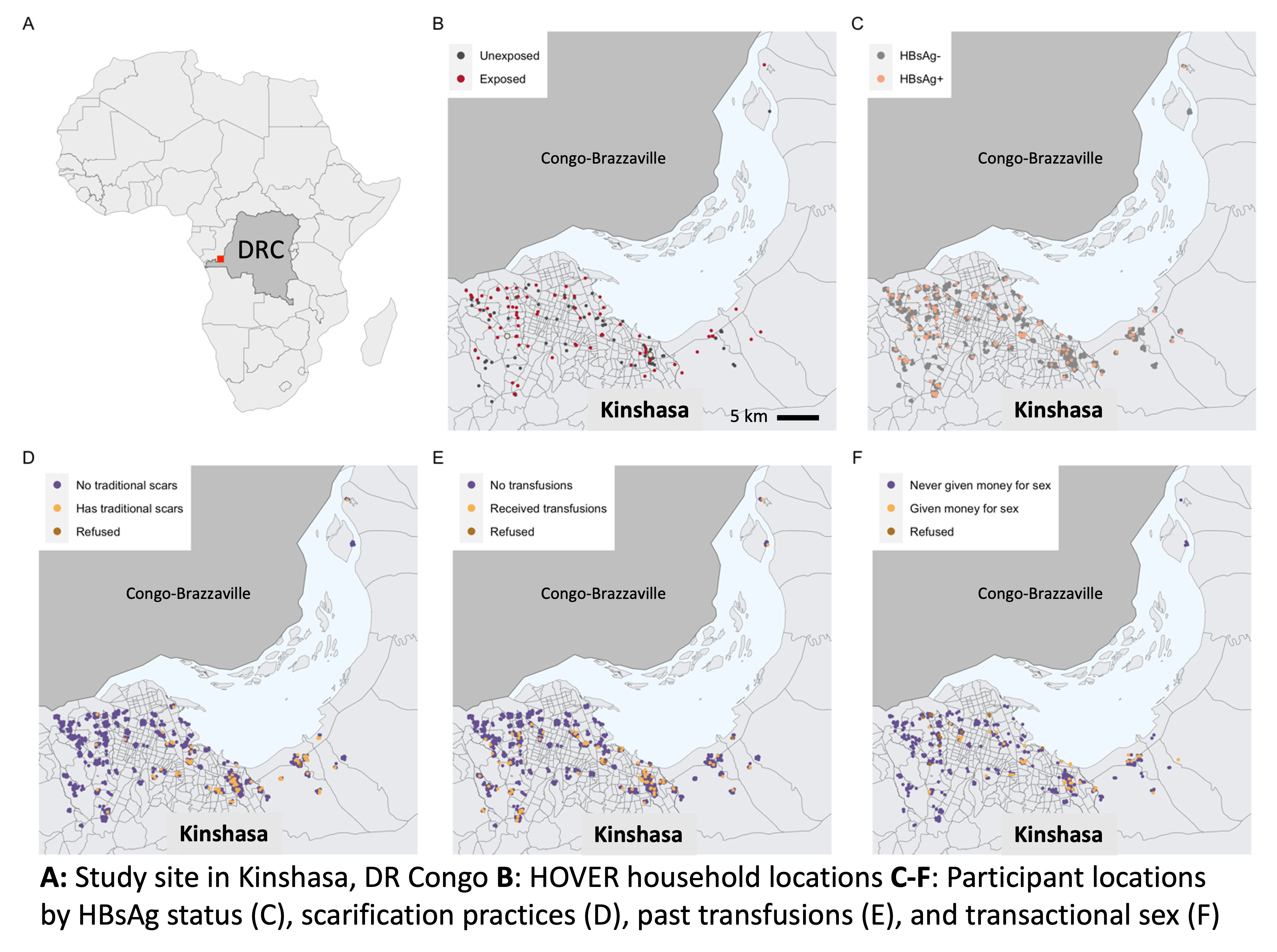
Among 200 households, we enrolled 1006 participants; 475 (47%) were direct offspring of index mothers. Clusters of ≥2 (range 2-6) infections were observed in 13 (8 exposed, 5 unexposed) households. Household members with HBV were more common in exposed than unexposed households (19 [5%] versus 8 [2%]), with 2.49 (95% CI: 1.65, 11.55) greater odds of being HBsAg+ after adjusting for household clustering. In exposed households, direct offspring of index mothers had similar odds (odds ratio [OR] 0.95 [95% CI: 0.37, 2.52]) of being HBsAg+ compared with other household members; while direct offspring in unexposed households had lower odds (OR 0.42 [95% CI: 0.09, 1.73]) compared to other household members. Of 22 who self-reported a past positive HIV test, 15 were HBsAg+, 14 of whom reported being on HIV treatment. Preliminary results indicate no spatial autocorrelation of household prevalence (Moran’s I: 0.14, p=0.59), but notable spatial variation in HBV exposures (e.g., scarification, past transfusions, and transactional sex; Figure 1). Shared razors and premastication of food were also more frequently reported by exposed participants with HBV. Phylogenetic analyses to characterize transmission patterns are ongoing.
Conclusions:
Vertical and horizontal HBV transmission is occurring in Kinshasa households despite infant vaccinations. Prevalence was highest among offspring and household members of women with HBV. Our findings reveal opportunities for expanded prevention efforts and integration of HBV in existing HIV programs.
Figure 1. Spatial variation in HBsAg positivity and potential community HBV exposures across Kinshasa, DR Congo