Background:
Viral Hepatitis remains a health priority. We performed a comprehensive evaluation of epidemiological HCV estimates in Southern countries of Western Europe and assessed the impact of the 2008 economic crisis on HCV burden.
Methods:
We analyzed data of the Global Burden of Diseases to describe the patterns of six measures of HCV burden [prevalence, incidence, mortality, years lived with disability (YLDs), years of life lost (YLLs), disability adjusted life years (DALYs)] in Greece, Italy, Portugal, Spain. We assessed age-standardized rates (per 100,000 population) between 2000-2019, disaggregated by sex and age, and compared the annualized age-standardized rate of change (ARC%) in 2000-2010 (pre-austerity) and 2010-2019 (post-austerity).
Results:
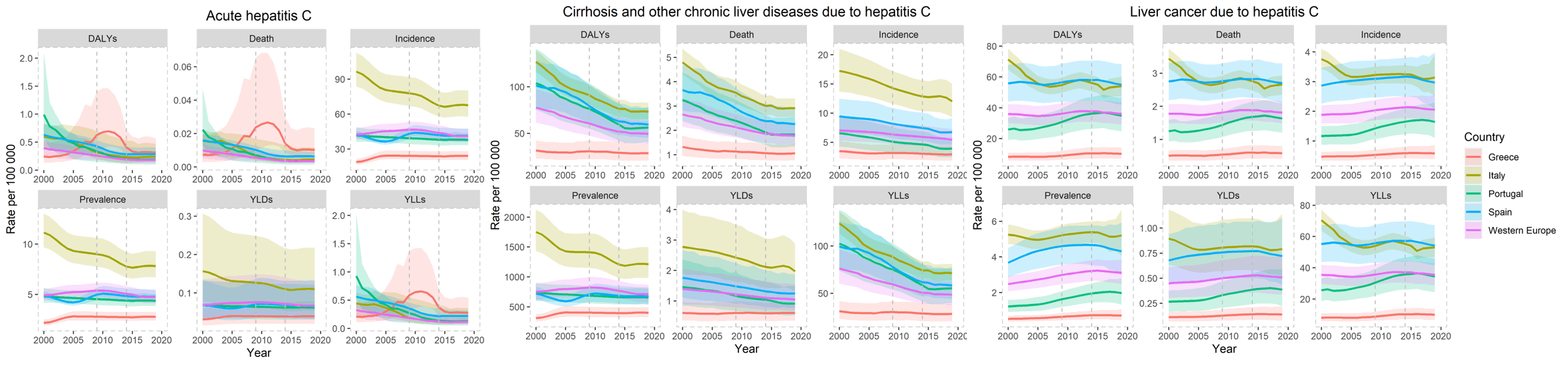
Prevalence, incidence and YLDs rates of acute HCV showed a general stable trend in Western Europe (WE), globally and in the four studied countries except Italy, where, despite a marked decline (ARC: 1.4% in 2010-2019), the 2019 estimates [7.8 (95% UI 6.6-9.2)] were still 1.7-fold higher than in WE. Mortality, YLLs and DALYs associated with acute HCV decreased in the analyzed countries and peaked in Greece post-austerity. Globally and in Greece, mortality rate was higher in females than in males (1.3-times and 1.5-times in 2019, respectively). Mortality caused by chronic liver diseases including cirrhosis decreased globally, in WE and in all countries albeit at a lower rate in the post-austerity period (decrease in ARC for WE: 2.5% in 2000-2010; 1.6 in 2010-2019).Liver cancer prevalence due to HCV increased in WE (ARC: 2.1%) and in the analyzed countries mainly in the pre-austerity period except for Italy. However, despite having the highest prevalence rate in both sexes, Italy showed major decreases in all six-disease metrics. HCV liver cancer mortality declined significantly only in Italy (ARC: 2.6%) and globally (ARC: 2.1%) especially in the pre-austerity period, while Portugal experienced a major increase post-austerity. Overall, males and people over 70 years old are at greater risk of developing chronic liver diseases due to HCV infection.
Conclusions:
The economic crisis of 2008 negatively impacted hepatitis C related liver cancer mortality rates in Greece, Italy, Portugal and Spain. Despite the observed recovery in recent years, elimination of HCV infection by 2030 will be a major challenge in these countries and the COVID-19 pandemic and the current grim economic context are expected to compromise even further hepatitis C elimination.
Figure 1 – Acute and chronic HCV age-standardized rates from 2000 to 2019.