Background:
The illicit drug toxicity crisis in British Columbia (BC) has reduced the survival gains among people living with HIV (PLWH) achieved by combination antiretroviral therapy. Supporting PLWH with concurrent opioid use disorder (OUD) to engage and remain on opioid agonist therapy (OAT) is necessary to optimize HIV care. We examined correlates of retention on OAT among a cohort of PLWH who received at least one OAT dispensation in BC.
Methods:
We analyzed data from the Seek and Treat for Optimal Prevention of HIV/AIDS database between April 1996 and March 2017. Those with known gender, age of ≥19 years old, and ≥12 months of follow-up were included. We identified OAT dispensation as the receipt of methadone or buprenorphine/Naloxone (introduced to BC in 2008) through the PharmaNet database. Treatment episodes with no interruptions in the prescribed doses lasting ≥ 3 days for methadone, or ≥ 6 days for buprenorphine were constructed. A period of continuous retention in treatment was evaluated as no interruption in the prescribed doses for at least 12 months. We examined temporal trends in retention over the calendar years. A generalized estimating equation (GEE) model was built to assess correlates of 12-month retention in OAT. Of note, in the present setting, methadone was the recommended treatment in BC until July 2017.
Results:
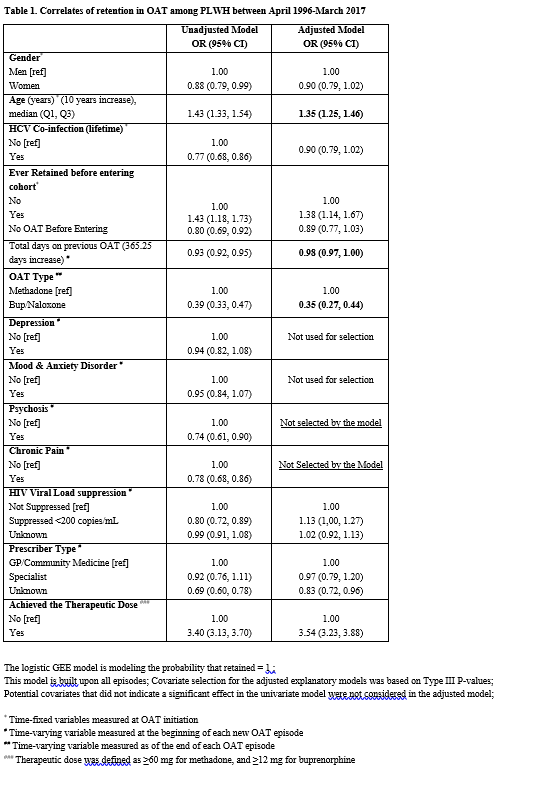
A total of 13,433 PLWH were included in the analysis of whom 2,151 (16.01) had at least one OAT dispensation (methadone: 2,075; buprenorphine: 76). Median (Q1, Q3) age was 37 years (31, 43) and 60.1% (n=1,293) were male. PLWH initiated on buprenorphine versus (vs.) methadone were more likely to be older 42.5 (34, 52) vs. 37 (31, 43), and had a significantly higher comorbidities n (%): depression 40 (52.6) vs. 821 (39.5); chronic pain 39 (51.3) vs. 440 (21.2), hepatitis C 47(61.8) vs. 802 (38.6); chronic obstructive pulmonary diseases 6 (7.80) vs. 65 (3.1); cancer 22 (28.0) vs. 254 (12.2). There was a decline in retention at the rate of 1.34 per year (p < 0.0001). Table 1 presents correlates of retention among PLWH.
Conclusions:
Our findings indicated that OAT retention among PLWH has declined over time. Higher odds of retention were associated with a ten-year increase in age, previous retention history, achieving therapeutic dose (≥ 60mg methadone; ≥12mg buprenorphine), and methadone treatment. To meet and sustain the UN 95-95-95 by 2025 Targets among PLWH with comorbid OUD, optimal management of OUD and implementation of OAT aimed at maximized retention is necessary.
Table 1. Correlates of retention in OAT among PLWH between April 1996-March 2017