Background:
Modifications to Fried’s frailty phenotype (FFP) are common, particularly to address data collection limitations in clinical care settings. We evaluated a self-reported modified frailty phenotype (Mod-FP) used among people with HIV (PWH) within a US-based cohort and compared it to the original FFP.
Methods:
Among 522 PWH who completed visits in the Impact of Physical Activity Routines and Dietary Intake on the Longitudinal Symptom Experience of people living with HIV (PROSPER-HIV) study within the Centers for AIDS Research Network of Integrated Clinical Systems (CNICS) cohort, we assessed validity of the Mod-FP using FFP as the gold standard. FFP includes unintentional weight loss, fatigue, and inactivity by self-report, and observed slow gait speed and weak grip strength. The Mod-FP includes unintentional weight loss, fatigue, inactivity, and poor mobility all collected via self-report. Each component is assigned a point if present. FFP is scored 0-5 while Mod-FP is scored 0-4. FFP categorizes frail as a score ≥3, prefrail as 1-2, and not frail as 0, and we identified cut points for Mod-FP in this analysis. We compared the Mod-FP with FFP via correlation, receiver operator characteristic (ROC) curves, agreement in classifying frailty status, and criterion validity via cross-sectional association with risk of having experienced falls.
Results:
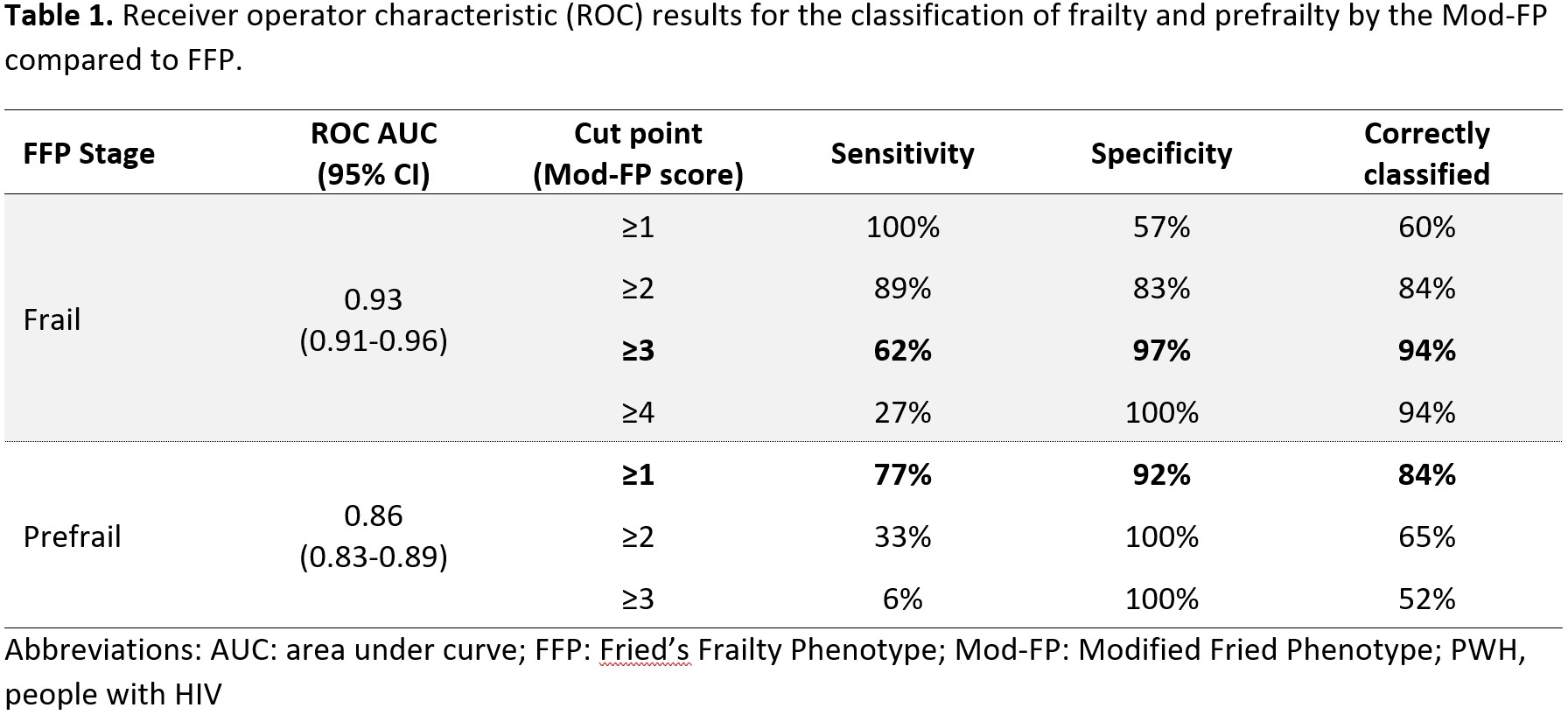
The median age of the cohort was 54 (IQR: 44-61), 21% were female, and 58% non-White. The Mod-FP and FFP were highly correlated (Pearson r: 0.83), and the Mod-FP classified 8% of PWH as frail, while FFP classified 9%. The area under the ROC curve for Mod-FP classifying frailty was 0.93 (95%CI:0.91-0.96) with 62% sensitivity and 97% specificity at a cutoff of 3 components (Table 1). For prefrailty, at a cutoff of 1 component, the AUC was 0.86 (95%CI:0.83-0.89). ROC values were consistent in age (over/under 55), sex (male/female assigned at birth), and race (Black/White) stratification. We observed 80% agreement (unweighted kappa=0.64, quadratic weighted kappa=0.75) between the phenotypes for categorizing PWH as not frail, prefrail, or frail. Both phenotypes found frailty associated with falls; FFP (OR:1.63, 95%CI:1.22-2.18) estimated a greater magnitude for the association than Mod-FP (OR:1.36, 95%CI:1.02-1.81), though the confidence intervals overlapped.
Conclusions:
The Mod-FP has good performance in measuring frailty among PWH and is reasonable to use when the gold standards of observed assessments (i.e., weakness and slowness) are not feasible.
Receiver operator characteristic (ROC) results for the classification of frailty and prefrailty by the Mod-FP compared to FFP.