Background:
HIV rapidly infects CD4+ T cells where it can establish latent infection. Identifying immune mechanisms which can render CD4+ T cells refractory to infection represents a critical step in limiting infection and viral spread during acute infection. In this study, we identify that the STING signaling pathway functions in CD4+ T cells and can be activated to mediate a cellular state refractory to HIV infection.
Methods:
Using purified memory CD4+ T cells from healthy human donors, we stimulated cells with titrating doses (0.1 mM-50 mM) of the STING agonist diABZI for 18 hours followed by infection with HIV 89.6. p24 levels were quantified by flow cytometry (FCM) after 72 hours of infection. We next identified the critical role for STING sensing of HIV in limiting infection by CRISPR mediated knockdown (KD) of STING in purified CD4+ T cells. Control (CTL) and STING KD cells were infected and p24 quantified, as described before. Finally, purified memory CD4+ T cells were treated with 1 mM diABZI for 24 hours and global proteomics performed by Mass Spectrometry to identify the protein signatures induced and suppressed by STING activation.
Results:
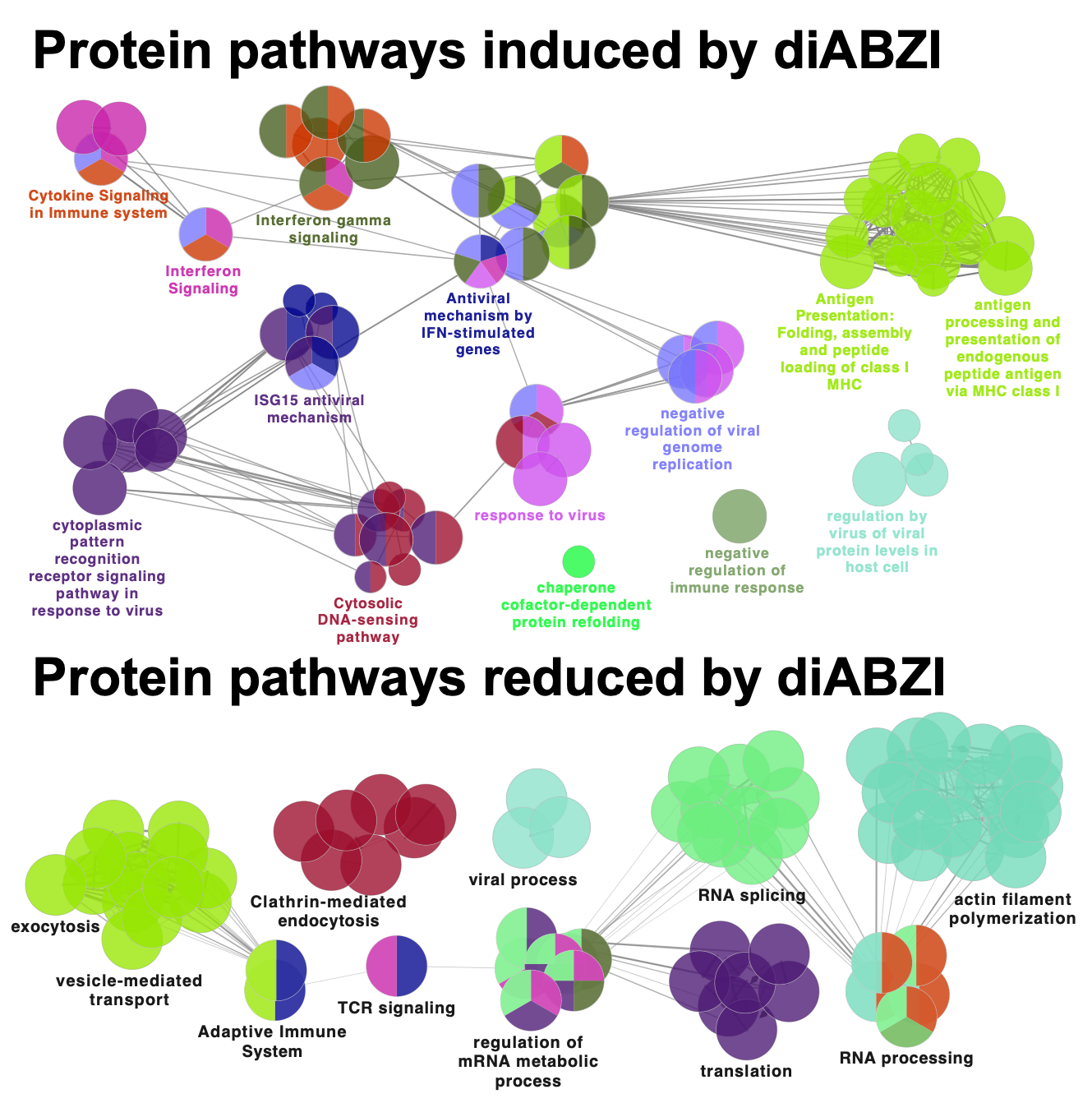
We found that 0.5 mM diABZI was sufficient to induce a state of refractoriness to HIV infection equivalent to IFN-a2a treatment in central memory CD4+ T cells, a major source of the HIV reservoir (Fig. 1A). We have also shown that diABZI induces Type I IFN production from CD4+ T cells and activates p-IRF3. CRISPR KD of STING in memory CD4+ T cells was shown to significantly enhance the level of HIV infected cells in vitro. Proteomics analysis revealed that HIV restriction factors and proteins involved in antiviral immunity and IFN signaling were significantly induced by diABZI. Importantly, proteins that were significantly reduced mapped to pathways including RNA processing and protein translation which are aspects of the host machinery which HIV needs to co-opt to replicate and produce infectious virions.
Conclusions:
Our data provide mechanistic insight into the STING pathway in CD4+ T cells as a means to mediate refractoriness to HIV infection and shows this pathway lands a “1-2” punch of heightening antiviral immunity while suppressing host machinery needed for viral replication. The prospect of treating with a STING agonist as part of post-exposure therapeutics represents a novel and impactful means of helping stop HIV infection in its tracks while restoring the normal antiviral immune response need to control the remaining virus.
Pathway analysis of proteins induced and reduced by diABZI treatment of memory CD4+ T cells