Background:
There are limited quantitative studies describing the association between meth use in the context of male-male sexual partnerships and PrEP care engagement. We assessed the longitudinal relationship between individual and partnership level meth use with inconsistent PrEP engagement among young gay, bisexual and other men who have sex with men (GBMSM) in Los Angeles.
Methods:
The mSTUDY (Men Who Have Sex with Men and Substance Use Cohort at UCLA Linking Infections, Noting Effects) is a cohort of GBMSM between the ages of 18 and 52 in Los Angeles. The primary outcome, PrEP engagement, had two levels. We defined consistent PrEP engagement as 18 consecutive months (3 study visits) of reported PrEP care. Inconsistent PrEP engagement was defined by 6 months of PrEP care followed by either 12 months of non-engagement or 6 months of non-engagement and 6 subsequent months of engagement. The primary exposure was meth use at the partnership level with a ternary variable (neither partner nor participant used meth, either used meth, or both used meth). We measured sexual risk characteristics including STI test positivity. Generalized estimating equations were used to assess odds of inconsistent PrEP engagement at different levels of partner-participant meth use, adjusting for age at visit, number of recent male partners and partner intimacy.
Results:
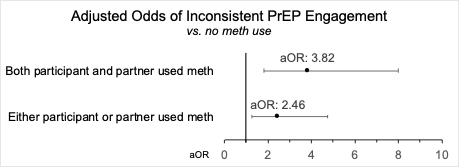
The sample included 149 unique participants (n=602 visits), of whom 48% were Black/African American, 36% were Hispanic/Latinx and 9% were white. There were 447 continuous PrEP events and 155 inconsistent PrEP events. Among inconsistent PrEP engagement, 61% (vs 79.5% continuous) reported that neither they nor their partner used meth, 22% (vs 18%) reported that either partner or participant used meth and 17% (vs 8%) reported that both partner and participant used meth (P < 0.01). Positive gonorrhea test was higher among inconsistent PrEP engagement (13.2%) vs. consistent (5.4%, P=0.04). There were increased odds of inconsistent PrEP engagement when both partner and participant reported meth use (aOR: 3.82; 95%CI: 1.83-7.99) and when either partner or participant reported meth use (aOR: 2.46; 95%CI: 1.28-4.75) (Figure).
Conclusions:
Meth use plays an important role in consistent PrEP engagement among GBMSM in mSTUDY. Odds of inconsistent PrEP engagement were higher when meth use was reported by either participant and partner or both. PrEP users who use meth with partners may benefit from integrated interventions addressing both meth use and PrEP engagement.
Adjusted odds of inconsistent PrEP engagement versus no meth use. Model also controls for age at visit, partnership assessment score and number of male partners.