Background:
The World Health Organisation approved Dolutegravir (DTG) with Zidovudine (ZDV) and Lamivudine (3TC) for second-line antiretroviral therapy. However, ZDV has been associated with adverse events which lead to treatment interruptions. There is evidence on efficacy of recycling failing NRTI backbone [tenofovir disoproxil fumarate (TDF) or tenofovir alafenamide (TAF), lamivudine (3TC) or emtricitabine (FTC) but this is seldom linked to baseline drug resistant mutations (bDRM) at the time of switch. We here analyzed the effect bDRM to NRTI on virologic outcome in patients switched from TDF, 3TC, Efavirenz (EFV) or Nevirapine (NVP) to DTG combined with either TDF,3TC [TLD] or TAF,FTC [TAFED], or ZDV, 3TC with a boosted protease inhibitor (bPI) of either lopinavir/ritonavir or atazanavir/ritonavir in the VISEND trial, an ongoing, 144-week randomised, open-label, noninferiority trial done at the University Teaching Hospital in Zambia.
Methods:
We evaluated virological outcomes at 96 week post-transition among individuals with a baseline HIV RNA >1000 copies/mL and HIVDR switched to either TLD/TAFED or ZDV,3TC,bPI. HIVDR testing was done using an Applied Biosystems Genetic Analyzer model 3500XL. Genotyping encompassed protease and codons 1–230 of reverse-transcriptase genes. Sequences were assembled and manually edited using Sequencer version 4.5 software. Descriptive statistics were computed using STATA version 13. Viral suppression rates and Multivariate logistic regressions for common factors associated with treatment failure were computed.
Results:
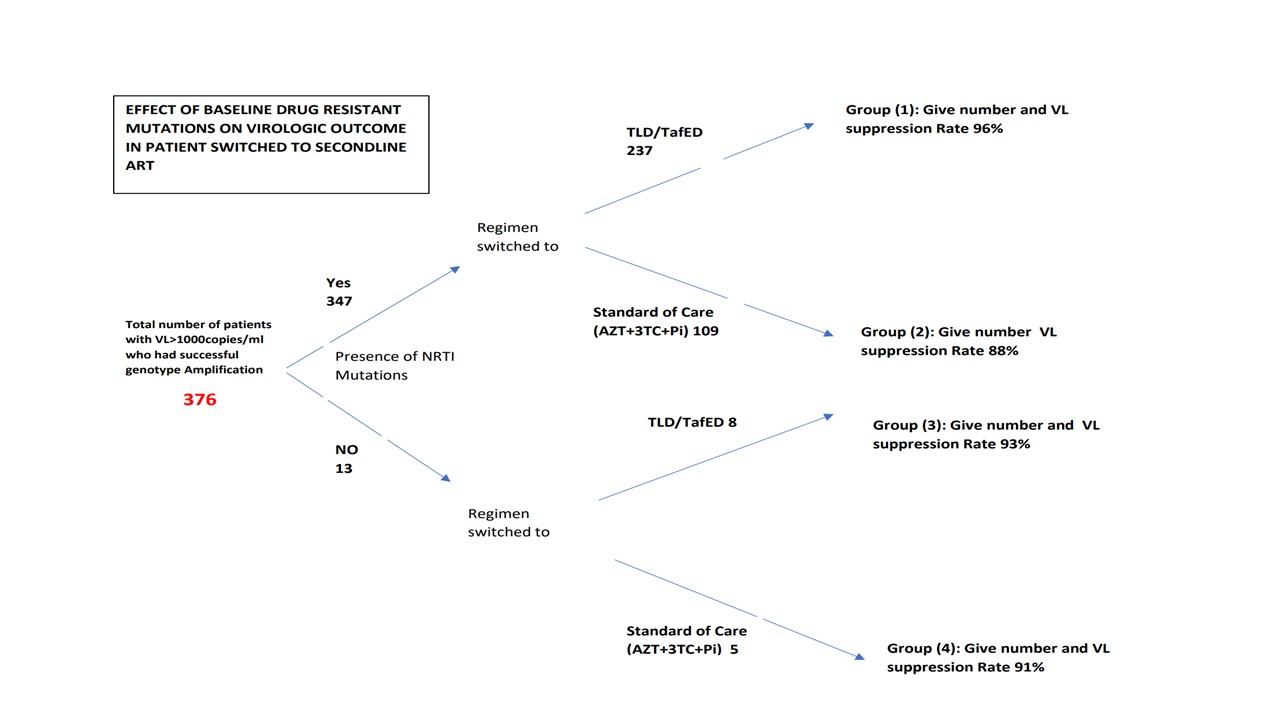
783 patients with VL >1000 copies/ml were enrolled of which 62% were females and mean age was 41. 640 patients had samples taken for genotype of which 376 had successful amplification with 347 participants having NRTI associated mutations of which 191 had K65R. 39 participants had >=2 Thymidine analogue mutation (TAMS). There was no difference in virological suppression among those switched to TLD/TAFED with or without NRTI mutations (95.8% vs 93%: p=0.14). in those with NRTI mutation, those on TLD/TAFED were more like to have VLS compared to those switched to ZDV,3TC,bPI (95.8 v 88% : p = < 0.001) . K65R mutation was not associated with viral suppression.
Conclusions:
This study demonstrated that recycling the NRTI backbone maybe efficacious in the presence of DTG despite NRTI mutations. Long time point assessment for the efficacy is required.
Effect of baseline HIVDR on Virologic outcomes in participants switched to second-line ART