Background:
The U.S. President’s Emergency Plan for AIDS Relief does not recommend returning HIV recent infection results to newly diagnosed persons living with HIV (PLHIV) due in part to lack of safety evidence that return of results does not increase experience of intimate partner violence (IPV). We evaluated if IPV is more likely to increase as a result of return of recent infection results among newly diagnosed PLHIV in Rwanda.
Methods:
We conducted a prospective cohort study of newly diagnosed PLHIV who underwent a rapid test for recent infection with baseline viral load from August 2021–October 2022 in 60 health facilities selected using probability sampling in all 5 provinces in Rwanda. Interviewer-administered questions on self-reported experiences of control, economic, emotional, physical, or sexual violence from a current partner 4 weeks prior to the interview were used to collect data at 4 study visits over a 6-month period. We compared 1. IPV prevalence using Fisher’s exact test before/after return of HIV diagnosis (baseline vs. 1st follow up visit) and before/after return of recent infection test result (1st vs. 2nd/3rd follow up visits) and 2. IPV experiences between recent (RT) and long-term (LT) cases, using generalized linear mixed models to estimate the mean difference (MD) in counts of IPV events. We included a subject-specific random effect, and adjusted for sex, age, marital status, living in Kigali, reported violence at baseline, and by multivariable propensity score.
Results:
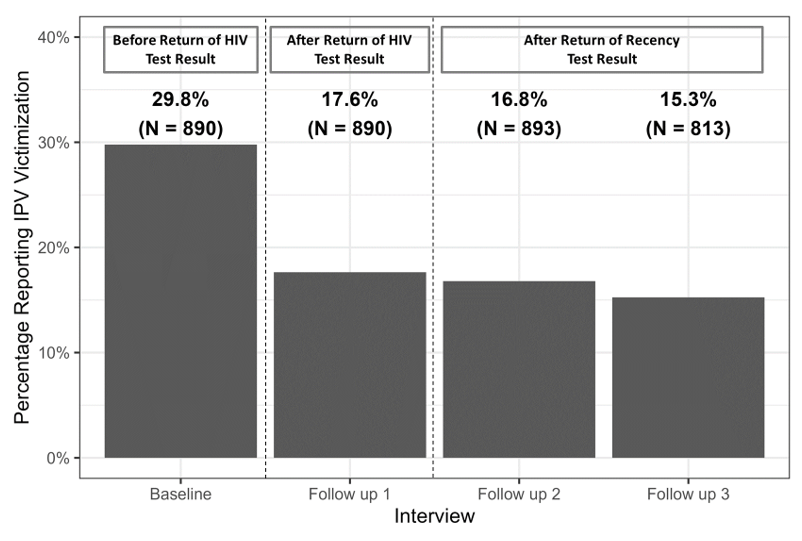
Of 932 newly diagnosed PLHIV with IPV data from ≥1 visits after return of recent infection test results, 849 (91%) had LT infection and 83 (9%) had RT infection. Prevalence of IPV was higher at baseline before HIV diagnosis compared to after HIV diagnosis (29.8% vs. 17.6%, p< 0.001). Prevalence of IPV did not increase after return of HIV recent infection test result (17.6% vs. 16.1%, p=0.4). Return of RT infection result was not associated with increased IPV relative to return of LT infection result in univariate analysis (MD=0.14, 95% CI -1.13–1.41), and after bivariate (MD=0.09, 95% CI -1.18–1.36) and multivariable propensity score adjustment (MD=0.13, 95% CI -1.15–1.41).
Conclusions:
IPV victimization did not increase after return of recent infection test results—RT or LT result—compared to return of HIV diagnosis in a context with high baseline IPV. Programs returning results can adopt strategies to mitigate IPV risks and ensure access to violence response services.
Figure. Percentage Reporting IPV Victimization by Follow Up Visit in Rwanda, 2021-2022