Background:
People with HIV (PWH) are at high risk for metabolic dysfunction-associated fatty liver disease (MAFLD). Liver fibrosis (LF) is the most significant predictor of liver disease progression and mortality. We aimed to investigate the effect of MAFLD and antiretroviral exposure on LF progression in PWH.
Methods:
This was a longitudinal study of three large prospective cohorts of PWH in Italy, Germany and Canada. Patients with at least two transient elastography with controlled attenuation parameters (CAP) exams were included. LF progression was defined as development of significant LF (defined as liver stiffness >8 kPa), or transition to cirrhosis (defined as liver stiffness >13 kPa for those with liver stiffness >8 but < 13 kPa at baseline). MAFLD was defined according to Eslam criteria: presence of hepatic steatosis (CAP>248 dB/m), plus any among type 2 diabetes, overweight (BMI >25 Kg/m2) or two other metabolic abnormalities. Other longitudinal predictors included co-infection with HBV or HCV, weight gain (WG), defined as a 5% BMI increase in two consecutive visits, and current exposure to ART classes. A multi-state Markov model was used to describe the process in which PWH moved through the next LF state. Cox regression model was used to identify predictors for LF progression event.
Results:
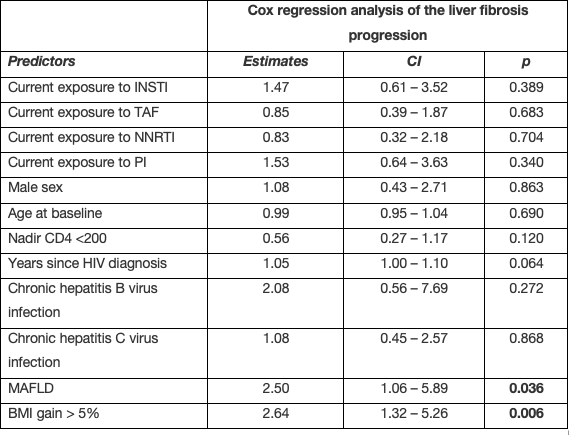
A total of 1183 PWH were included (median age 52.9 years, 77% males, median duration since HIV diagnosis 18 years). Prevalence of MAFLD was 46.8%. Coinfections with HBV and HCV were present in 3.6% and 21%, respectively. At baseline, liver stiffness was < 8 kPa in 85.6%, 8-12.9 kPa in 8.6%, and >13 kPa in 5.7% of PWH. During a median follow-up period of 2.5 years, a minimum of two and maximum of six yearly LF assessments were performed. In Markov model, WG was positively associated with progression of LF (OR=3.107, 95% CI 1.588, 6.078) while it prevented LF regression (OR=0.304, 95% CI 0.037, 2.514).The incidence rate of LF progression was 3.4 per 100 persons-year. Comparing 128 (9,6%) LF progressors with 1212 (90,4%) of non LF progressors, significant differences included mean BMI (26.3 vs 24.5), duration of HIV (16.7 vs 18.6 yrs), MAFLD (66.7 vs 48.3), HBV co-infection (7.8 vs 3.5%), ALT (36 vs. 25 UI) and WG (32.4 vs 21.9%). On multivariable analysis, predictors of LF progression were WG and MAFLD (see Table).
Conclusions:
LF progression occurs in a significant proportion of PWH. Its main drivers include metabolic health variables, while ART exposure does not seem to impact LF progression.
Cox regression analysis of the liver fibrosis progression