Background:
Sub-Saharan Africa has a growing burden of cardiovascular disease (CVD) among people living with HIV. Differentiated antiretroviral therapy (ART) services are being scaled up but do not always integrate management of CVD comorbidities. Our objective was to (1) describe the burden of CVD risk within a randomized trial of community- and facility-based HIV care in South Africa [the DO ART Study], (2) evaluate if effective ART is associated with CVD risk, and (3) determine whether this association differs by mode of HIV service delivery.
Methods:
We assessed CVD lifestyle risk factors (tobacco use, exercise, diet) and clinical measures (blood pressure, BMI, hemoglobin A1c, total cholesterol) at 12 months after ART initiation. To compare CVD risk by service delivery mode and viral suppression status, we estimated relative risks of hypertension, obesity/overweight, pre-diabetes/diabetes, hypercholesterolemia (defined using ACC/AHA thresholds), and tobacco use, and differences in underlying continuous measures, using generalized estimating equations for Poisson and linear regression, respectively. We assessed whether the relationship between viral suppression and CVD risk was modified by whether clients received community- or facility-based care.
Results:
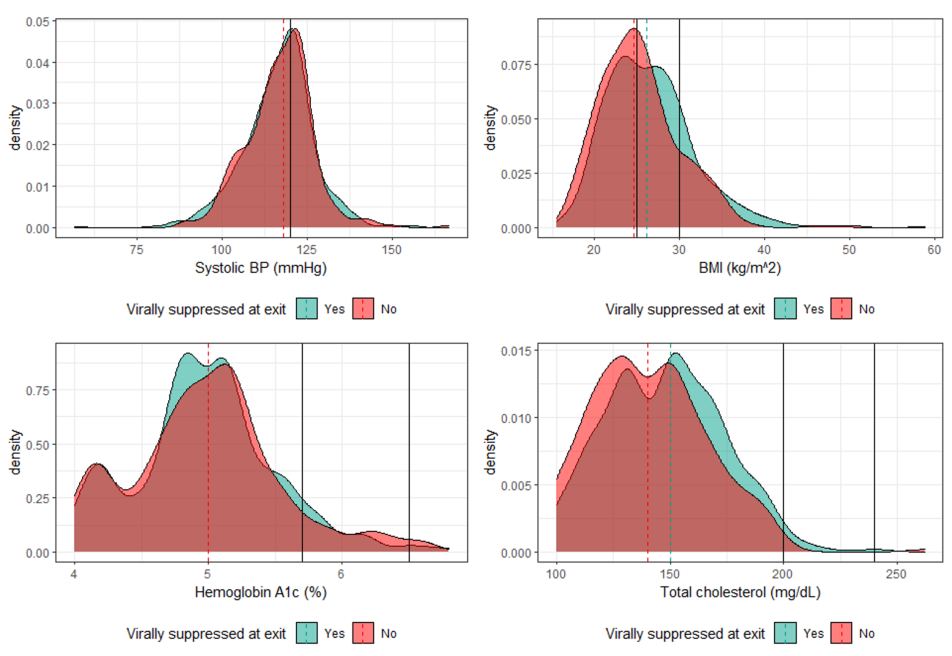
Among 1010 eligible participants, the median age was 32 years, 505 (50%) were men, 245 (24%) were current smokers, 468 (46%) exercised ≤2 days/week, 280 (28%) rarely ate vegetables, 450 (45%) had elevated blood pressure including 229 (23%) with hypertension, 502 (50%) had BMI ≥25 including 183 (18%) with BMI ≥30, 62 (6%) had prediabetes or diabetes, and 12 (1%) had hypercholesterolemia. CVD risk did not significantly differ by mode of service delivery. Virally suppressed persons had on average 5.75 mg/dL higher cholesterol (p = 0.001), 0.95 kg/m2 higher BMI (p = 0.003), and 16% higher risk of being overweight (p = 0.03) compared with clients who were not virally suppressed. Associations between viral suppression and CVD risk were stronger for community-based care and null for facility-based care.
Conclusions:
In a relatively young population in South Africa, clients accessing community- and facility-based HIV care had substantial burden of tobacco use, hypertension and overweight. Among clients accessing community-based care, CVD risk factors were more prevalent among virally suppressed participants at 12 months. As community-based ART is scaled up, programs should evaluate integrated CVD screening and treatment services.
Distribution of clinical measures of cardiovascular risk, by viral suppression status at endline [dashed lines are group medians]