Background:
People with HIV (PWH) continue to experience opportunistic infections and critical illness, increasing their risk of, and mortality after, intensive care unit (ICU) admission. The literature-reported data on risk of death in and after discharge from ICU are limited. We describe trends in 1-year mortality among adult PWH (>18 years) admitted to ICU from 2000-2019 in an HIV-referral centre.
Methods:
One-year mortality was calculated from index ICU admission to date of death; follow-up was right-censored at day 365 if the person was known to remain alive at 1 year, or day 7 after ICU discharge if known to be alive at hospital discharge but lost to follow-up. Between-group differences in characteristics at admission by calendar year (2000-3, 2004-7, 2008-11, 2012-15 and 2016-19) were explored using Kruskal Wallis/Cochrane Armitage tests, and 1-year mortality using Kaplan-Meier/log-rank tests. Cox regression described associations with calendar year (as a continuous covariate) before and after adjustment for characteristics at ICU admission: age, sex, Acute Physiology and Chronic Health Evaluation II (APACHE II), CD4+ T-cell count, and recent HIV diagnosis (within 3 months of ICU admission).
Results:
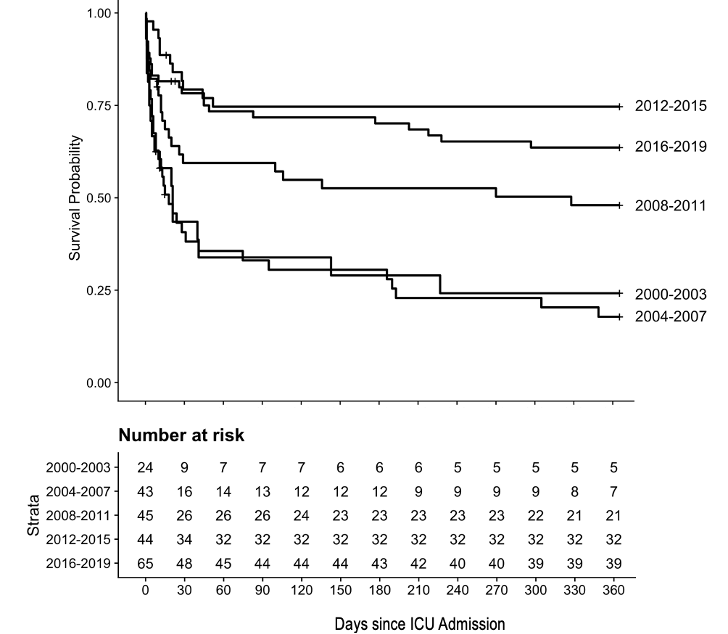
221 PWH were admitted to ICU (72% male, median [interquartile range (IQR)] age 45 [38-53] years) of whom 108 had died within 1-year (median survival: 349 days, cumulative 1-year survival: 50%). Those admitted in later years had a lower median admission APACHE II (29, 25, 17, 14, 13 respectively, p< 0.001) and were older (medians of 40, 44, 44, 46, 49 years, respectively, p=0.03), with higher median CD4+ T-cell count (98, 52, 169, 212, 128 cells/mm3, p=0.002), lower percentage with advanced HIV (CD4+ T-cell count < 200 cells/mm3 and/or AIDS at admission to ICU; 95, 77, 66, 50, 66%, p=0.01) and greater percentage with HIV-RNA <50 copies/mL (17, 34, 59, 46, 53%, p=0.02). Cumulative survival increased in later years (Figure, p=0.001, log-rank test), with an 11% reduction in the hazard of 1-year mortality per later year (hazard ratio (HR): 0.89 (95% confidence interval (CI): 0.87-0.93)). After adjustment, the annual decrease in 1-year mortality was reduced to 7% per year (adjusted HR: 0.93 (95% CI: 0.89-0.98)).
Conclusions:
One-year mortality after ICU admission declined at our ICU. Whilst confirmation in other ICUs is needed, our finding emphasises that despite improvements in long-term survival, continued appropriate management of care both in and after discharge from hospital among PWH is critical.
Figure. Kaplan-Meier plot by 4-year ICU admission year group, 1 year of follow-up (“+” indicates censoring)