Background:
Mitochondrial DNA (mtDNA) haplogroups have been associated with obesity among various populations and with weight gain following the switch to integrase strand transfer inhibitor (INSTI)-based antiretroviral therapy (ART) among people with HIV (PWH). We studied the association of mtDNA haplogroups with weight gain after ART in PWH.
Methods:
Participants were ART-naïve PWH, recruited in the Spanish HIV Research Cohort, who started ART from 2014 onwards and had blood/DNA deposited in the cohort Biobank. The primary outcome was a change in weight at 96 weeks after starting ART. mtDNA genotyping was performed using the iPLEX Gold technology and Agena Bioscience’s MassARRAY platform (San Diego, CA, USA). Changes over time in weight and BMI were studied using adjusted linear mixed models (LMM).
Results:
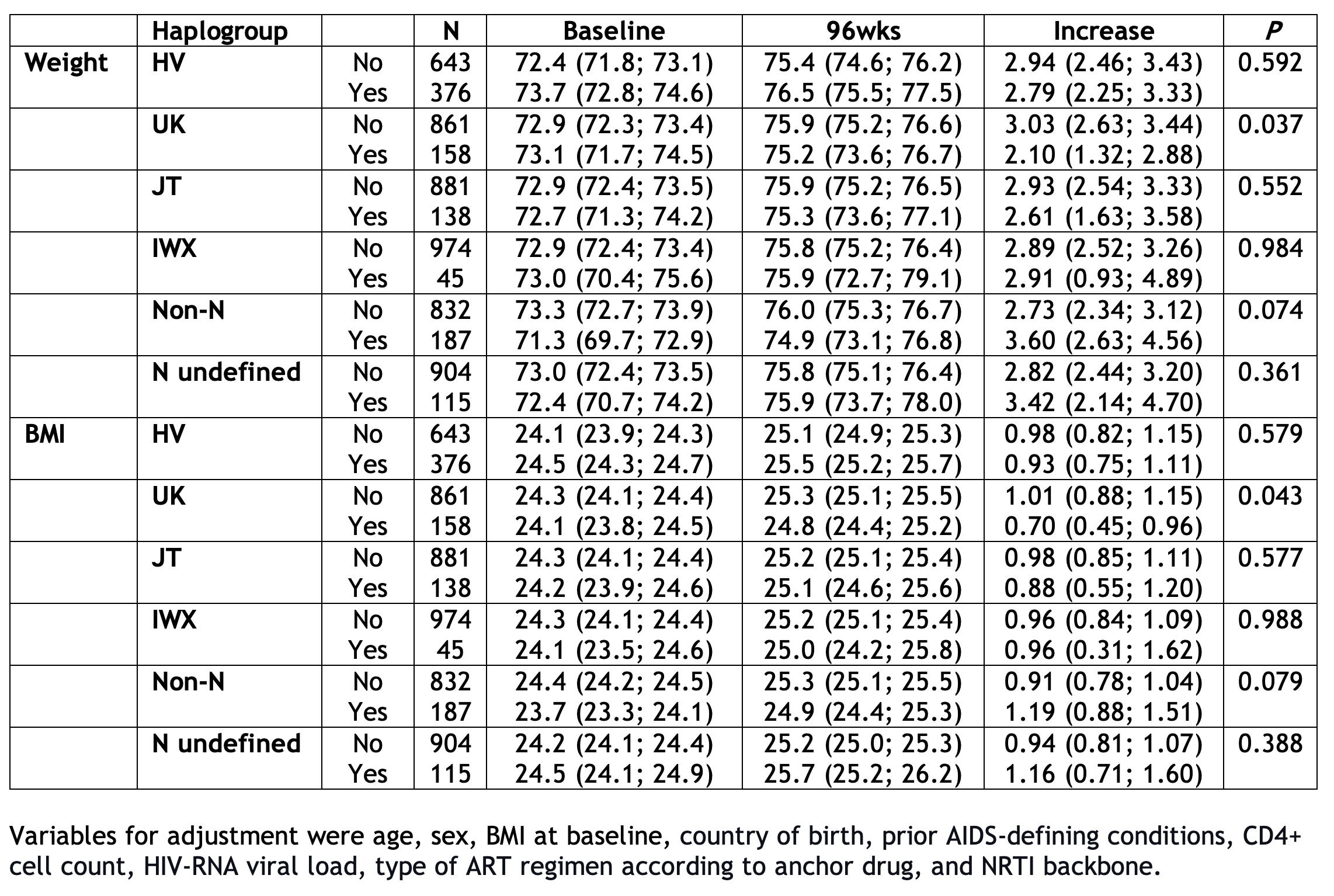
A total of 1,019 PWH were included. The mean weight gain over 96 weeks was 2.90 (95% CI: 2.54 – 3.26) Kg. Factors associated with weight gain were female sex, birth in Sub-Saharan Africa, prior AIDS, CD4+ < 200 cells/uL, HIV-RNA > 100,000 copies/mL, negative HCV serology, and tenofovir alafenamide. The distribution of major mtDNA haplogroups was 376 (36.9%) HV, 158 (15.5%) UK, 138 (13.5%) JT, 45 (4.4%) IWX, 187 (18.3%) non-N, and 115 (11.3%) N-undefined. The results of LMM adjusted by age, sex, BMI at baseline, country of birth, prior AIDS-defining conditions, CD4+ cell count, HIV-RNA viral load, type of ART regimen according to anchor drug, and NRTI backbone showed an association between mtDNA haplogroup UK and a lower increase in weight and BMI at 96 weeks (Table).
Conclusions:
The presence of the UK mtDNA haplogroup was associated with a lower increase in weight and BMI after ART in PWH. Our findings suggest that mitochondrial genomics plays a role in weight gain in this clinical context.
Estimated means (95% CI) of weight (Kg) and BMI at baseline and 96 weeks and increase according to major mtDNA haplogroups