Background:
Brazil ranks second in number of mpox cases globally, with 10,500 cases notified by December 27, 2022. Most of the current outbreak’s cases are reported among gay, bisexual, and other cisgender men who have sex with men (MSM). Data from endemic countries show an increased risk of severe mpox among children, immunosuppressed individuals and pregnant women. This study aims to describe epidemiological and clinical aspects of mpox in women (cisgender and transgender) compared to men in Rio de Janeiro, Brazil.
Methods:
We accessed an unidentified database with all confirmed mpox cases notified to the Rio de Janeiro State Health Department from June 12 to December 15, 2022. Gender identification of the female spectrum were included in the women category (cisgender or transgender), and gender identification of the male spectrum (cisgender or transgender) were included in the men category. Chi-squared test, Fisher’s exact test and Moods median test were used for comparisons. We also provided behavioral and clinical characteristics of transgender women and non-binary individuals separately.
Results:
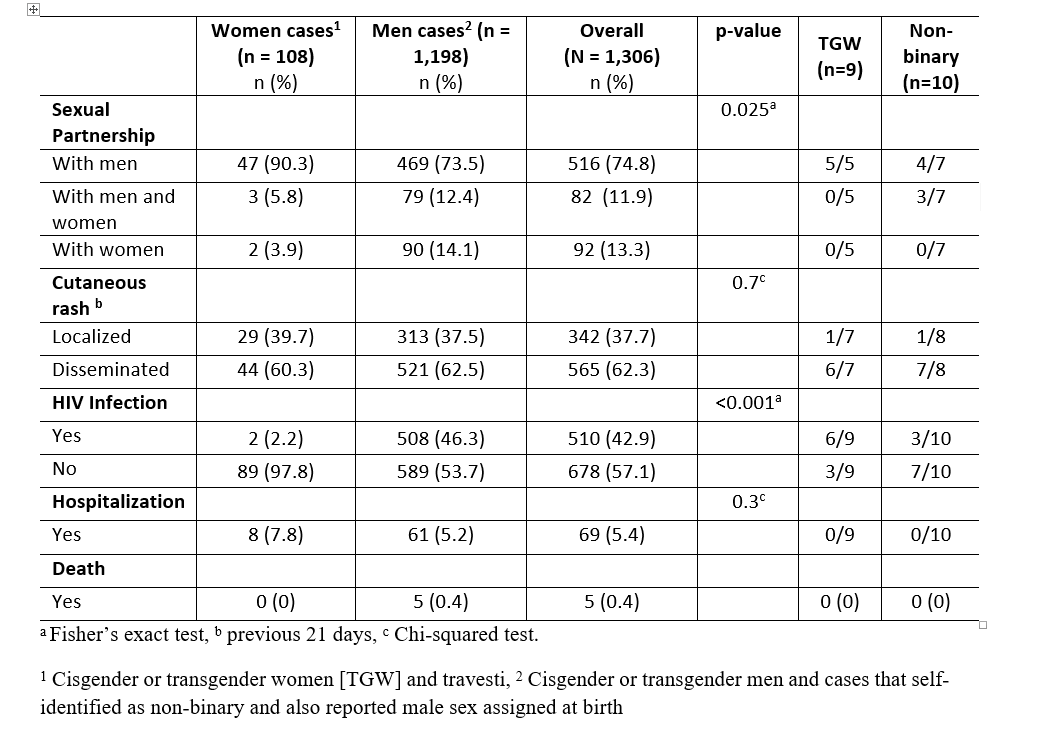
A total of 1,306 confirmed mpox cases were reported, 1198 (91.7%) among men, 108 (8.3%) women (91.7% cisgender and 8.3% transgender) and 10 (0.8%) non-binary. Compared to men, women were more frequently older (40+ years: 34.3% vs. 25.1%; p< 0.001), reported more frequent non-sexual contact with a potential mpox case (21.4% vs. 10.0%; p=0.004), reported fewer sexual partnerships (10.9 vs. 54.7%; p< 0.001) and less physical contact with a partner with unknown mpox status (20.2% vs. 55.8%; p< 0.001) (Table). HIV prevalence was lower among women (2.2% vs. 46.3%; p< 0.001), with all cases among transgender women. Genital lesions were less frequent among women (31.8% vs. 57.9%; p< 0.001). Fewer women presented systemic mpox signs and symptoms (38.0% vs. 50.2%; p=0.015), including fever (43.5% vs. 58.7%; p=0.002) and adenomegaly (16.7% vs. 43.2%; p< 0.001).
Conclusions:
We describe different epidemiological, behavior and clinical profiles of mpox among women and men. The milder mpox clinical presentation in women can be related to their lower HIV prevalence compared to men. Health services must provide a comprehensive clinical and epidemiological assessment that accounts for gender diversity to address the knowledge gaps regarding the impact of mpox on both cisgender and transgender women.
Table 1. Sociodemographic, behavioral and clinical characteristics of the mpox cases, according to gender (Nf1,306), Rio de Janeiro State, Brazil.