Background:
Despite its known efficacy, human immunodeficiency virus (HIV) pre-exposure prophylaxis (PrEP) has had limited uptake in United States (US) Veterans at high risk for HIV acquisition. We hypothesized that Black US Veterans of minoritized sexual orientation (MSO) receive PrEP at comparable rates relative to other racial categories. However, we also hypothesized that higher rates of HIV acquisition would be associated with Black race, regardless of PrEP receipt.
Methods:
A retrospective analysis was conducted for the period of July 12, 2012 through July 1, 2019, using a validated natural language processing system to derive a cohort of Veterans documented as MSO. HIV diagnosis was defined as the first appearance of the diagnosis in the electronic health record (EHR) as identified by an International Classification of Disease code. PrEP recipients were individuals with two or more pharmacy fills of emtricitabine/tenofovir disoproxil fumarate. Race was defined by structured categories available in the Veterans Affairs EHR. Chi-square tests evaluated the association between race and HIV acquisition stratified by PrEP use (α=0.05).
Results:
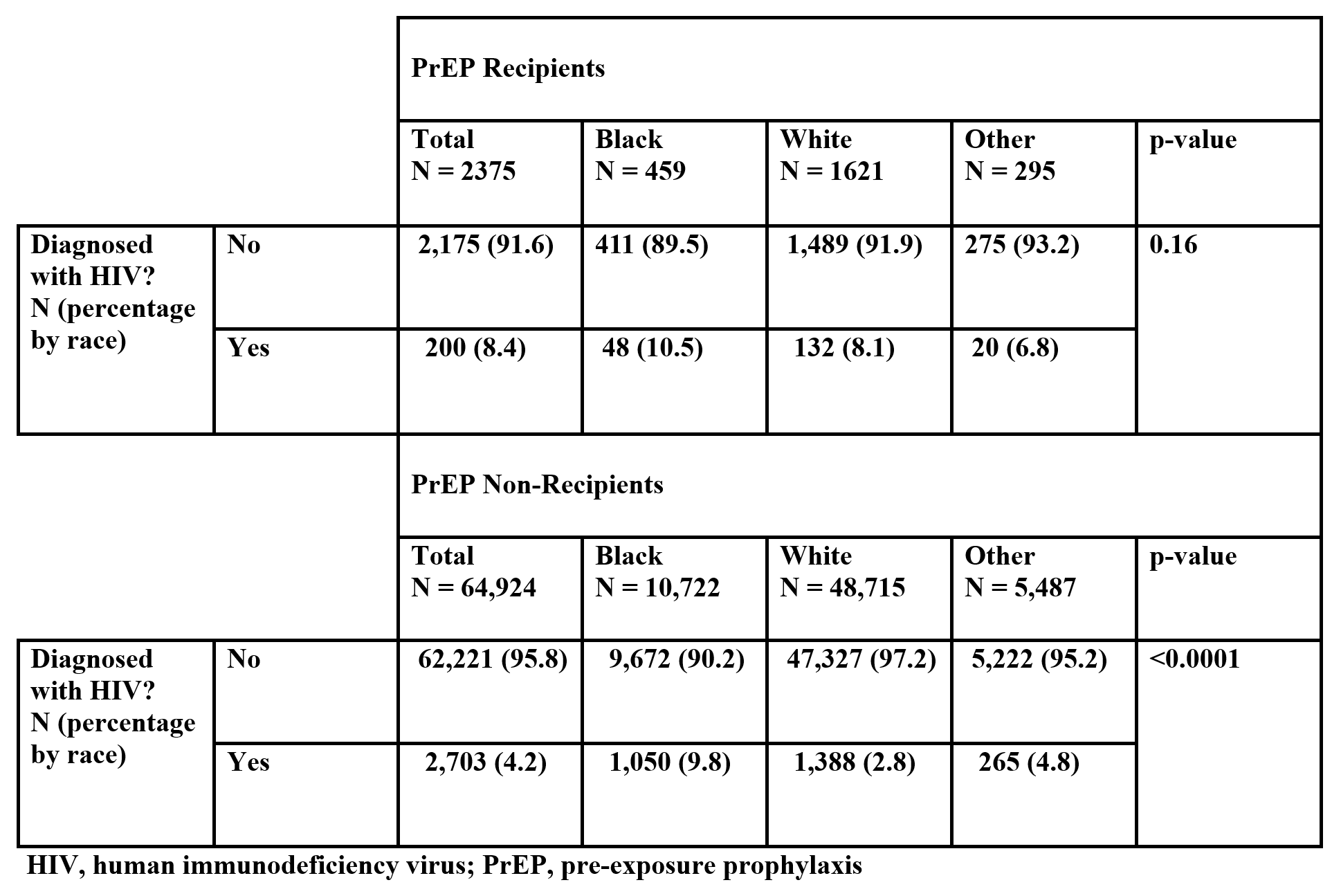
A cohort of 67,299 HIV-negative male Veterans with MSO documentation was identified. In total, 2,375 received PrEP and 64,924 did not. Of the 11,181 Black Veterans, 459 (4.1%) received PrEP, while 1621 (3.2%) of the 50,336 White Veterans and 295 (5.1%) of the 5,782 Other Veterans received PrEP. For those who received PrEP, 10.5% of Black Veterans, 8.1% of White Veterans, and 6.8% of Other Veterans acquired HIV. The association between HIV acquisition and race was not statistically significant in PrEP recipients. For those who did not receive PrEP, 9.8% of Black Veterans, 2.8% of White Veterans, and 4.8% of Other Veterans acquired HIV. The association between HIV acquisition and race was statistically significant in PrEP non-recipients.
Conclusions:
Rates of PrEP receipt in Veterans with MSO documentation were comparable across racial groups. HIV acquisition was lower in White and Other Veterans who did not receive PrEP, suggesting that patients and providers assessed their risk as lower than those who were offered and accepted PrEP. The lack of full protection in those receiving PrEP reinforces the real-world occurrences of gaps in adherence and persistence. For Black Veterans, rates of HIV acquisition were comparable for those who did and did not receive PrEP. These findings suggest a higher baseline risk for HIV acquisition independent of PrEP receipt.
HIV Acquisition by Racial Category for Veterans Who Did and Did Not Receive PrEP