Background:
As people with HIV (PWH) continue to age, it remains unclear whether they are at higher risk for age-related neurodegenerative disorders e.g. Alzheimer disease (AD), and how to differentiate HIV-related neurocognitive impairment from AD. This study used a novel blood-based AD biomarker,plasma Aβ42/Aβ40 ratio and the Amyloid Probability Score (APS), in cognitively normal (CN) or cognitively impaired (CI) PWH compared to people without HIV (PWoH) who were CN or had symptomatic AD.
Methods:
66 PWH (age >40 years old) with undetectable viral load (< 50 copies/mL) and 195 PWoH completed a blood draw, magnetic resonance imaging (MRI), and a comprehensive neuropsychological battery or structured clinical interview (Clinical Dementia Rating scale [CDR]). Participants were categorized by degree of cognitive impairment (PWH_CN n=43; PWH_CI n=23; PWoH_CN n=138; PWoH_AD n=57). Plasma Aβ42/Aβ40 ratios were obtained using a liquid chromatography tandem mass spectrometry method. APS, which incorporates Aβ42/Aβ40 ratio, ApoE proteotype and age and indicates the likelihood of brain amyloidosis, was also calculated. Log-transformed plasma Aβ42/Aβ40 ratios and the APS were compared among groups. Regression analyses assessed relationships between Aβ42/Aβ40 or APS and hippocampus volume for each group, and between Aβ42/Aβ40 or APS and cognitive domain scores or HIV clinical characteristics (CD4 and CD8 t-cell count, CD4:CD8 ratio, duration of infection) within PWH.
Results:
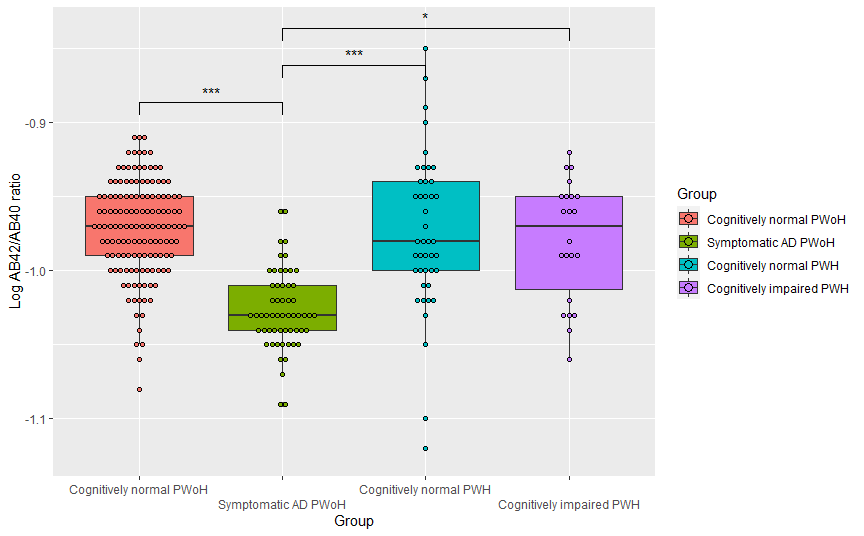
PWoH_AD (mean log Aβ42/Aβ40=-1.03, SD=0.03; mean APS=41.2, SD=28.9) exhibited significantly reduced plasma Aβ42/Aβ40 ratio (p< .001; Figure 1) and higher APS (p< .001) compared to PWoH_CN (mean log Aβ42/Aβ40 = -0.97, SD=0.03; mean APS=4.73, SD=11.3), PWH_CN (mean log Aβ42/Aβ40 = -0.98, SD=0.05; mean APS=6.63, SD=13.6), and PWH_CI (mean log Aβ42/Aβ40 = -0.99, SD=0.06; mean APS=10.2, SD=17.7). There were no differences observed among other groups. Lower Aβ42/Aβ40 ratio and higher APS was associated with smaller hippocampal volume only within the PWoH_AD group. Within the PWH group, neither Aβ42/Aβ40 ratios nor APS were significantly associated with cognitive domain scores, global cognition, or any HIV clinical characteristics (CD4 and CD8 t-cell count, CD4:CD8 ratio, or duration of HIV infection) (p-values >.05).
Conclusions:
Plasma Aβ42/Aβ40 ratio and APS may serve as a screening tool for AD and help differentiate cognitive impairment due to AD from HIV-related cognitive impairment in older PWH.
Log-transformed Aβ42/Aβ40 ratios by group. People without HIV (PWoH) with symptomatic Alzheimer disease (PWoH_AD) exhibited significantly reduced ratios compared to the other three groups. People with HIV (PWH) did not have lower ratios compared to cognitively normal PWoH (PWoH_CN), regardless of cognitive impairment status.