Background:
Asymptomatic Cytomegalovirus (CMV) infection reshapes systemic immune responses and its replication can be both a consequence and cause of inflammation. As CMV resides in the same tissues affected by SARS-CoV-2, we hypothesized that asymptomatic CMV co-infection might modify the pathogenesis of both acute and post-acute COVID-19.
Methods:
Participants had current or prior nucleic acid-confirmed SARS-CoV-2 infection in the COVID-19 Multi-Phenotyping for Effective Therapies (COMET, n=219), Immunophenotyping Assessment in a COVID-19 Cohort (IMPACC, n=244) or the Long-term Impact of Infection with Novel Coronavirus (LIINC, n=327) cohorts. We assessed the relationship between CMV serostatus and odds of hospitalization and plasma SARS-CoV-2 N antigen levels during acute COVID-19 as well as post-acute “Long COVID” symptoms, defined as >=1 of 32 COVID-19-attributed symptoms present at least 60 days following initial symptom onset.
Results:
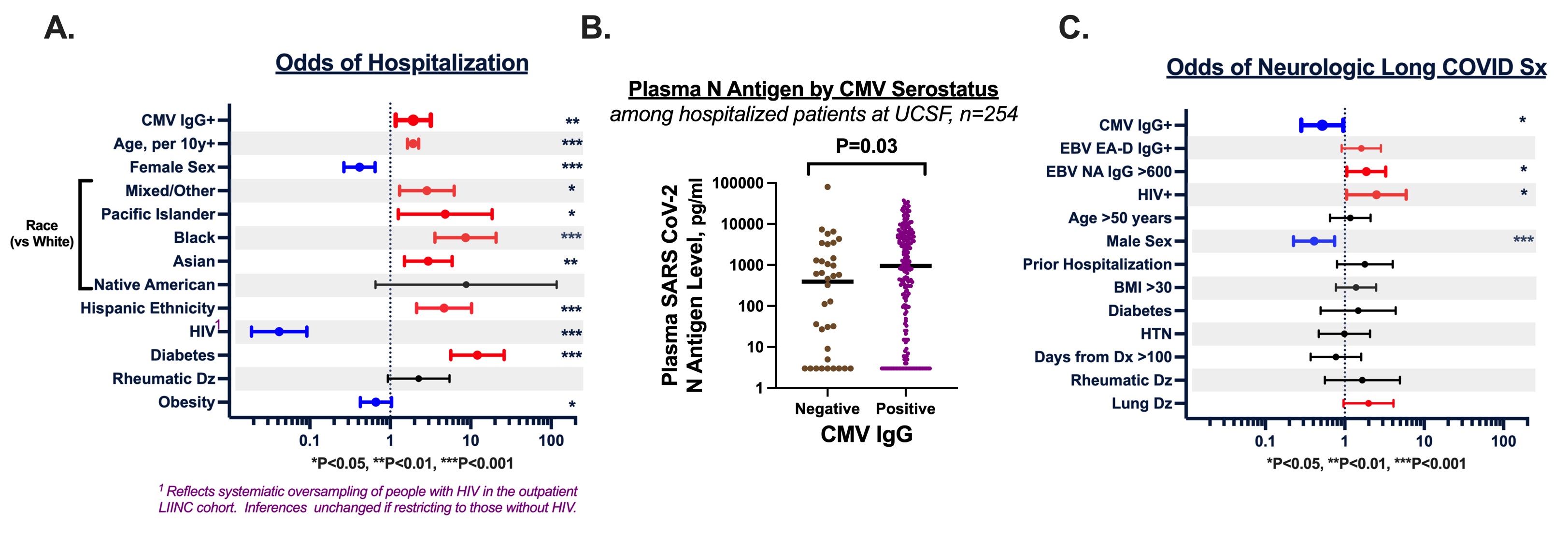
Among 758 participants, 518 were hospitalized for their acute COVID-19 episode. CMV seropositivity was independently associated with a 1.9-fold increased odds of hospitalization for acute COVID-19, after adjustment for age, sex, race, ethnicity, HIV status, prior autoimmune disease, diabetes, and obesity (p=0.01, A). Among those hospitalized, CMV seropositivity was also associated with higher plasma SARS-CoV-2 N antigen levels (median 936 vs. 323 pg/ml, P=0.03, B), which remained significant after adjustment for potential confounders, but not with ICU admission (n=209), death (n=58), or thrombotic events (n=31). In contrast to its relationship to acute COVID-19 disease severity, CMV seropositivity was independently associated with a 48% decreased odds of having neurocognitive Long COVID symptoms such has headache and brain fog 4 months after initial COVID-19 diagnosis (P=0.036). Conversely, serologic evidence of Epstein-Barr Virus (EBV) reactivation and HIV both increased the odds of these symptoms (C).
Conclusions:
CMV seropositivity is associated with a 1.9-fold higher odds of hospitalization in people with acute COVID-19 and a nearly 3-fold higher SARS-CoV-2 antigen burden in hospitalized patients. In contrast, CMV seropositivity is associated with a decreased odds of neurocognitive Long COVID symptoms, while other chronic viral co-infections like EBV reactivation and HIV are associated with an increased odds of this complication. The biologic mechanisms mediating these relationships are unknown, but warrant further investigation.
Association of demographic and disease factors with acute and post-acute COVID-19 outcomes.