Background:
Adverse metabolic profiles in adults living with HIV are associated with traditional risk factors, HIV viraemia and antiretroviral therapy (ART) with a paucity of data for youth living with perinatally acquired HIV (YPaHIV). As body mass index (BMI) impacts metabolic health and bone mineral density (BMD), we explored the relationship between markers of metabolic health, body fat distribution, hepatic steatosis and BMD in YPaHIV.
Methods:
A longitudinal observational study examined bone and metabolic health in YPaHIV aged 15-24 years by total body dual-energy X-ray absorptiometry (DXA), liver fibroscan and fasting metabolic biochemistry. Associations of metabolic markers with DXA and fibroscan outcomes and by tenofovir alafenamide (TAF) use were made using two-sample t-tests and correlations investigated by Pearson’s coefficient. Metabolic risk factors for lumbar spine (LS) BMD were assessed by linear regression.
Results:
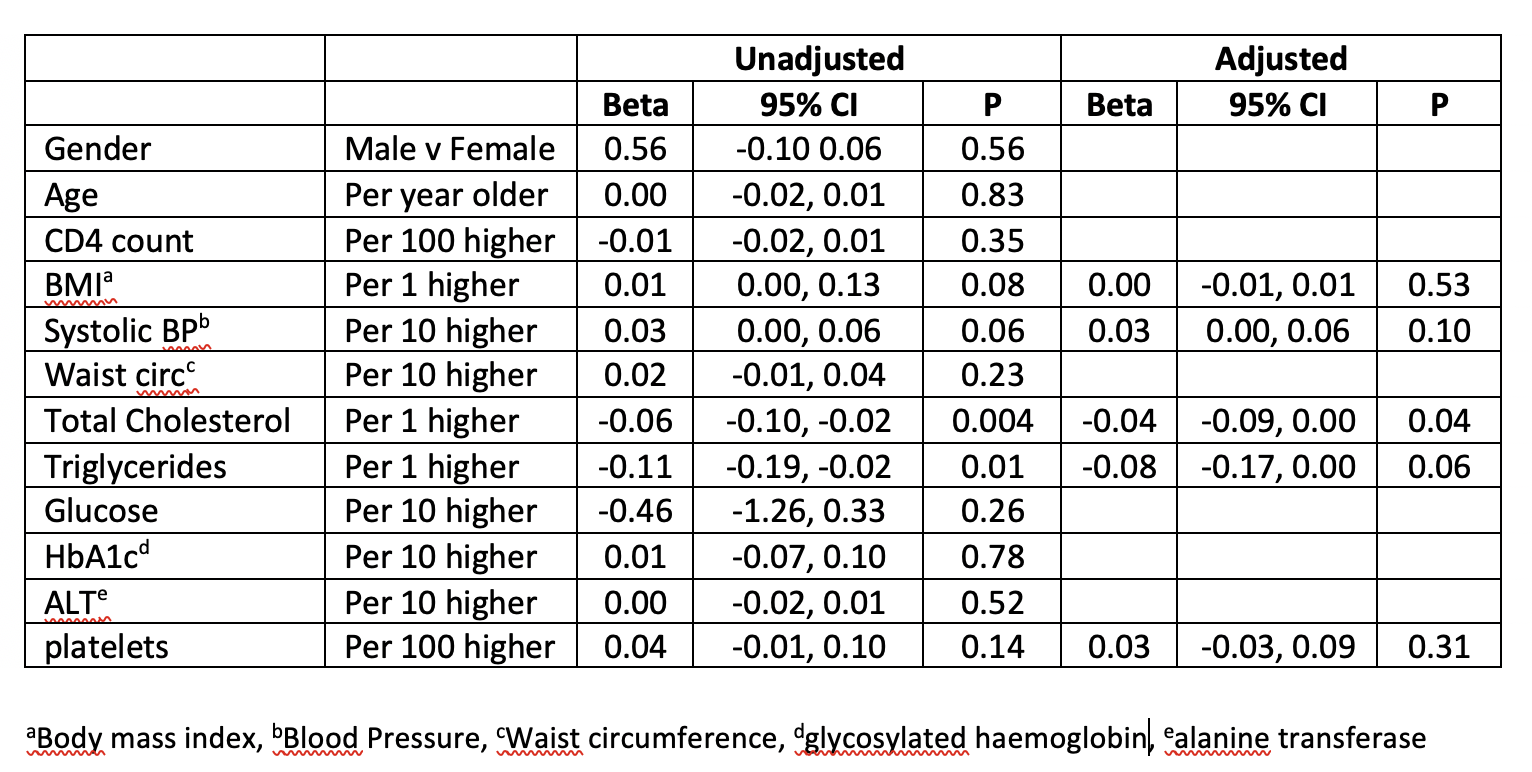
85 participants; 49 (58%) male, 80 (94%) black/black African, median age 22 years (IQR 19-24), and CD4 count 645 (IQR 373-917) cells/ul, were followed for 26 months (IQR 25-28). Mean (SD) systolic blood pressure was 120 (12), fasting lipids (triglycerides 0.7 [0.9], HDL 1.4 [0.4]) and glucose 4.5 (0.5). Baseline BMI was 25.7 (5.4) increasing at 26 months by TAF (n=44) versus non-TAF (n=41) by +0.6 (2.7), +1.4 (2.6), (p 0.22) with weight gain of 2.2 (7.8) and 3.7 (6.3), (p 0.34) respectively. Correlation (p< 0.05) with BMD included BMI 0.23 (0.03), fasting lipids (total cholesterol -0.33 [0.002], triglycerides -0.23 [0.03], LDL -0.31 [0.004]), total body -0.26 (0.02) and gynoid -0.26 (0.02) fat. Correlation with controlled attenuation parameter (CAP) score included; BMI 0.27 (0.01), waist circumference 0.29 (0.007) and fasting glucose 0.33 (0.002) but not lipid or body fat parameters. Hepatic transaminases correlated with E score (ALT 0.56 [< 0.0001], AST 0.42 [0.0001]) but not CAP. Factors associated with BMD are shown in table 1. Metabolic factors according to TAF versus non-TAF differed only for total cholesterol; mean (SD) 4.4 (0.9) versus 4.0 (1.0), (p 0.03) with no differences seen for triglycerides, BMI, weight, waist circumference and body fat distribution.
Conclusions:
Metabolic factors including obesity, gynoid fat distribution and abnormal lipid profiles were associated with adverse bone health in this youth cohort living with PaHIV. Effective interventions targeting traditional risk factors are required.
Linear regression of factors associated with lumbar spine bone mineral density