Background:
To better define the number of transmitted founder variants and sequence divergence from founders in the first few weeks following HIV-1 transmission, we performed ultra-sensitive single genome sequencing (SGS) of pol and env HIV-1 RNA in plasma samples from individuals with acute HIV-1 infection.
Methods:
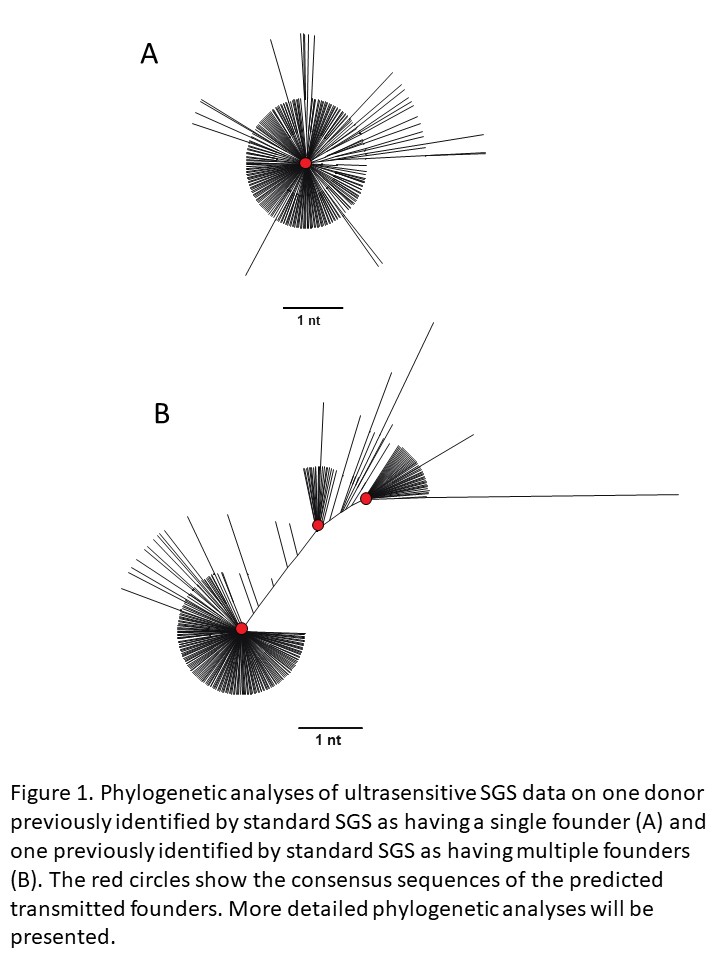
HIV-1 RNA was extracted from plasma samples of donors with acute CRF01_AE infection (Fiebig II-IV) enrolled in the RV254/SEARCH010 Cohort (NCT00796146). Five of the donors had been identified by standard SGS as having multiple transmitted founders (TFs) and 10 as single TFs, consistent with the prior report showing 70% having single TFs in RV254. Our ultrasensitive SGS method with primer IDs and 500 bp paired-end Illumina sequencing was applied to identify >10,000 independent pol and env sequences per sample. We used radial trees (Figure 1) and star phylogeny to identify TFs, calculated transition/transversion (Ti/Tv) and non-synonymous/synonymous (dN/dS) ratios, identified drug resistance mutations (DRMs), and analyzed the phylogenetic relationships between emergent variants.
Results:
An average of 12,823 pol and 11,249 env independent RNA sequences determined from consensus building of millions of barcoded reads were obtained from the plasma samples of the 15 donors. In single TF infections, an average of 85% of the genomes were identical to the TF. An average of 13% of the genomes contained only a single mutation. 1% of the genomes contained 2 mutations and 1% had 3-6 mutations, with 2 samples containing up to 12 mutations in a few genomes. Ti/Tv ratios were 5.5 and 3.4 in pol and env respectively. DRMs were found at very low frequency (0.01-0.09%) in all samples. Mutations predicted to confer resistance to the antibody VRC-01 were also present in all samples. The dN/dS in env (M=2.83, SD=0.90) was greater than pol (M=1.47, SD=0.74; t(9)=3.31, p=0.009). Mutation frequency was higher in both genomic regions in samples from later Fiebig stages.
Conclusions:
Overall, ultrasensitive SGS ( >10,000 genomes per sample) did not identify more transmitter founder variants than low depth (10 genomes) SGS, verifying that HIV-1 infection is most commonly established by a single variant. By contrast, ultrasensitive SGS revealed viral evolution from the founder variants in all samples including those from as early as Fiebig stage II, indicating rapid evolution of HIV-1, including appearance of DRMs soon after transmission.