Background:
The U.S. South represents 38% of the U.S. population, but as of 2020 more than 50% of new U.S. HIV diagnoses occurred in the region. HIV and other health-related outcomes are poorer in states considered the “Deep South,” including Alabama. Relative to other states, Alabama has higher rates of HIV and other STIs, and 17% of people with HIV in Alabama are unaware of their status. Throughout the Deep South, HIV and STI epidemics are in part driven by socioeconomic vulnerability, and sex work may play a role. However, few studies have estimated the prevalence or effects of sex work in Alabama or the Deep South.
Methods:
We estimated the history of sex work (exchanging sex for money, drugs, or something of need in the last 5 years) among clients (ages 15-64) receiving services at a Birmingham, Alabama-based AIDS Service Organization from 2008-2022. We used chi-square tests to assess sex work’s association with diverse drug use (injection and non-injection) and sexual risk behavior. We used logistic regression to examine the association between sex work and new HIV, hepatitis C (HCV), and STI (chlamydia, gonorrhea, syphilis, trichomoniasis) diagnoses. Analyses adjusted for age, race/ethnicity, and gender identity, with stratification to examine differences among gay, bisexual and other men who have sex with men (MSM, n=4,784).
Results:
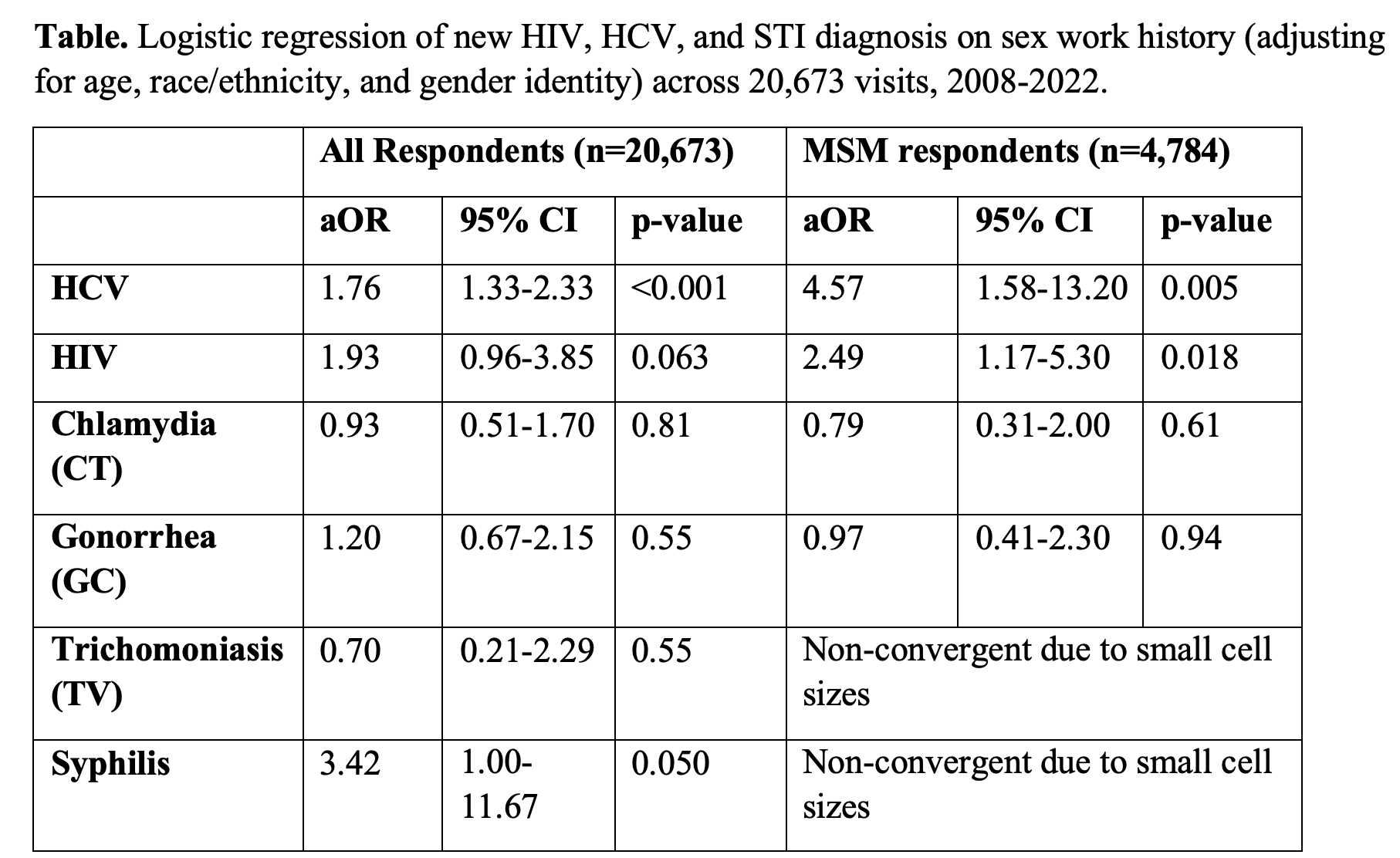
Across 20,673 visits, history of sex work was reported at 950 visits (4.6%). Sex work was associated with older age (p=0.002), being a cisgender woman or gender minority, identifying as non-Hispanic white, increased diverse drug use, and increased sharing of non-injection drug equipment (p< 0.001). Compared to other clients, those reporting sex work had increased odds of syphilis (aOR 3.42, p=0.05) and HCV diagnosis (aOR 1.76, p< 0.001). MSM with history of sex work had increased odds of diagnosis with HCV (aOR 4.57, p=0.005) and HIV (aOR 2.49, p=0.02), compared to other MSM.
Conclusions:
Using 14 years of community-based data, this study is among the first to estimate the relationship between sex work and HIV, HCV, and STIs in the Deep South. We document converging sex work and diverse drug-related risks, which may act synergistically to influence poorer health outcomes and reinforce existing health inequities. Differences in HIV and HCV diagnosis between sex workers and other clients were even greater among MSM, suggesting a need for tailored interventions with this group.
Logistic regression of new HIV, HCV, and STI diagnosis on sex work history (adjusting for age, race/ethnicity, and gender identity) across 20,673 visits, 2008-2022.