Background:
Dolutegravir concentrations are reduced by the induction effect of efavirenz, necessitating twice daily dolutegravir dosing when co-administered. Efavirenz induction persists for several weeks after stopping, which could select for resistance if switching occurred with unsuppressed HIV-1 RNA levels. We evaluated the need for a lead-in supplemental dolutegravir dose in adults failing first-line antiretroviral therapy (ART) with tenofovir-emtricitabine-efavirenz (TEE) switching to tenofovir-lamivudine-dolutegravir (TLD).
Methods:
We conducted a randomised, double-blind, placebo-controlled, phase 2 trial in Khayelitsha, Cape Town, South Africa. Eligible patients had virologic failure (defined as two consecutive plasma HIV-1 RNA ≥1000 copies/mL) on first-line TEE. Participants were randomly assigned (1:1) to switch to TLD with a supplemental 50 mg dolutegravir dose or placebo taken 12 hours later for the first 14 days. The primary outcome was the proportion of participants with plasma HIV-1 RNA < 50 copies/mL at week 24. This study was not powered to formally compare arms.
Results:
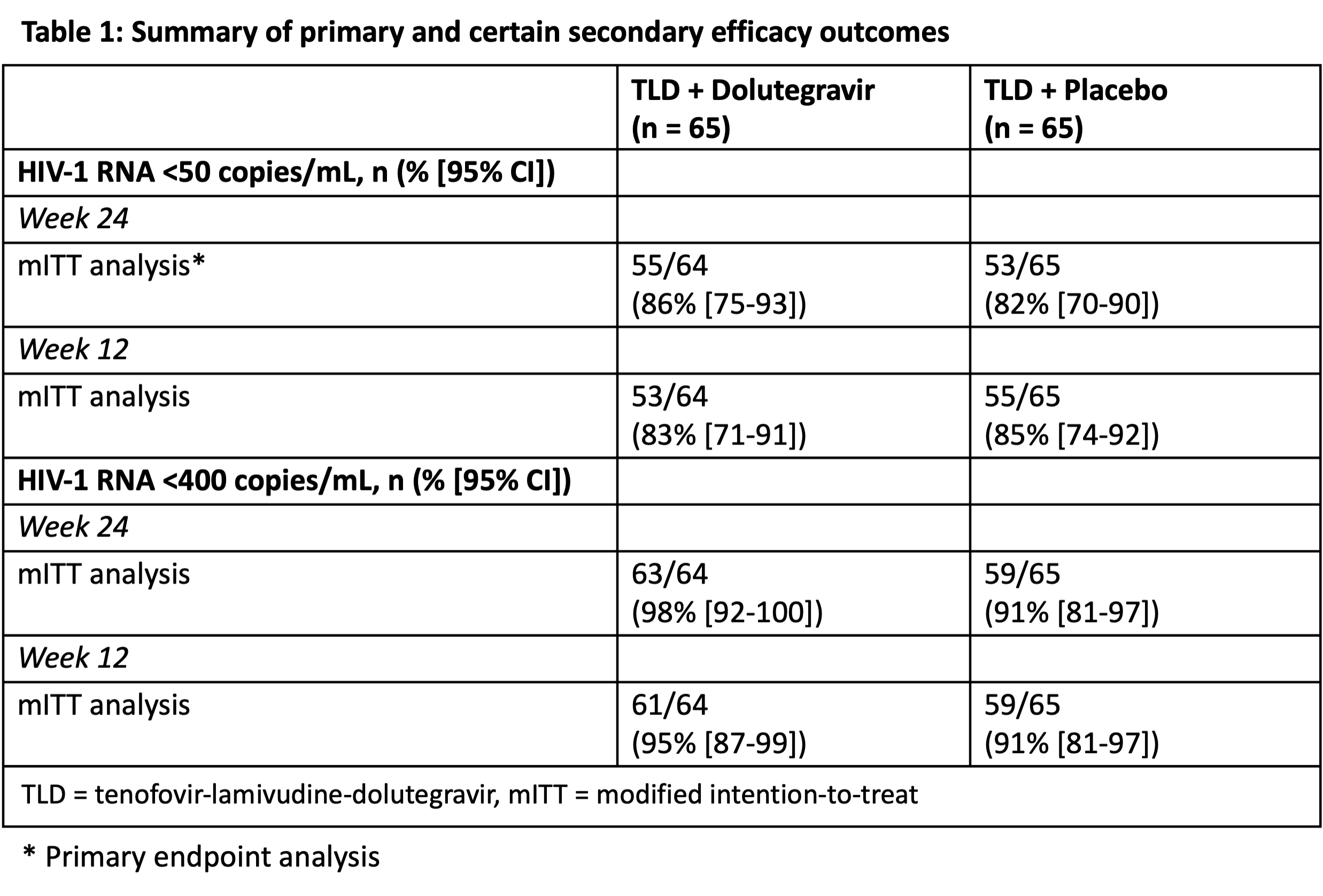
130 participants were randomly assigned to receive TLD with supplemental dolutegravir (n = 65) or placebo (n = 65). Median age was 38 years (IQR 32 – 45), 69% female, and participants had a median of 85 months of experience with ART (IQR 50 – 119). The median baseline HIV-1 RNA was 4.0 log10 copies/mL (IQR 3.5 – 4.7) and 76% had baseline resistance to both tenofovir and lamivudine. Baseline characteristics were similar between arms. By week 24, one participant died and two were lost to follow-up. Proportions with virologic suppression at weeks 12 and 24 were similar between arms (Table 1). In the subgroup of participants with baseline resistance to both tenofovir and lamivudine, 76 (84%, 95% CI, 75 – 91%) of 90 participants had HIV-1 RNA < 50 copies/mL at week 24. There were 19 participants with HIV-1 RNA ≥50 copies/mL at week 24; 15/19 (79%) participants re-suppressed HIV-1 RNA < 50 copies/mL with enhanced adherence counselling. Grade 3 or 4 adverse events were similar in frequency between arms. None of the six participants (3 in each arm) meeting criteria for resistance testing developed dolutegravir resistance.
Conclusions:
TLD in second-line ART was effective and well tolerated in both arms. Our findings do not support the need for initial dolutegravir dose adjustment in patients switching to TLD who failed first-line TEE.